
Onar Holding Advances Middle-Market MarTech Platform Despite Liquidity Strains
Recent quarterly filings reveal Onar's continued execution on agency integrations and proprietary AI tech development amid significant going concern risks.
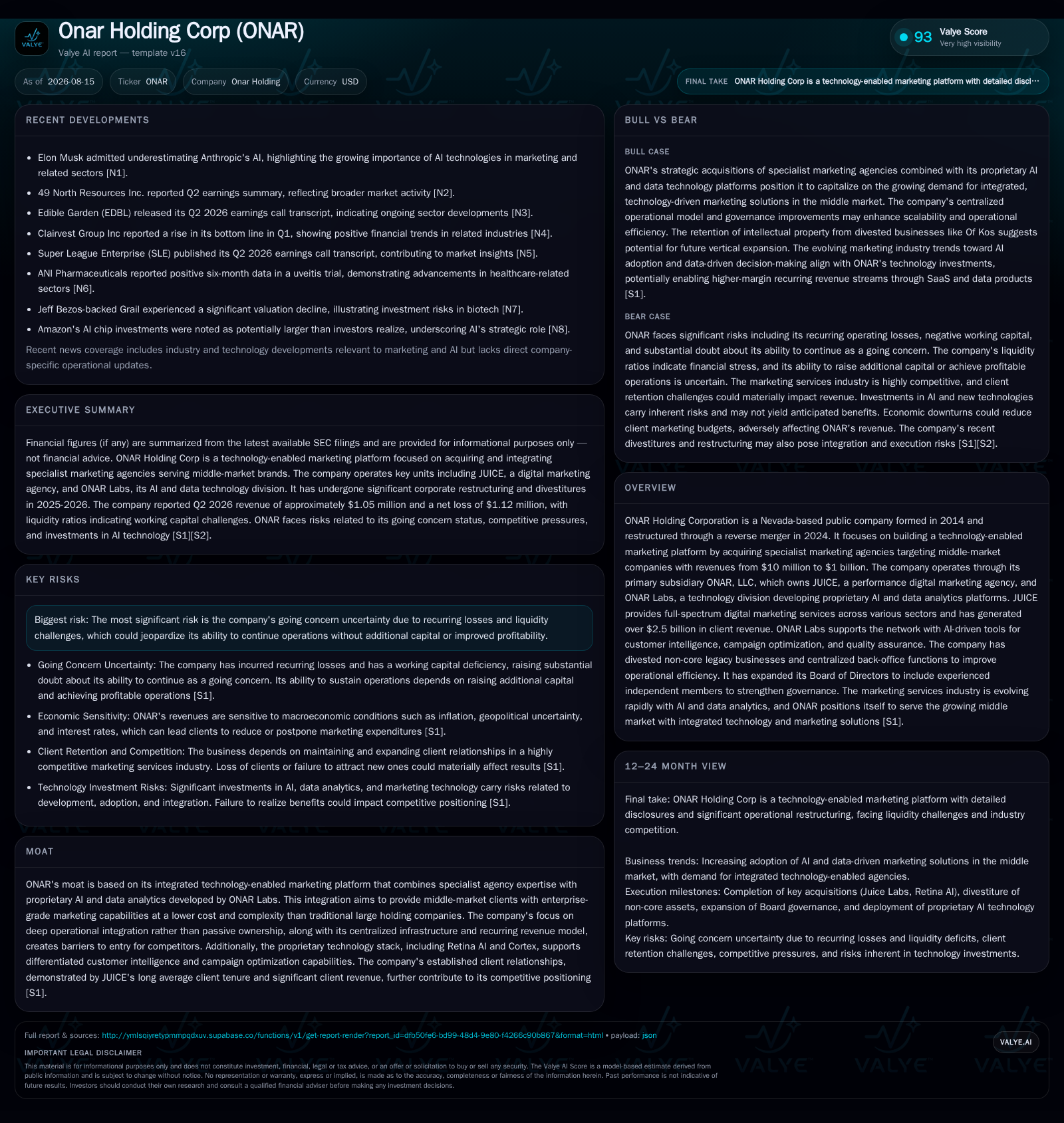
Onar Holding Corporation is executing its strategy to build a technology-enabled marketing platform targeting middle-market companies by acquiring specialist agencies and developing proprietary AI-driven marketing tools. The latest quarterly filing shows progress in operational integration, including the consolidation of JUICE and deployment of ONAR Labs' technology stack. However, substantial liquidity constraints and recurring losses continue to challenge near-term financial stability, raising doubts about the firm's viability without additional capital or improved cash flow. Onar's differentiated focus on middle-market clients and integrated tech-agency model positions it uniquely against traditional global holding companies, yet success will hinge on scaling recurring revenue and monetizing its AI platforms while managing integration risks.
Recent Operating Update
Onar Holding Corporation’s latest quarterly report filed August 14, 2026 ([S2]) reinforces the company's ongoing efforts to consolidate its operating subsidiaries and advance its technology-driven marketing platform. The filings affirm progress on integrating acquired assets such as Juice Labs LLC into a unified JUICE brand — Onar’s primary performance digital marketing agency — along with forward momentum in developing its proprietary ONAR Labs AI and data analytics platforms.
An August 11, 2026 event filing ([S3]) disclosed amendments extending key transaction deadlines with Advertise Purple that indicate ongoing capital-raising or strategic negotiation efforts. This extension signals management's active engagement in securing necessary funding to support both operations and acquisition cadence.
Business Model Overview
Onar operates a hybrid business model combining specialist marketing agency services with an embedded proprietary MarTech stack developed through ONAR Labs. Revenue accrues primarily from client retainer contracts, project-based engagements, and media management fees generated by its agency brands, chiefly JUICE. JUICE delivers full-spectrum digital marketing solutions encompassing paid media campaigns, creative services, SEO, web development, conversion optimization, and data-driven campaign management. Its client portfolio spans sectors including consumer products, manufacturing, technology, e-commerce, healthcare, and B2B services ([S1]).
Strategically anchored in serving middle-market companies with revenues between $10 million and $1 billion ([S1]), Onar’s value proposition emphasizes providing enterprise-grade marketing capabilities tailored for this underserved segment at a lower cost point than offered by large global holding companies like WPP or Publicis. This market positioning leverages Onar’s ability to aggregate specialized agency expertise while centrally deploying proprietary AI platforms such as Retina AI — delivering customer lifetime value prediction and audience segmentation — Cortex for real-time analytics monitoring, Agentic Ops automation for campaign execution, and a governance-focused QA Layer for quality assurance ([S1]).
MONETIZATION MECHANICS rely heavily on contractual service fees from agencies' client relationships complemented by anticipated higher-margin recurring revenue prospects through SaaS licensing of ONAR Labs’ marketing technology solutions both internally across the network and potentially to third-party customers over time ([S1]). Recurring revenue stability benefits from JUICE’s reported average client tenure exceeding three years and substantial cumulative client revenue surpassing $2.5 billion since inception ([S1]), though this scale is still nascent relative to established global peers.
Centralization of back-office functions—finance, legal, compliance, HR—is another cornerstone of the business model designed to optimize cost structures across fragmented acquisitions while enabling operational consistency ([S1]). This approach aligns with operational integration leading industry norms favoring efficiency over passive holding company models.
Industry Structure and Competitive Positioning
Onar sits at the intersection of the digital marketing services sector and broader marketing technology (MarTech) industry. The sector is marked by rapid technological evolution propelled particularly by artificial intelligence and data analytics advancements that demand integrated creative-technology hybrid offerings.
While dominant global holding firms like WPP target multinational enterprises with extensive geographic reach and broad service portfolios involving multiple agencies worldwide (), Onar differentiates itself through a targeted middle-market focus combining specialist agility with proprietary technology sophistication. Competition includes boutique agencies offering tailored services without integrated tech stacks as well as emerging pure-play MarTech SaaS vendors innovating on AI-driven campaign optimization platforms.
In this landscape, key competitive advantages depend on:
- Depth of technology integration enabling superior customer intelligence and automated campaign management.
- Ability to sustain high client retention rates within target market segments.
- Efficiency gains from centralized infrastructure reducing overhead burdens.
- Speed in innovating AI tools matched with creative execution capacity.
Though still early stage in scale compared to titans like Publicis or Omnicom which dominate through breadth of clients and multi-discipline reach, Onar’s focused platform constitutes a differentiated niche proposition addressing middle-market demands unmet by legacy holding companies. Peer comparisons highlight differences primarily in recurring revenue ratios—traditionally lower for project-based boutique firms—which Onar seeks to increase through SaaS platform expansion ().
Growth Drivers
Growth rests principally on four interrelated vectors:
Agency Acquisitions Focused on Middle-Market Specialists: ONAR aims to capitalize on favorable private-market conditions where valuations have moderated due to macroeconomic uncertainty. This gives Onar advantageous access via public equity currency to acquire agencies demonstrating strong client ties aligned culturally with its technology-forward approach ([S1], [S4]).
Scaling Proprietary Technology Deployment: Expansion of ONAR Labs' portfolio—including Retina AI predictive analytics—and subsequent rollout of automation tools like Agentic Ops aim at embedding higher-margin SaaS capabilities network-wide while creating potential standalone commercial licensing opportunities exceeding internal use cases ([S1]).
Client Retention Stability Through Deepened Service Integration: JUICE's longstanding client tenure (~3+ years) provides a stable base; expanding value propositions via integrated data intelligence fosters stickiness crucial in an industry where clients may readily switch providers [S1]
Operational Efficiencies via Back-Office Centralization: Minimizing duplicated administrative overheads across acquired entities preserves margins despite ongoing integration costs.[S1]
The accelerating adoption of AI-driven marketing tools among mid-sized businesses seeking enterprise sophistication without prohibitive costs further validates Onar's strategic focus ([S16]). Industry trends show a broad shift toward performance-based marketing models demanding continuous campaign optimization achievable only through integrated tech platforms.
Risks and Watchpoints
Significant risks include:
Going Concern Uncertainty: The company’s current ratio is approximately 0.02 as of June 30, 2026, indicating a severely negative working capital position ([F1]). This highlights acute liquidity pressure requiring urgent capital raises or operational breakeven achievement. Failure to address these pressures could threaten continuity.
Economic Sensitivity: Advertising spending historically suffers rapid contraction in recessions or inflationary environments impacting middle-market clients disproportionately given smaller budgets potentially reducing service demand abruptly ([S1]).
Integration Execution Risk: Incorporating diverse acquired agencies entails complex cultural harmonization challenges alongside systems unification risks that could impair client relationships or reduce operational efficiency if poorly managed ([S15]).
Technology Adoption & Development Risks: Success depends not only on building but also commercializing proprietary platforms amidst evolving digital trends; software deployment delays or lower adoption than expected could stall margin expansion plans ([S1]).
Legal Exposure: Ongoing litigation related to debt obligations introduces potential financial liabilities that can divert management focus or drain resources if outcomes are unfavorable ([S13]).
Competitive Intensity: Rivalry from large incumbents with scale advantages alongside nimble boutique firms or tech disruptors could erode pricing power or market share if Onar cannot accelerate innovation or deliver distinct value propositions quickly enough.
What To Watch Next
Key milestones that will signal progress include:
- Quarterly revenue trajectory improvements demonstrating successful client acquisition/retention amid integration consolidation,
- Metrics related to ONAR Labs’ product adoption rates internally across agencies,
- Announcements regarding standalone SaaS product launches targeting external customers,
- Capital raises or debt refinancing events addressing cash runway extension,
- Client retention rates reported specifically within the JUICE platform,
- Achievement of positive operating income or cash flow breakeven reflecting sustainable unit economics,
- Resolution progress on existing legal proceedings mitigating litigation risk ([N3], [N4], [N5], [S3], [S13]).
Financial Profile Discussion
This financial condition underscores reliance on external capital infusions either through equity issuances or debt restructuring combined with strict cost control measures realized partly through centralized back-office efficiencies ([S1], [S15]). The strategic intent stresses growing high-margin recurring revenue from SaaS licensing which would improve cash flow conversion ratios critically needed to alleviate ongoing working capital pressures.
This analysis synthesizes available SEC filings up to August 2026 without recommending any investment action but aims to illuminate Onar Holding Corporation’s evolving business profile within the dynamic technology-enabled marketing services industry framework. Continued monitoring of liquidity events alongside technological commercialization will be critical indicators for assessing future viability amid sector transformation dynamics.
Disclaimer: This is research-only, informational analysis and not investment advice. It may include AI-generated interpretation and general industry context. Always verify important details using primary sources.

Comments