
Paylocity Q3 2026: Stable Client Base and Strong Liquidity Amid Board Transition
Paylocity Holding Corp reports steady client count and solid financial position in Q3 2026 alongside a planned board member departure.
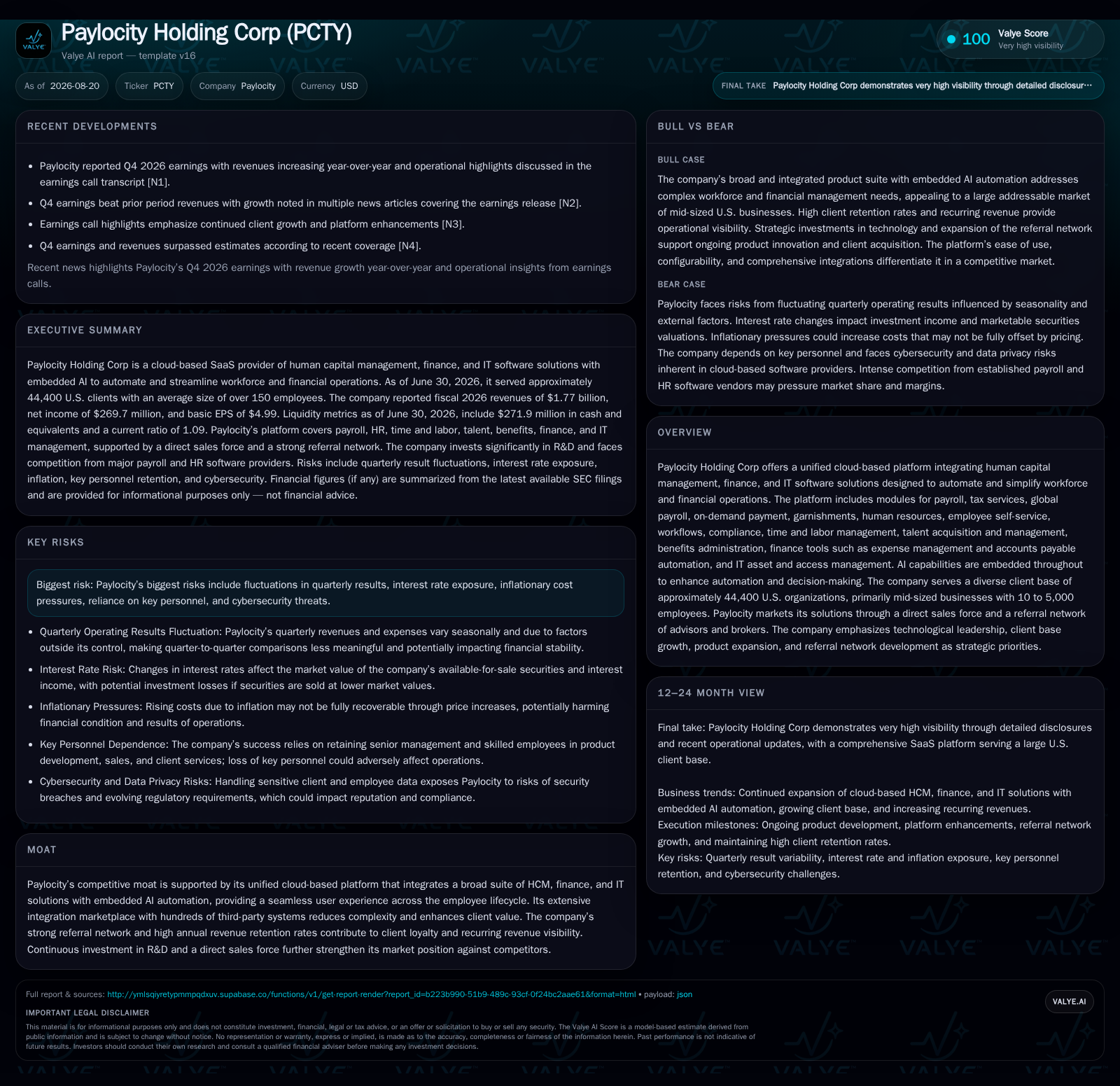
In Q3 2026, Paylocity Holding Corp maintained a stable client base of approximately 44,400 U.S. organizations and reported a current ratio of 1.09 with a net cash position of about $191 million. The company’s unified cloud-based SaaS platform continues to embed AI capabilities that enhance automation and decision-making. A board member announced plans to leave after the 2027 annual meeting, a governance change unlikely to disrupt near-term operations. These developments support Paylocity’s operational resilience and capacity for ongoing product innovation.
Latest Quarterly Operating Performance
Paylocity Holding Corp reported stable operating metrics for Q3 2026, serving approximately 44,400 clients across the United States as of June 30, 2026. These clients are primarily mid-sized businesses with an average of over 150 employees each, reflecting the company’s focus on organizations requiring integrated human capital management (HCM), finance, and IT solutions [S1][S2]. This client base may contribute to recurring revenue visibility in the SaaS HCM sector, where client retention and seat expansion can drive growth.
The company’s current ratio was 1.09, supported by current assets of $3.72 billion and current liabilities of $3.42 billion, resulting in working capital of approximately $300 million [F1]. Additionally, Paylocity maintained a net cash position of about $191 million, with $272 million in cash and equivalents against $81 million in total debt as of June 30, 2026 [F1]. Mr. Conway will continue to serve through the remainder of his current term [S3]. The departure was not due to any disagreement with company operations or policies, indicating a planned and orderly governance transition.
While governance changes can influence strategic oversight and investor confidence, this particular development is unlikely to materially disrupt Paylocity’s near-term strategic direction or operational execution. The advance notice and absence of conflict suggest continuity in board governance, which is important for sustaining investor trust and supporting long-term planning.
Business Model and Competitive Positioning
Paylocity operates a unified, cloud-based SaaS platform that integrates human capital management, finance, and IT software solutions. The platform automates workflows across the employee lifecycle—from recruiting and onboarding to payroll, benefits, and performance management—streamlining administrative tasks and enhancing user experience [S1]. Embedded artificial intelligence (AI) capabilities further automate processes and provide real-time insights, supporting better decision-making and reducing manual effort.
The company’s business model centers on recurring revenue generated primarily through SaaS subscriptions, which scale with the number of client employees and the breadth of solutions adopted. This model benefits from high client retention rates and a strong referral network comprising 401(k) advisors, benefits administrators, insurance brokers, third-party administrators, HR consultants, and accountants [S1][S2]. The net cash position of approximately $191 million, derived from $272 million in cash and equivalents less $81 million in total debt, indicates financial flexibility [F1].
This financial strength is particularly relevant in the SaaS HCM industry, where ongoing investment in research and development (R&D) is essential to maintain competitive product offerings, especially with rapid technological advancements such as AI automation. Paylocity’s liquidity and working capital provide a buffer against short-term fluctuations and support sustained innovation.
Scenario Analysis and Outlook
Looking ahead, several scenarios could influence Paylocity’s trajectory:
Bull Case: Continued embedding of AI capabilities and platform integration drives higher client retention and new client acquisition, accelerating revenue growth and margin expansion [S1][S2]. This scenario depends on sustained R&D investment, positive client adoption of AI features, and a stable macroeconomic environment. Confirmation would come from improved retention metrics, increased average revenue per client, and favorable commentary in future earnings reports
Base Case: Paylocity maintains its current client base and financial position with moderate growth, effectively managing seasonal fluctuations and competitive pressures without major disruption. This scenario is supported by historical stability and a mature platform with a strong referral network. Confirmation would include flat to modestly growing client counts, stable margins, and consistent quarterly results [S2][F1].
Bear Case: Macroeconomic pressures such as rising interest rates or inflation, combined with competitive innovation from rivals, erode Paylocity’s client base and margins, leading to revenue declines and liquidity strain [S1][S2]. The planned departure of a board member in 2027 represents a governance change but is unlikely to materially impact the company’s strategic or operational outlook in the near term.
Investors and observers should monitor upcoming quarterly filings for trends in client count and employee base growth, retention rates, average revenue per client, and operating margin developments. Additionally, updates on product innovation—particularly AI feature adoption—and any further governance changes will be important indicators of Paylocity’s ongoing competitive positioning and growth prospects.
Disclaimer: This is research-only, informational analysis and not investment advice. It may include AI-generated interpretation and general industry context. Always verify important details using primary sources.

Comments