
Peace Acquisition Corp.: Trust-Centric SPAC Economics and the Countdown to a Defining Deal
Peace Acquisition Corp. sits at the classic SPAC crossroads: substantial trust assets, negligible operating activity, and the clock ticking for a business combination. With $61.1 million in trust and net income driven by interest, the company's fate now hinges on both the quality and timing of its inaugural merger—where execution risk and market conditions loom large.
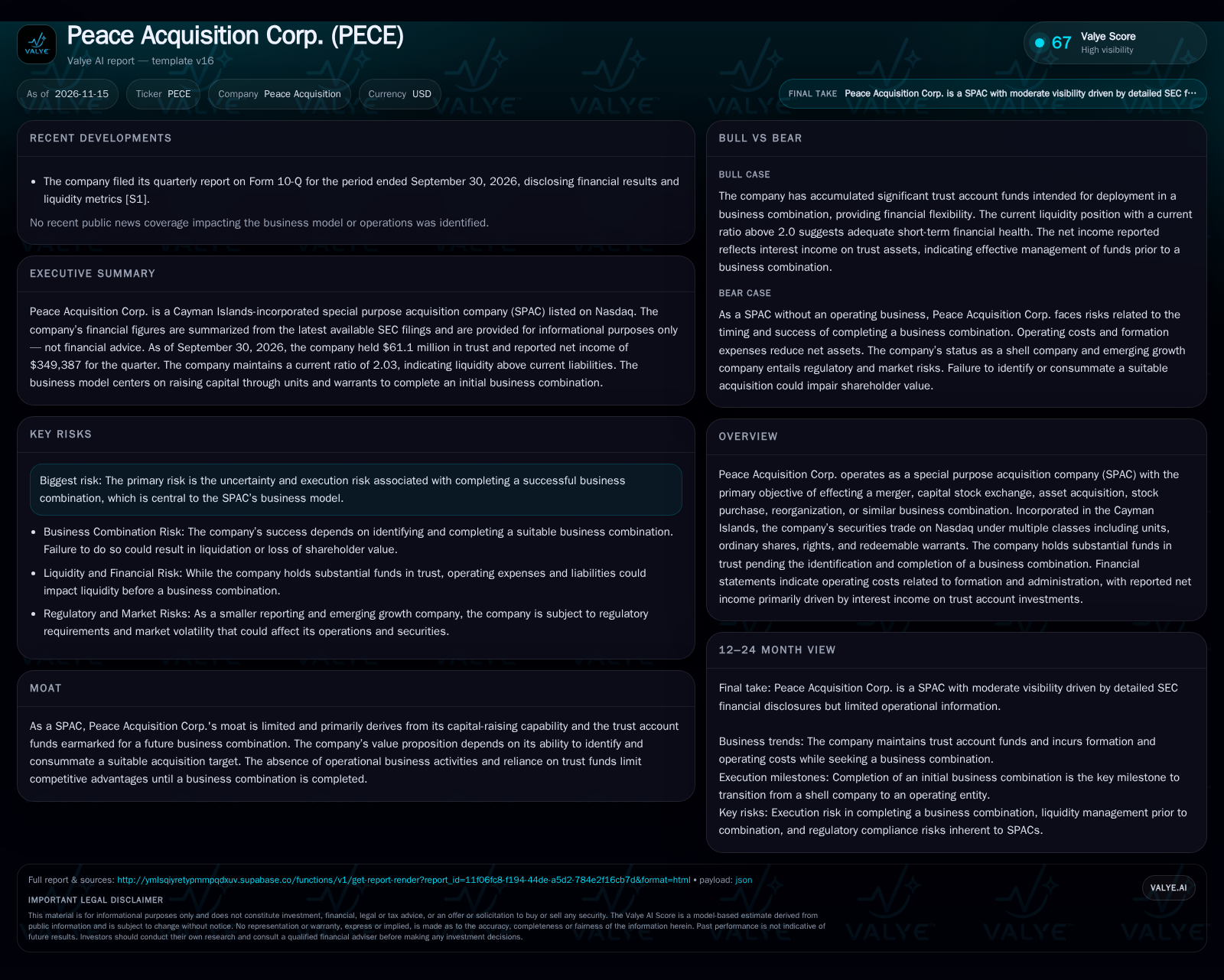
Peace Acquisition Corp. is a SPAC with $61.1 million in trust and net income sourced from interest, not operations. Its success depends entirely on identifying and closing a value-creating business combination before regulatory deadlines or market conditions erode shareholder value. Execution risk remains the dominant factor.
Peace Acquisition Corp. illustrates the archetypal SPAC lifecycle: flush with investor capital held in trust, minimal operational activity, and the singular mandate to engineer a business combination. As of September 30, 2026, the company’s $61.1 million trust account and net income from interest underscore a business model defined by financial stewardship rather than revenue generation. With a current ratio of 2.03 and no outstanding sponsor loans, financial housekeeping appears sound, but the absence of an operating business means future value creation is entirely dependent on the timing, quality, and execution of a target acquisition. The challenge now is navigating the high-stakes SPAC environment, where execution speed, deal selection, and market volatility will determine whether the trust capital translates into lasting shareholder value.
Current Financial Structure and the SPAC Imperative
Peace Acquisition Corp. holds $61.1 million in a trust account as of September 30, 2026, which constitutes the bulk of its assets and is earmarked for a future business combination [S1]. The company reported net income of $349,387 for the latest quarter, driven by interest income on trust assets rather than operational activity [S1]. [S1] However, as a shell company, all material future value depends on successfully identifying and consummating a business combination before regulatory or contractual deadlines trigger forced liquidation.
How Peace Acquisition Corp. Generates (or Preserves) Value Pre-Merger
The economics of Peace Acquisition Corp. are defined by the SPAC model: investors supply capital via an IPO, which is placed in a trust account and generates interest income until a deal is struck or the SPAC is liquidated. The company incurs modest operating and formation costs—$206,652 in the most recent quarter—largely for legal, administrative, and regulatory compliance [S1]. Net income to date is a function of interest rates on trust investments, not business activity or value creation. This capital-light, low-burn structure persists until a merger candidate is found. At that point, the economics pivot dramatically: the trust capital is deployed into a new operating entity, and shareholders’ returns become dependent on the acquired business’s growth, margins, and capital needs. Until then, Peace’s financial profile is almost entirely fixed, with variable costs only emerging if deal diligence intensifies or a transaction closes. The real economic inflection point will be the terms and structure of the eventual business combination—especially the valuation, dilution, and post-merger capital requirements.
The preservation of value pre-merger is intricately tied to the trust's investment strategy and prevailing interest rate environment. Should interest rates decline materially, the income generated from the trust assets would correspondingly decrease, potentially compressing net income and limiting the SPAC’s ability to cover operating expenses without eroding principal. Conversely, a rising interest rate environment could enhance income but may also signal broader market volatility, which could complicate merger negotiations. Additionally, the timing of deploying trust capital is critical; premature investment in a suboptimal target could crystallize losses, whereas delayed deployment risks forced liquidation. Thus, the SPAC’s economics before merger are a delicate balance between maintaining capital integrity, managing operating costs, and navigating macroeconomic factors affecting trust returns.
SPAC Market Realities: Capital as the Only Moat—For Now
Peace Acquisition Corp.’s only current competitive lever is its $61.1 million in trust, which it can use to attract a merger partner. In the crowded SPAC landscape, sourcing a compelling target is a race against time and competing vehicles, all seeking differentiated assets. Until a combination is completed, Peace does not possess operational advantages, proprietary technology, or established customer relationships. Its negotiating leverage with potential targets is a function of trust size, sponsor reputation, and deal structure flexibility. The broader competitive environment includes other SPACs, traditional private equity, and direct listings—each presenting alternative capital sources for potential targets. Should Peace secure a deal, its future competitive position will depend entirely on the target business’s moat, market, and differentiation—not Peace’s own pre-merger attributes.
The competitive dynamics for Peace Acquisition Corp. extend beyond mere capital availability to include sponsor reputation and network effects. Sponsors with established track records or sector expertise can unlock proprietary deal flow or negotiate more favorable transaction terms, which may be decisive in a crowded SPAC market. Moreover, the SPAC’s ability to offer flexible deal structures, such as earnouts, PIPE participation, or tailored governance provisions, can enhance attractiveness to target companies wary of traditional acquisition risks. However, these advantages are conditional on sponsor credibility and market perception, which are intangible and can fluctuate rapidly. Hence, while capital is the foundational moat, sponsor intangible assets and deal structuring agility are critical competitive levers until an operating business is established.
A Value-Creating Business Combination and Upside Leverage
The most favorable scenario for Peace Acquisition Corp. is the identification and closing of a merger with a high-quality, scalable business at an attractive valuation. If the acquired target demonstrates strong growth prospects, healthy margins, and capital efficiency, Peace’s shareholders could benefit from post-deal appreciation. Upside would be further amplified if the SPAC structure enables the combined entity to access additional capital or public market liquidity for expansion. Evidence confirming this scenario would include a well-received merger announcement, favorable deal terms with minimal dilution, and investor enthusiasm reflected in post-announcement trading volumes and price performance. Falsification would come from a lack of deal progress, poor target selection, excessive dilution, or shareholder redemptions exceeding expectations.
Most Likely Trajectory: Incremental Costs, Execution Clock, and Uncertain Deal Dynamics
The most plausible path for Peace Acquisition Corp. is continued incremental operating costs while the sponsor team evaluates targets, with trust assets generating modest interest income. The company may announce a potential merger within the typical SPAC window, but deal negotiations, regulatory review, or market volatility could delay or complicate closing. In this scenario, the eventual deal may be with a business of average quality or limited growth prospects, reflecting the competitive realities of the SPAC market. Shareholder redemptions could dilute the trust pool, and post-merger trading may be volatile. Confirmation would come from a timely deal announcement and completion, but with moderate redemptions and unremarkable post-close performance. Falsification would be a failure to announce a deal before the SPAC’s deadline, or a transaction rejected by shareholders.
In this incremental progression scenario, the interplay between shareholder behavior and market conditions is pivotal. Elevated redemption rates ahead of a merger reduce the trust pool, constraining deal size and potentially forcing less attractive transactions. Additionally, regulatory scrutiny can introduce timing uncertainty and necessitate concessions that dilute shareholder value. Market volatility may depress valuation multiples, compelling the SPAC to accept lower-priced deals or increase dilution to secure financing. Consequently, the post-merger entity might face capital constraints that limit growth initiatives, thereby capping shareholder returns. The scenario underscores the conditional nature of value creation, reliant on synchronized execution across deal sourcing, shareholder alignment, and market receptivity.
No Deal or Poorly Executed Merger: Capital Erosion and Forced Liquidation
The adverse scenario centers on Peace Acquisition Corp. failing to identify or close a business combination within the regulatory timeframe. In this case, the SPAC would be forced to liquidate, returning trust capital to shareholders (minus permitted expenses), with the opportunity cost of idle capital and unrecovered sponsor investment. Alternatively, a rushed or suboptimal merger could destroy value through excessive dilution, poor target fundamentals, or post-deal underperformance—potentially leading to sharp share price declines and high redemption rates. Evidence of this scenario would include missed deal deadlines, a lack of substantive target updates, or a merger announcement met with heavy redemptions and immediate price deterioration.
Milestones That Will Define Peace Acquisition Corp.’s Outcome
Announcement of a definitive business combination agreement and details of the target’s sector, growth prospects, and financials.
Shareholder redemption rates and vote outcomes at the time of merger approval, as high redemptions can materially shrink the trust pool.
Timing relative to the SPAC’s mandated deadline for closing a business combination, as delays increase liquidation risk.
Dilution from warrants, rights, or PIPE (private investment in public equity) financings, if disclosed, which could impact post-merger ownership structure.
Regulatory review or antitrust clearance progress, especially if the target operates in a sensitive or heavily regulated sector.
Post-announcement and post-merger share price and trading volume, which would reflect market confidence in the deal quality.
Updates on trust account balance and any permitted withdrawals for operating expenses, which affect capital available for the combination.
Sponsor or insider actions (e.g., extensions, additional capital contributions, or open-market purchases), if disclosed, as signals of sponsor commitment.
Disclaimer: This is research-only, informational analysis and not investment advice. It may include AI-generated interpretation and general industry context. Always verify important details using primary sources.

Comments