
Sound Financial Bancorp: Dividend Consistency, Profitability, and the Stakes of Limited Disclosure
Sound Financial Bancorp demonstrates consistent profitability and regular dividends, underpinned by substantial cash reserves. Yet, with limited disclosure on revenue and core banking metrics, investors must weigh the resilience of its business model against sector volatility and transparency constraints.
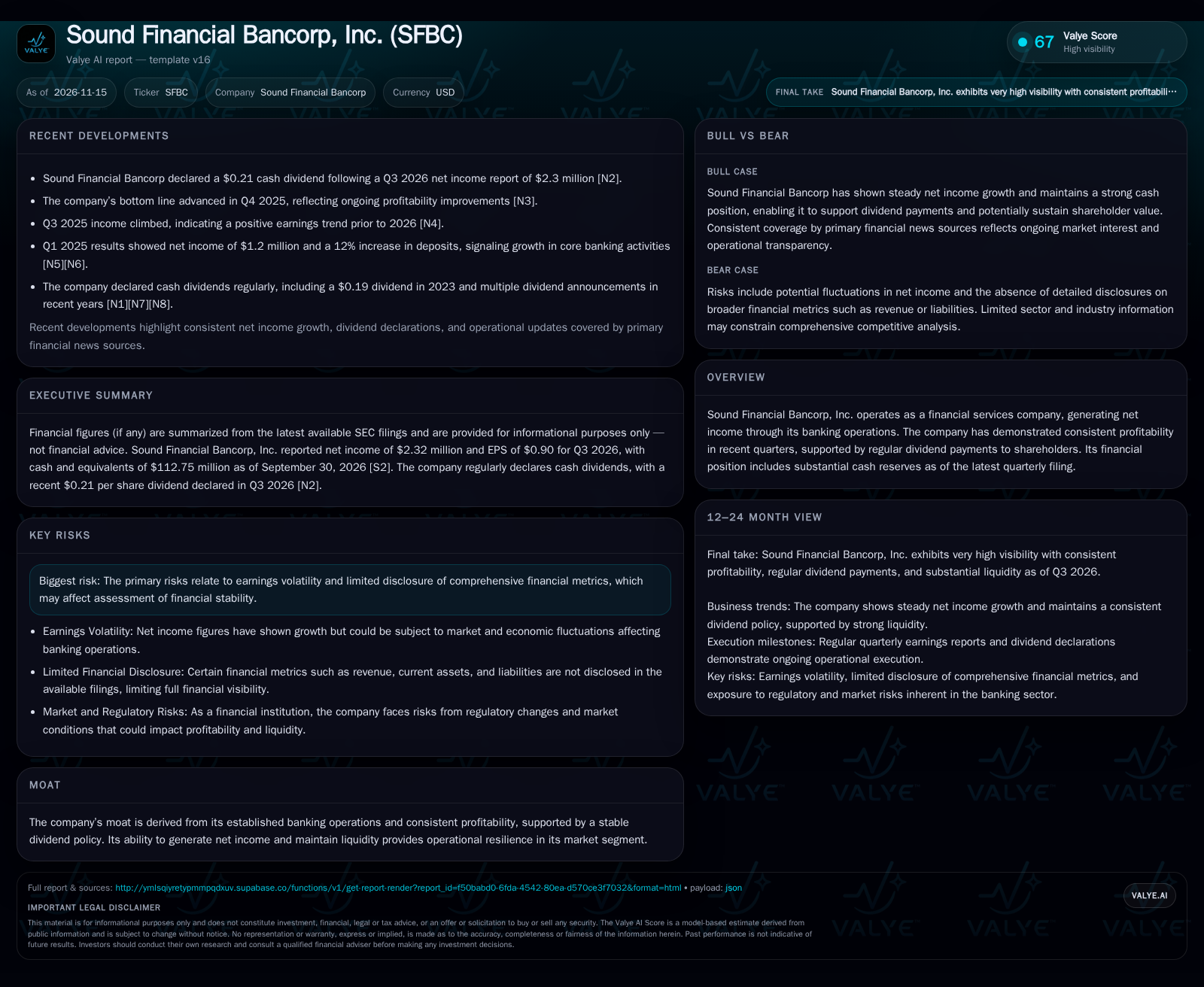
Sound Financial Bancorp, Inc. The company’s operational and financial stability is evident, but incomplete disclosure of revenue and other key metrics leaves questions about underlying drivers and future resilience in a changing banking environment. [S2] [N2]
Sound Financial Bancorp, Inc. is operating from a position of visible strength: it delivers steady net income, maintains robust cash reserves, and continues to reward shareholders with regular dividends. These attributes speak to operational discipline and a degree of resilience uncommon among smaller financial institutions. However, the company’s limited disclosure of revenue, asset composition, and liability structure raises questions about the sources of its profitability and the sustainability of its current trajectory, especially in a sector highly sensitive to market, economic, and regulatory shifts.
Profitability and Cash Strength Define the Current Picture
Sound Financial Bancorp reported net income of $2.32 million for Q3 2026, with basic and diluted EPS of $0.90 per share. The company declared a $0.21 per share cash dividend for the period, backed by a substantial $112.75 million in cash and equivalents as of September 30, 2026. The cited source reports dividend-related activity; that disclosure alone does not establish dividend-policy continuity, management confidence, or a material constraint on capital flexibility. Additionally, the Q1 2025 report highlighted a 12% increase in deposits, suggesting underlying growth in the company’s core banking franchise. [S2] [N2] [N5] [N6]
How Sound Financial Bancorp Generates and Sustains Earnings
As a traditional banking institution, Sound Financial Bancorp likely earns the bulk of its revenue from net interest income—spreads between interest earned on loans and paid on deposits—supplemented by fees from various banking services. The company’s consistent profitability and deposit growth suggest a stable loan portfolio and the ability to attract and retain low-cost deposits, which is critical for margin management in a competitive rate environment.
Operating leverage in banking is typically moderate: fixed costs (such as personnel and branch infrastructure) are high, but incremental deposit and loan growth can translate into higher marginal profitability if credit costs and overhead are controlled. However, the absence of disclosed revenue, asset, and liability detail creates uncertainty about the precise drivers of Sound Financial’s margin and risk profile. The company reported cash and liquidity metrics for the period; these figures do not by themselves establish operating runway, investment capacity, financial flexibility, or financing capacity.
The company’s reliance on net interest margin as a primary revenue source implies sensitivity to interest rate fluctuations and yield curve dynamics. In a rising rate environment, if Sound Financial Bancorp manages to reprice loans more rapidly than deposit costs increase, net interest income could expand, enhancing profitability. Conversely, a flattening or inverted yield curve might compress margins, especially if deposit rates rise faster than loan yields. The bank’s ability to manage interest rate risk through asset-liability matching, hedging strategies, or loan product mix adjustments would be critical to sustaining earnings. Without detailed disclosures on the duration and repricing characteristics of assets and liabilities, evaluating this risk exposure remains challenging.
Another important dimension is credit risk management. The quality of the loan portfolio directly affects profitability through provisions for loan losses and charge-offs. If Sound Financial Bancorp maintains conservative underwriting standards and effective risk monitoring, the incidence of nonperforming loans and related costs would remain low, supporting stable earnings. However, economic downturns or sector-specific stress could increase credit losses, eroding net income. The absence of granular data on loan composition, sector concentrations, and credit metrics limits the ability to assess vulnerability to adverse credit cycles or localized economic shocks.
Franchise Stability Versus Sector Pressures and Substitution Threats
Sound Financial Bancorp’s competitive position is shaped by its established presence and ongoing profitability, as reflected in its ability to pay consistent dividends and report rising deposit balances. In the community and regional banking landscape, advantages often stem from local brand trust, relationship banking, and niche lending expertise. However, the broader sector faces mounting pressures: digital banks and fintechs are increasingly targeting deposit and lending share, while regulatory and compliance burdens continue to rise.
Without specifics on the company’s market footprint, customer mix, or technology adoption, it is difficult to assess its true defensibility. If Sound Financial maintains a loyal, sticky customer base and prudent underwriting discipline, it may be better insulated from rate competition and credit shocks. Still, the risk of disintermediation by digital-first competitors, especially if customer experience or cost advantages are not matched, is a growing factor for all traditional banks.
The competitive landscape for regional banks increasingly hinges on technological adaptability and customer experience enhancements. If Sound Financial Bancorp invests strategically in digital platforms, it can improve operational efficiency and meet evolving customer expectations, thereby reducing attrition risk to fintech competitors. Conversely, lagging in technology adoption may increase customer churn and elevate cost-to-income ratios. Moreover, the bank’s ability to leverage data analytics for targeted marketing, credit decisioning, and fraud prevention can create competitive differentiation. Without insight into the company’s technology initiatives or digital engagement metrics, assessing its long-term franchise sustainability remains speculative.
Regulatory compliance costs and capital adequacy requirements also influence competitive positioning. Smaller banks often face disproportionately high per-unit compliance expenses, which can compress margins and limit investment capacity. Sound Financial Bancorp’s ability to efficiently manage regulatory burdens while maintaining capital buffers sufficient to support growth and absorb shocks is vital. The absence of detailed capital adequacy ratios or regulatory disclosures constrains evaluation of the bank’s resilience to regulatory changes or economic stress scenarios. Strategic responses, such as operational streamlining or capital optimization, would be necessary to sustain competitiveness in an increasingly regulated environment.
Deposit Growth and Asset Quality Drive Positive Repricing
A favorable trajectory for Sound Financial Bancorp would see continued core deposit inflows—enabling low-cost funding—and disciplined loan growth in higher-yielding segments.
Evidence that would confirm this scenario includes sustained deposit expansion (as seen in Q1 2025), rising or stable loan balances with low delinquency rates (if disclosed), and further increases in quarterly net income and dividends. Expansion into fee-generating services or digital banking capabilities would also strengthen the upside case by diversifying revenue and improving customer retention.
Steady Earnings Amid Sector Volatility and Disclosure Constraints
Margin compression from rising deposit costs or competitive lending pressure may offset some gains from asset growth. The absence of detailed financial disclosures makes it challenging to fully evaluate the durability of recent performance.
This scenario would be confirmed by ongoing quarterly profitability, steady or gradually increasing dividends, and maintenance of high cash balances. However, a lack of transparency on revenue composition, asset quality, or interest rate sensitivity would leave investors with incomplete tools to assess risk-adjusted returns.
Earnings Volatility and Transparency Gaps Expose Fragility
If economic or credit conditions deteriorate, Sound Financial Bancorp could face declining net interest margins, higher loan losses, and increased funding costs. In this scenario, limited financial disclosure would exacerbate investor uncertainty, potentially leading to a re-rating of risk and a higher cost of capital. Regulatory or compliance shocks, or a failure to adapt to changing customer expectations, could hurt both earnings and deposit retention.
The downside would be confirmed by reported declines in net income, reductions or suspensions of the dividend, or a material drawdown in cash and equivalents. Additional warning signs would include sudden deposit outflows, rising nonperforming assets (if disclosed), or negative regulatory developments.
Metrics and Developments That Will Shape the Sound Financial Bancorp Thesis
Deposit growth rate: Sustained increases in core deposits would signal franchise health and funding stability; declines may indicate competitive or economic strain.
Dividend declarations and payout ratio: Maintenance or growth of the dividend would reinforce the company’s shareholder-return narrative; cuts would be a negative signal.
Cash and equivalents relative to total assets: While current cash levels are high, tracking this as a percentage of assets (if disclosed) would clarify liquidity strength versus potential yield drag.
Loan growth and credit quality: If disclosed, trends in loan balances and nonperforming assets would help assess risk exposure and underwriting discipline.
Fee income and noninterest revenue: Disclosure of noninterest income would indicate progress toward revenue diversification and reduced margin dependency.
Regulatory or compliance developments: Any material changes in the regulatory environment, especially new requirements or enforcement actions, could affect operational costs and strategic flexibility.
Technology investments and digital banking adoption: Evidence of digital transformation would signal competitiveness against fintech and digital-only banks.
Disclaimer: This is research-only, informational analysis and not investment advice. It may include AI-generated interpretation and general industry context. Always verify important details using primary sources.

Comments