
Synlogic: Reported Liquidity Position and Platform Ambition Confront the Realities of Clinical-Stage Biotech Economics
Synlogic holds $11.56 million in cash and boasts a reported current ratio, supporting ongoing R&D in its biopharmaceutical pipeline.
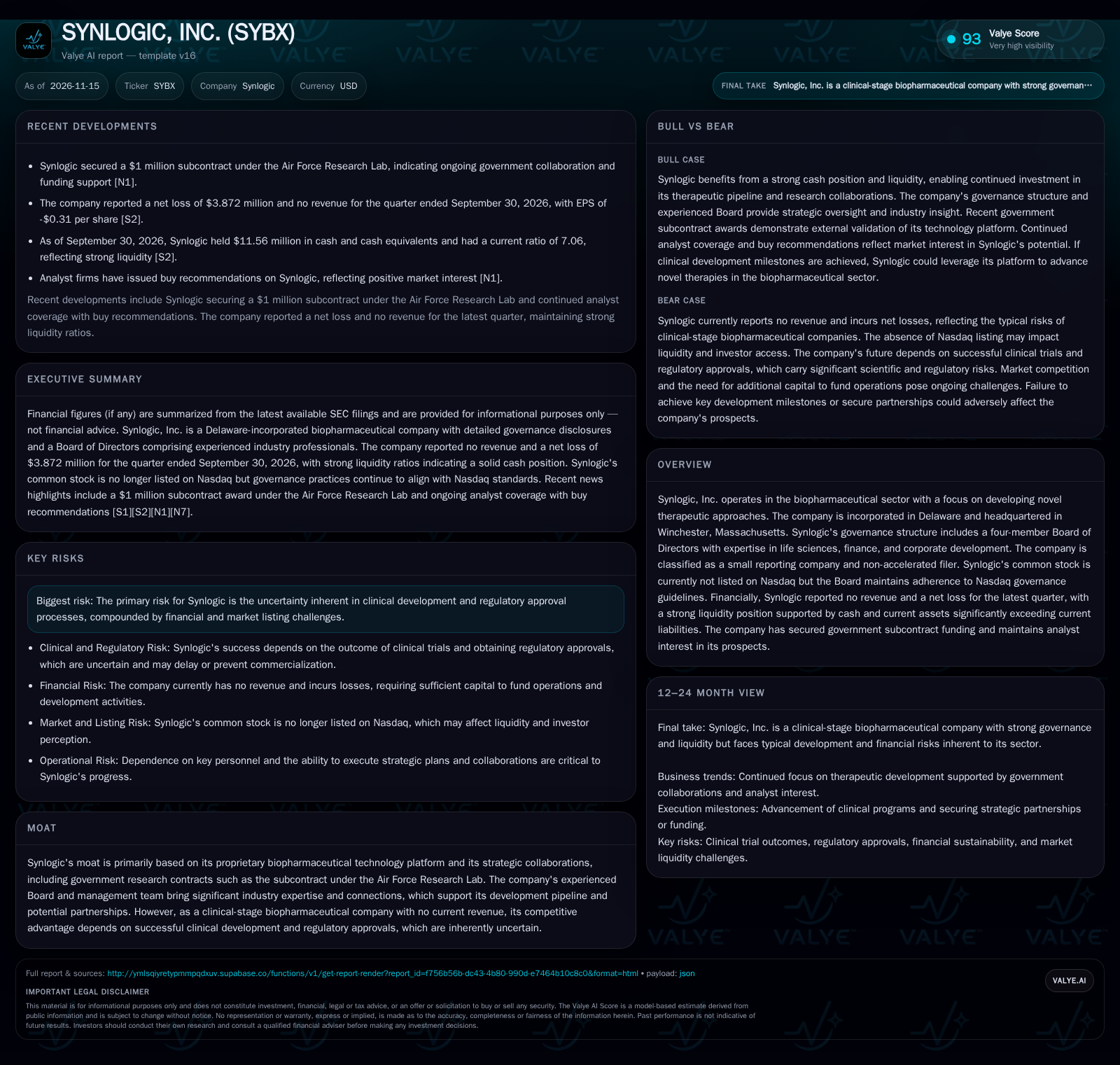
Synlogic holds $11.56 million in cash and boasts a reported current ratio, supporting ongoing R&D in its biopharmaceutical pipeline. While a recent $1 million Air Force Research Lab subcontract offers external validation, the company reported no revenue and a $3.872 million net loss for the latest quarter. As a non-Nasdaq-listed, clinical-stage company, Synlogic faces the sector’s standard challenges: dependence on successful clinical milestones, regulatory approvals, and future capital raises to sustain operations and commercialization efforts. [S2]
Synlogic, Inc. exemplifies the promise and peril of early-stage biopharmaceutical innovation. The company’s $11.56 million cash reserve and recent government subcontract position it to pursue ambitious therapeutics development. Yet, with no revenue, ongoing net losses, and a Nasdaq delisting, Synlogic’s future hinges on its ability to deliver clinical milestones and attract follow-on funding. The classic biopharma challenge—bridging scientific promise to commercial reality—remains at the core of Synlogic’s investment case.
Liquidity, Losses, and Government Validation: Synlogic’s Present-Day Snapshot
As of September 30, 2026, Synlogic reported no operating revenue and a net loss of $3.872 million for the quarter, with basic and diluted EPS of -$0.31 per share [S2]. This underscores its status as a clinical-stage biotech, pre-commercialization, and reliant on external funding. The company’s liquidity position is notable: $11.56 million in cash and a current ratio of 7.06, pointing to ample resources for near-term operations [S2].
A $1 million subcontract from the Air Force Research Lab offers not only non-dilutive capital but also external validation that Synlogic’s technology platform is attracting interest beyond traditional pharma partners. However, the company’s common stock is no longer listed on Nasdaq, which could dampen market liquidity and limit investor access [S1]. Together, these facts frame Synlogic’s current opportunity and risk: a well-resourced but pre-revenue biotech with a platform seeking proof, capital, and a path to commercial relevance.
The Economics of Pre-Revenue Biotech: Capital as Lifeblood, Value in Milestones
Synlogic’s economics are typical of clinical-stage biopharma: there is no product revenue, and R&D and G&A spending drive persistent operating losses. The company’s financial survival and eventual value creation are tied to its ability to advance therapeutic candidates through costly preclinical and clinical development, with the hope of achieving inflection points—such as positive trial data, government or strategic partnerships, or out-licensing deals—that attract further capital or trigger milestone payments.
The $1 million Air Force Research Lab subcontract provides a small but meaningful source of non-dilutive funding, reducing immediate dependence on equity or debt raises. However, this sum is modest relative to the burn rate implied by the recent net loss. If Synlogic advances to later-stage clinical trials, capital needs could increase substantially, as late-stage studies and regulatory submissions are resource-intensive. Fixed costs (e.g., core R&D infrastructure, executive compensation) may offer some operating leverage if the pipeline scales, but variable costs—especially for clinical trials—will rise as programs progress.
The company’s long-term economics, if a therapy is commercialized, could feature high gross margins typical of innovative biologics, but this is speculative until clinical and regulatory hurdles are cleared. For now, Synlogic’s business model is capital-intensive and milestone-driven, with value accruing in the form of platform validation, intellectual property, and the potential for out-licensing or acquisition.
Platform Differentiation vs. Sector Headwinds: Where Synlogic Stands
Synlogic’s proprietary technology platform and recent government subcontract suggest a differentiated approach within the biopharmaceutical landscape. The sector is crowded, with many companies pursuing novel therapeutics, often targeting similar disease pathways or leveraging synthetic biology. The company’s ability to secure external validation from the Air Force Research Lab may indicate unique capabilities or applications, potentially in areas of national interest or specialized indications.
However, Synlogic faces sector-wide challenges: competition from larger, better-capitalized biotech and pharmaceutical companies, the rapid pace of innovation, and the risk of technological obsolescence. Without commercialized products or recurring revenue, Synlogic’s competitive advantage remains theoretical—dependent on the eventual success of its pipeline and the defensibility of its intellectual property. The absence of a Nasdaq listing may further weaken visibility and access to capital relative to listed peers.
In sum, Synlogic’s position is that of a promising platform player seeking to carve out a niche, but with competitive durability contingent on successful clinical execution and ongoing external interest.
From Platform Validation to Transformative Partnerships: The Bullish Chain of Events
A favorable trajectory for Synlogic would see its therapeutic candidates achieve positive clinical trial results—perhaps building on the validation implied by the Air Force Research Lab subcontract. Such milestones could trigger additional non-dilutive funding, attract strategic partners, or support lucrative out-licensing deals. If the pipeline demonstrates differentiated efficacy or safety, Synlogic could command a premium for its platform in partnering discussions or even as an acquisition target.
Confirmation of this scenario would require: (1) successful completion of early-stage clinical trials with compelling data; (2) announcements of new partnerships, especially with established pharmaceutical or government entities; and (3) evidence of milestone payments or upfront licensing revenue. Falsification would result from clinical setbacks, inability to secure further partnerships, or failure to progress programs beyond the preclinical or early clinical stage.
Incremental Progress, Ongoing Cash Burn, and the Next Funding Decision
The most plausible near-term path for Synlogic is one of incremental progress: advancing one or more pipeline assets through preclinical or early clinical development, leveraging existing cash resources, and seeking additional non-dilutive funding or strategic collaborations. The company continues to operate at a loss, with cash reserves gradually declining, but retains enough liquidity for several quarters of operations.
This scenario would be confirmed by periodic R&D updates, continued government or foundation grants, and announcements of additional research collaborations. It would be challenged if the company’s burn rate accelerates without offsetting funding, or if clinical progress stalls, forcing Synlogic to seek dilutive capital raises under unfavorable terms.
Clinical Setbacks and Capital Constraints: The Risk of Value Erosion
The classic risk for Synlogic—and for clinical-stage biotechs more broadly—is the combination of negative or inconclusive clinical trial results and tightening capital markets. If Synlogic’s lead candidates fail to achieve their primary endpoints, or if regulatory or safety hurdles emerge, the company could find itself unable to attract new partners or investors. The absence of a Nasdaq listing may amplify these risks by limiting liquidity and reducing visibility to institutional investors.
This scenario would be confirmed if Synlogic announces clinical trial discontinuations, fails to secure additional non-dilutive funding, or is forced to raise capital at highly dilutive terms. An accelerating cash burn without corresponding progress would further validate the downside. Conversely, any indication of successful trial outcomes or above-expectation partnership activity would challenge the bear thesis.
Milestones and Metrics That Will Define Synlogic’s Next Chapter
Updates on the progression of Synlogic’s lead therapeutic candidates through preclinical and clinical development—especially any data readouts or regulatory submissions.
Disclosure of new government, foundation, or industry research collaborations or partnerships, including the structure and financial terms if provided.
Quarterly cash burn trends and updates to cash and cash equivalents, to gauge runway and capital needs.
Announcement of any out-licensing, milestone, or upfront payment deals that would provide non-dilutive funding and external validation.
Changes in board composition, management, or strategic direction—especially relating to business development or capital markets strategy.
Progress toward relisting on a national exchange, or updates on efforts to improve market liquidity and investor access.
If disclosed, pipeline attrition rates, trial enrollment progress, or partnership conversion ratios, which would clarify operational execution.
Disclaimer: This is research-only, informational analysis and not investment advice. It may include AI-generated interpretation and general industry context. Always verify important details using primary sources.

Comments