
ITG, Inc.: Contract Dependency, Platform Ambition, and the Economics of U.S. Broadband Infrastructure Services
ITG, Inc. operates at the core of the U.S. broadband and utility infrastructure boom, offering end-to-end deployment and maintenance services through a model shaped by customer concentration and contract flexibility. Recent operational improvements, a proprietary tech platform, and acquisitive expansion highlight both the company’s potential and its most acute risks.
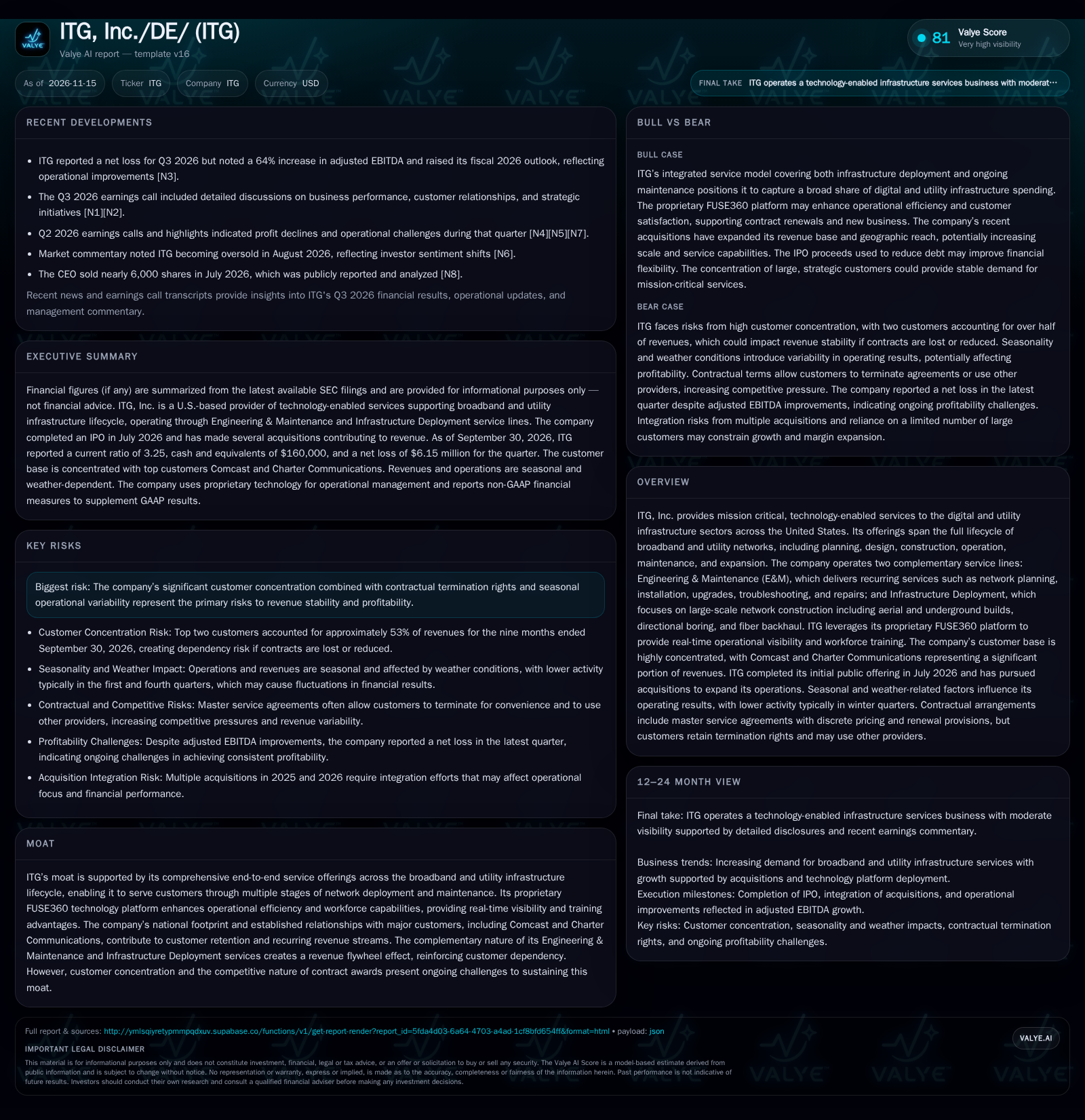
ITG, Inc. provides technology-enabled deployment and maintenance services for broadband and utility infrastructure, primarily serving Comcast and Charter. The business model leverages a full-lifecycle approach and a proprietary platform, but faces high customer concentration, seasonality, and flexible contract terms. Recent EBITDA gains and acquisitions signal operational progress, yet profitability and revenue stability remain sensitive to customer actions and integration execution. [S1] [N3]
ITG, Inc. sits at the intersection of surging U.S. broadband infrastructure investment and the competitive realities of contract-driven services. The company’s strategy—anchored by full-lifecycle offerings and its proprietary FUSE360 platform—targets operational leverage and customer stickiness, but also exposes ITG to the risks of customer concentration and the vagaries of master service agreements. Recent operational gains and acquisitive expansion suggest scaling ambition, yet the pathway to consistent profitability and revenue stability depends on execution, integration, and the evolution of its core customer relationships.
Concentration, Contracts, and Recent Performance: What’s Changed for ITG in 2026
Three facts define ITG’s current position. First, the company’s top two customers—Comcast and Charter Communications—accounted for approximately 53% of revenues in the nine months ended September 30, 2026, underscoring a high degree of customer concentration. Second, ITG reported a net loss of $6.15 million for Q3 2026 but delivered a 64% increase in adjusted EBITDA and raised its fiscal 2026 outlook, signaling operational improvements even as profitability remains elusive. Third, the business completed an initial public offering in July 2026, raising $339.3 million (primarily for debt repayment), and has since executed several acquisitions that have contributed incremental revenues and expanded geographic reach. These developments are material because they shape both the company’s near-term potential financial flexibility and its exposure to contract renewal, integration, and execution risks. [S1] [N3]
The Economics of Lifecycle Infrastructure Services: Revenue Flywheel and Margin Tensions
ITG’s business model is designed around a two-pronged service structure: Engineering & Maintenance (E&M) and Infrastructure Deployment. E&M offers recurring services—planning, installation, troubleshooting, and repair—while Infrastructure Deployment focuses on large-scale network builds, including fiber construction and backhaul. This structure is intended to create a revenue flywheel, with deployment work seeding future maintenance contracts and vice versa.
Revenue is primarily generated through master service agreements (MSAs) with major broadband providers. These MSAs typically price individual tasks discretely (e.g., per mile of fiber laid, per repair call), and while many agreements auto-renew annually, customers retain the right to terminate for convenience or supplement with other providers. This contract structure supports volume but limits pricing power and long-term visibility.
Margins in this sector hinge on project mix, labor efficiency, and weather/seasonality. E&M work may offer greater recurrence but often at lower margins due to competitive pricing and labor intensity. Infrastructure Deployment can be higher-margin if well-executed but is project-based and sensitive to cost overruns. ITG’s FUSE360 platform could, if effective, drive incremental margin by optimizing workforce training and real-time operational visibility, but the scale and durability of these benefits remain to be demonstrated.
Recent acquisitions add both scale and integration risk—potentially improving fixed-cost leverage but also introducing operational complexity and near-term margin dilution if synergies are not promptly realized. Capital intensity is moderate, with significant working capital needed for large projects and some exposure to customer retainage provisions (5–10% of invoiced amounts withheld pending project completion).
Customer Lock-In or Contract Commoditization? ITG’s Place in a Fragmented Market
ITG operates in a highly competitive and fragmented sector, with peers ranging from national infrastructure service firms to regional contractors and specialized engineering shops. The company’s full-lifecycle offering—spanning deployment to maintenance—could serve as a moat if it drives deep customer integration and switching costs. However, the master service agreement model, with annual renewals and termination rights, means even long-standing relationships remain contestable.
The FUSE360 platform is a potential differentiator, promising operational transparency and efficiency that could improve customer satisfaction and retention. Yet, the existence of this proprietary system does not guarantee customer lock-in; for true stickiness, the platform would need to become embedded in customer workflows, support measurable efficiency, or create meaningful switching frictions.
Customer concentration is a double-edged sword: while it can signal trusted relationships and stable base demand, it also exposes ITG to outsized risk if a major contract is lost, reduced, or competitively repriced. In addition, large customers like Comcast and Charter have the scale and bargaining power to extract pricing concessions and to periodically rebid work among multiple vendors.
Competitive threats come from both established national players and smaller regional firms willing to compete aggressively on price. Additionally, technology advances in network deployment (e.g., automation, fiber-laying robotics) could alter the labor and margin structure of the industry over time.
Unlocking Platform Leverage and Customer Expansion: What Would Drive Sustainable Growth?
The most favorable scenario for ITG would involve the company translating recent operational improvements and acquisitive scale into durable margin expansion and broader customer penetration. If the FUSE360 platform proves to materially reduce field costs, improve project delivery, or enhance customer transparency, ITG could see higher contract renewal rates, more sole-source awards, or increased share-of-wallet from existing clients.
Successful integration of acquired businesses—demonstrated by rising adjusted EBITDA margins and expanding geographic reach without proportional increases in SG&A—would further support this case. A reduction in customer concentration, either through new large contract wins or expansion into adjacent infrastructure segments (e.g., energy, smart grid), would also improve revenue stability and bargaining leverage.
Confirmation would come in the form of: (1) consistent year-over-year adjusted EBITDA margin gains, (2) a declining percentage of revenue from the top two customers, (3) announcements of new multi-year contracts or entry into new verticals, and (4) evidence of customer testimonials or industry awards recognizing operational excellence attributable to FUSE360.
Recurring Revenue and Renewal Risk: The Likely Middle Ground for ITG
The most plausible outlook is that ITG continues to generate steady revenues from its core customer base, with seasonality and project timing driving quarter-to-quarter variability. Adjusted EBITDA may improve incrementally as acquisition synergies are realized and as the FUSE360 platform matures, but net income is likely to remain pressured by tight margins, integration costs, and the ongoing need to compete for contract renewals.
Customer concentration will persist as a structural feature, and while ITG may win additional contracts or expand within its existing base, revenue visibility will remain limited by the annual renewal and termination provisions in its MSAs. Seasonality and weather disruptions will continue to cause revenue and margin swings, particularly in the first and fourth quarters.
Evidence supporting this base case would be stable or mildly improving adjusted EBITDA margins, maintenance of market share with Comcast and Charter, and a relatively flat customer concentration ratio. Conversely, unexpected contract losses, margin erosion, or failed integration efforts would tilt outcomes toward the downside.
Customer Retrenchment and Margin Compression: How ITG Could Lose Ground
The most adverse scenario involves one or both of ITG’s major customers reducing spend, terminating agreements, or competitively rebidding a significant portion of their work. Given the 53% revenue concentration, even partial loss or repricing of these contracts could drive a step-down in revenue and create negative operating leverage.
Integration missteps from recent acquisitions—manifested by cost overruns, cultural clashes, or operational disruptions—could further erode margins and distract management. If the FUSE360 platform fails to deliver on its efficiency promise, ITG could lose its positioning edge, making it harder to defend pricing or win renewals.
Downside evidence would include: (1) a sudden drop in revenue or gross margin, (2) an increase in customer concentration due to loss of smaller accounts, (3) public disclosure of contract terminations or rebids, or (4) rising SG&A and integration costs outpacing revenue growth.
Milestones and Metrics to Gauge ITG’s Resilience and Execution
Quarterly changes in the percentage of revenue derived from the top two customers—declines would suggest diversification and reduced concentration risk.
Year-over-year trends in adjusted EBITDA margin and free cash flow conversion, if disclosed, to assess operational improvements and the impact of the FUSE360 platform.
Announcement of new multi-year contracts, customer wins outside the Comcast/Charter base, or expansion into adjacent infrastructure segments.
Integration progress and synergies from recent acquisitions, as reflected in SG&A trends and consolidated margin movement.
Seasonal revenue swings and the extent to which weather or operational disruptions impact quarterly results.
Churn or termination of master service agreements, especially with major customers, and any related disclosures.
Retention rates or renewal frequency for MSAs, if disclosed, to track underlying contract stability.
Labor cost trends and project-level margin variance, as these are critical drivers of profitability in a labor-intensive services business.
Disclaimer: This is research-only, informational analysis and not investment advice. It may include AI-generated interpretation and general industry context. Always verify important details using primary sources.

Comments