
Activate Energy Acquisition Corp.: Timing and Market Dynamics in the SPAC Journey
Activate Energy Acquisition Corp. faces a narrowing window to secure an oil and gas deal amid mounting liquidity concerns, potential shareholder dilution, and sector volatility. The company's outcome now hinges on management's ability to leverage its network and structure a viable business combination before the December 2027 deadline.
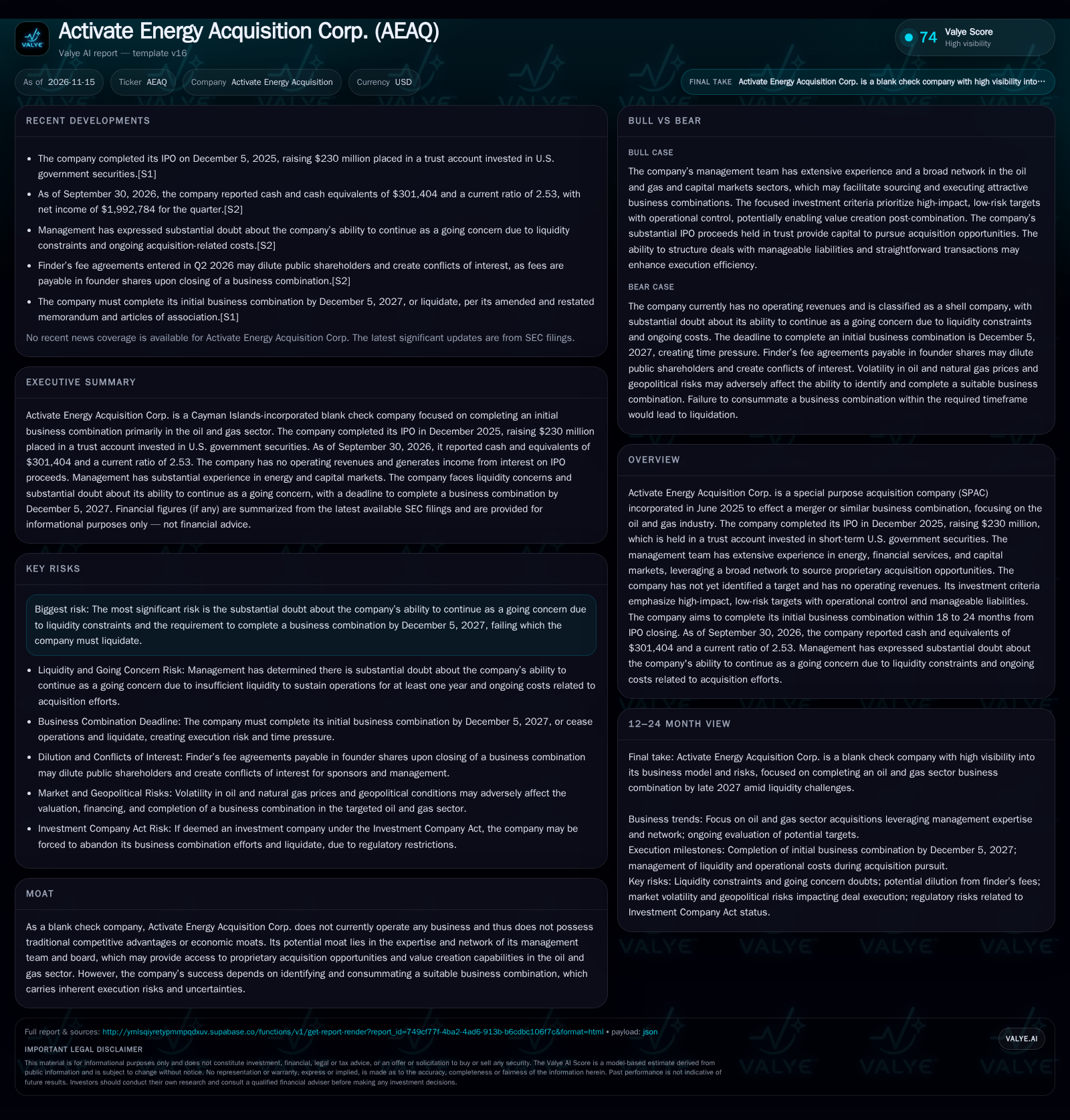
Activate Energy Acquisition Corp. is a SPAC targeting the oil and gas sector, with $230 million in trust from its December 2025 IPO. As of September 2026, the company faces substantial doubt about its ability to continue as a going concern due to limited working capital and ongoing costs. Finder’s fee agreements may dilute shareholders if a deal closes, and the company must complete a business combination by December 2027 or liquidate. Success now depends on sourcing and executing a suitable deal under time and financial pressure.[S1] [S2]
Activate Energy Acquisition Corp. is a SPAC racing the clock: flush with $230 million in trust from its December 2025 IPO but constrained by low working capital, the company has yet to identify a business combination in the oil and gas sector. With less than $0.3 million available for operations, looming dilution risks, and a hard deadline to close a deal by December 2027, the company’s future depends on its management’s ability to convert relationships and expertise into a viable acquisition before time and funds run out. The next 12 months will be decisive for both deal prospects and shareholder value.
Current Liquidity Challenges and the Approaching Deal Deadline
Activate Energy Acquisition Corp. has raised $230 million in trust from its December 2025 IPO, earmarked for an acquisition in the oil and gas sector.[S1] However, as of September 30, 2026, only $301,404 in cash and equivalents remain outside the trust, with a current ratio of 2.53 and a cash ratio of 1.29.[S2] Management has publicly expressed substantial doubt about the company's ability to continue as a going concern, citing ongoing costs and limited access to working capital.[S2] No acquisition target has been selected, and the company must close a business combination by December 5, 2027, or liquidate and return trust proceeds to shareholders.[S1] Finder’s fee agreements entered in Q2 2026 could dilute public shareholders if a deal closes, potentially introducing conflicts of interest.[S2]
Understanding SPAC Trust Structures and Search Economics
The economics of Activate Energy Acquisition Corp. are typical of a SPAC: virtually all of the IPO proceeds are held in a trust account, invested in U.S. government securities, and cannot be used for operating expenses or due diligence costs. The company generates non-operating income solely from interest on these trust assets.[S1] [S2] Real operating leverage or value creation only materializes after a successful business combination.
Pre-combination, fixed costs (legal, regulatory, diligence, and administrative) steadily erode the reported cash balance outside the trust. Without additional funding from the sponsor or third parties—which is permitted but not required—these costs increase the risk of running out of operational runway before a deal can be executed.
Upon a successful acquisition, the economics shift dramatically: the trust is released, and the company may gain access to the target's cash flows, assets, and growth opportunities. However, the dilution from founder shares and finder’s fees can significantly impact public shareholder returns, especially if a deal is struck under time pressure or if market conditions force less favorable terms.
The company’s stated investment criteria—high-impact, low-risk targets with operational control and straightforward structures—suggest a focus on acquiring operating assets or companies with clear cash flow and manageable liabilities. However, the ability to secure such a deal at an attractive valuation will depend on both sector dynamics and the negotiating leverage of the SPAC as the deadline approaches.
Activate’s Sourcing Edge Amid Growing SPAC Investor Wariness
Activate Energy Acquisition Corp.'s main potential edge lies in its management team's industry network and experience in oil and gas dealmaking, capital markets, and M&A. In theory, this could provide access to proprietary deals or targets not easily accessible to competing SPACs or private equity funds.
However, the company faces strong counterforces: the oil and gas sector is crowded with both financial sponsors and strategic buyers, many of whom have deeper operating experience, capital, and established reputations. The current SPAC market is also characterized by 'SPAC fatigue'—a glut of blank-check companies competing for a shrinking pool of quality targets, which increases competition and could drive up valuations or force riskier deals.
Potential substitutes include direct listings, private equity recapitalizations, or M&A with established industry players. For Activate to win a deal, it must convince attractive targets that the SPAC route offers speed, certainty, and post-transaction support differentiated by alternatives. Absent a clear sourcing advantage or unique value proposition, Activate may be forced to accept less desirable targets or terms as the deadline nears.
Unlocking Potential: Impact of a Strategic, Timely Acquisition
The upside scenario for Activate Energy Acquisition Corp. is predicated on its management team successfully leveraging its network to source a proprietary, high-quality target in the oil and gas sector—ideally one with robust cash flows, manageable liabilities, and operational upside post-acquisition. If such a deal is executed well before the deadline, the company could avoid value-destructive dilution from rushed negotiations or excessive finder’s fees.
Confirmation of this scenario would include: a definitive agreement announced with a target that meets the company’s stated criteria (operational control, low-risk, straightforward structure), limited dilution from founder and finder shares, and clear evidence of value creation for public shareholders. Early signs would include material SEC filings disclosing a letter of intent, target financials demonstrating sustainable cash flows, and positive market reception.
This scenario would be falsified if the company announces a deal with a highly speculative or distressed asset, or if excessive dilution erodes the value of the SPAC’s public shares. A protracted search with no credible targets would also undermine the upside case.
Projected Path: Balancing Time Constraints, Dilution, and Deal Quality
The most plausible outcome is that Activate Energy Acquisition Corp., like many SPACs approaching the end of their search window, will face mounting pressure to close a deal as the December 2027 deadline approaches. This time pressure may force management to compromise on target quality, valuation, or deal structure, increasing the risk of post-combination underperformance.
Shareholder dilution from founder shares and recently agreed finder’s fees is likely, particularly if the eventual deal is struck late in the SPAC's life cycle. The company’s limited cash outside the trust may also constrain diligence and negotiation resources, making it more vulnerable to unfavorable terms or last-minute hurdles.
Evidence confirming this scenario would include: a late-stage deal announcement with a target that is not clearly differentiated or is in a challenged segment of oil and gas, significant dilution reflected in the post-combination capitalization table, or SEC filings noting delays or renegotiations. Conversely, a clean, early, high-quality transaction would falsify this scenario.
Consequences of SPAC Liquidation on Shareholder Value
The adverse scenario is straightforward: Activate Energy Acquisition Corp. fails to execute a business combination by the December 2027 deadline, triggering mandatory liquidation. In this scenario, public shareholders receive their pro rata share of the trust (minus permitted withdrawals and expenses), but lose any upside from an operating business or premium deal.
This outcome is made more likely by the combination of high competition for targets, sector volatility, and the company’s shrinking reported cash balance. Ongoing costs, limited sponsor support, or regulatory complications could further erode available resources and negotiating leverage.
Clear confirmation would come from SEC filings noting an inability to secure a definitive agreement, sponsor unwillingness to provide additional working capital, or shareholder votes against proposed extensions or deals. Early warning signs include continued absence of target announcements, increasing going concern warnings, and a rising proportion of trust assets allocated to expenses rather than an acquisition.
Specific Milestones and Market Conditions Influencing Activate Energy’s Prospects
Disclosure of a letter of intent or definitive agreement with a target business—ideally one that meets the company’s operational and financial criteria.
Details on the magnitude and terms of finder’s fees, as well as their impact on post-transaction dilution for public shareholders.
Announcements of shareholder votes regarding business combination approval, deadline extensions, or liquidation proposals.
SEC filings or press releases detailing the financial health, liabilities, and growth prospects of any announced target (if disclosed), to assess deal quality.
Evidence of sponsor willingness to inject additional funds or cover working capital shortfalls as the deadline approaches.
Material changes in oil and gas sector valuations, regulatory conditions, or geopolitical events that could affect target availability or deal economics.
Disclaimer: This is research-only, informational analysis and not investment advice. It may include AI-generated interpretation and general industry context. Always verify important details using primary sources.

Comments