
ALT5 Sigma Corp: Navigating Liquidity Constraints and the Uncertain Path to Sustainable Operations
ALT5 Sigma Corp’s persistent operating losses and challenged liquidity position highlight an urgent need for business model clarity and financial stabilization. With limited public disclosure and sector-agnostic news flow, the company’s future hinges on its ability to redefine its economic engine, restore balance sheet health, and articulate a competitive edge.
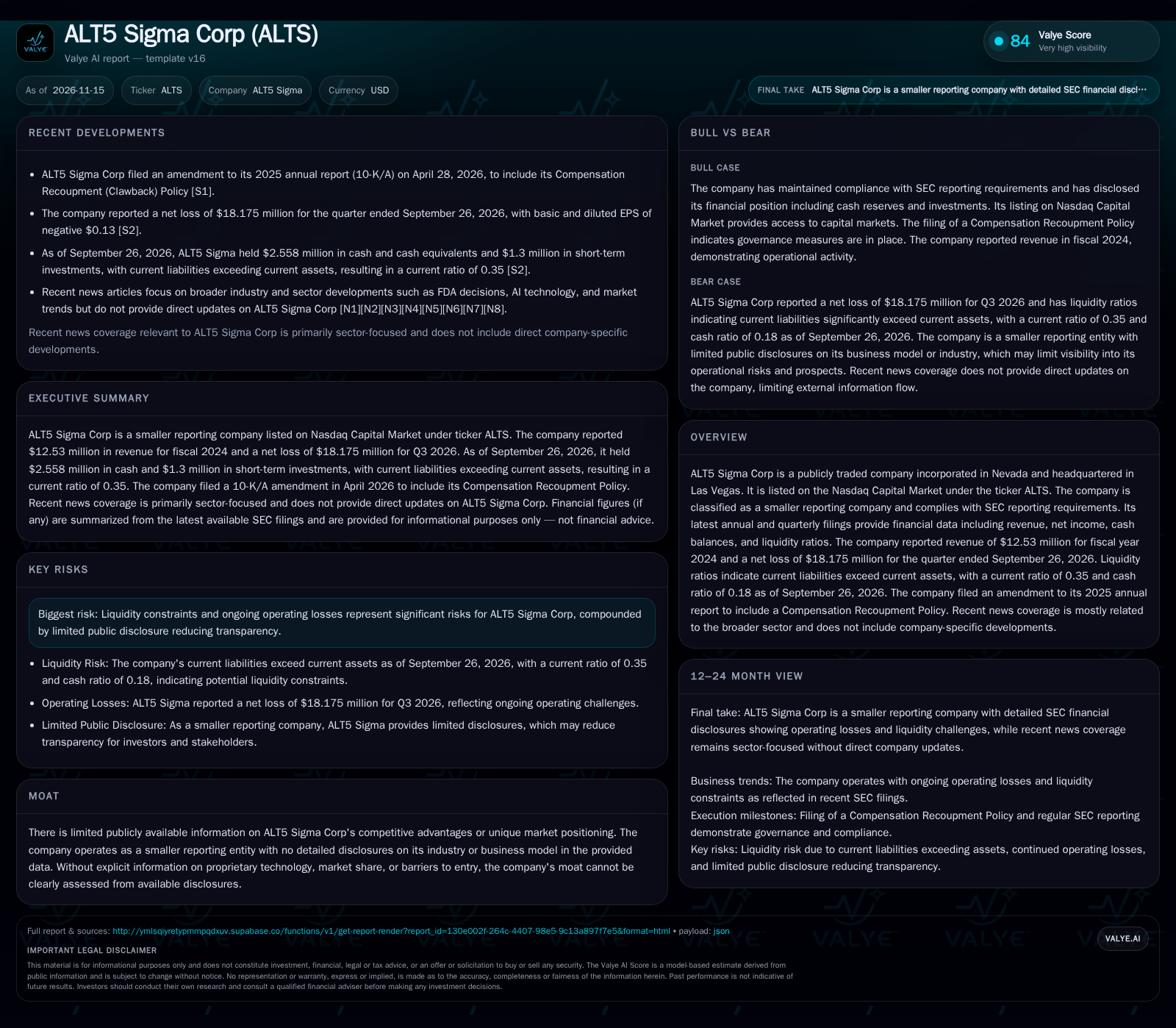
With current liabilities far exceeding assets and minimal cash, its survival depends on decisive business model execution and capital management. Limited disclosure clouds investor visibility, raising the stakes for near-term strategic moves and transparent communication. [S1] [S2]
ALT5 Sigma Corp presents a challenging case for investors seeking visibility and stability. Despite generating $12.53 million in revenue in 2024, the lack of detailed disclosure on business lines, customer base, or competitive positioning leaves major gaps in understanding how or whether ALT5 Sigma can transition to sustainable operations. The next chapters for ALT5 Sigma will be defined by its ability to secure funding, clarify its value proposition, and demonstrate a path out of persistent losses. [S1] [S2]
ALT5 Sigma’s Financial Position: Losses Mount and Liquidity Dries Up
ALT5 Sigma Corp reported a net loss of $18.175 million for the quarter ended September 26, 2026, equating to a negative $0.13 per share. Revenue for fiscal 2024 was $12.53 million, indicating that the company remains operational but is not generating sufficient profit to cover expenses. As of the latest quarter, ALT5 Sigma held $2.558 million in cash and $1.3 million in short-term investments, while current liabilities reached $20.892 million—nearly three times current assets of $7.271 million. The resulting current ratio of 0.35 and cash ratio of 0.18 underscore a severe liquidity crunch. These facts suggest the company is operating under considerable financial strain, raising immediate questions about its ability to meet obligations and fund ongoing operations without new external capital or a rapid turnaround in operating performance. [S2]
Unpacking the Revenue Engine: Unclear Economics and the Stakes of Cash Burn
ALT5 Sigma’s reported revenue of $12.53 million in 2024 suggests the presence of an active commercial operation, but the lack of segment or product detail obscures the underlying economics. If the business is software- or platform-based, gross margins could be high, but the ongoing net losses imply either significant fixed costs, high customer acquisition expenses, or low pricing power. Conversely, if ALT5 Sigma operates in a capital-intensive or hardware-driven segment, working capital needs and gross margin pressure could explain both the negative cash flow and balance sheet stress.
With a current ratio of 0.35 and limited cash, the company likely faces urgent capital needs. Unless it can achieve positive operating leverage by scaling revenue faster than costs, ALT5 Sigma may be forced to seek dilutive equity, expensive debt, or asset sales to bridge the gap. The lack of disclosure on recurring revenue, customer contracts, or cost structure makes it difficult to assess the sustainability of its operations or the efficacy of its economic model. A useful metric would be gross margin trend, customer retention rate, or segment contribution—none of which are currently disclosed.
Competitive Dynamics: Unknown Moat and the Threat of Substitution
ALT5 Sigma’s competitive positioning remains opaque, as no public disclosures clarify its core industry, customer base, or sources of differentiation. As a smaller reporting company, it provides limited insight into whether it holds proprietary technology, unique distribution, or cost advantages. In most sectors, companies with thin liquidity and persistent losses face intense pressure from both direct peers and substitutes—especially if switching costs are low and barriers to entry are minimal.
Potential competitor categories could include fintech, SaaS, or niche hardware, depending on ALT5 Sigma’s actual business line. Without evidence of network effects, intellectual property, or a sticky customer ecosystem, the risk is that larger, better-capitalized rivals or new entrants could quickly erode any existing market share. The absence of recurring revenue disclosures or customer lock-in mechanisms further clouds the company’s ability to withstand competitive threats. If disclosed, customer concentration or retention metrics would help clarify its resilience.
What a Turnaround Would Require: Capital Infusion and a Profitable Model
The most constructive scenario for ALT5 Sigma would involve securing new capital—whether through equity, debt, or strategic partnership—to stabilize liquidity and buy time for operational improvements. If the company can clarify its business model, demonstrate product-market fit, and convert revenue growth into positive cash flow, investor confidence could recover. Key signals would include a successful capital raise, disclosure of high-margin or recurring revenue streams, and evidence that operating losses are narrowing quarter-over-quarter.
Falsification of this scenario would occur if the company fails to secure funding, if losses accelerate, or if customer churn or revenue declines are disclosed. Confirmation would come from improving liquidity ratios, positive operating cash flow, and increased transparency around its business mechanics.
Incremental Progress Amid Financial Pressure: Survival Hinges on Near-Term Moves
The most plausible near-term outlook is that ALT5 Sigma continues to operate under significant financial stress, seeking ways to extend its runway. This could include cost-cutting, asset sales, or small capital raises, but without a clear business model pivot or revenue acceleration, the company is unlikely to achieve profitability soon. Investors may see ongoing operating losses, periodic funding events, and limited disclosure, with survival hinging on management’s ability to negotiate with creditors and maintain Nasdaq listing requirements.
Evidence supporting this scenario would be further amendments to SEC filings, announcements of bridge financings, or incremental operational updates that extend but do not resolve the company’s fundamental challenges. A falsification would be either a dramatic turnaround—such as a strategic acquisition, transformative partnership, or rapid revenue/margin improvement—or a sudden loss of listing status or bankruptcy filing.
Liquidity Shock and the Risk of Forced Restructuring
If ALT5 Sigma is unable to secure additional funding or slow its cash burn, it faces the real possibility of a liquidity crisis. With current liabilities far exceeding current assets and reported cash balance, the company could miss payments to creditors, trigger default provisions, or face delisting from Nasdaq due to financial non-compliance. In this scenario, options could include a distressed asset sale, Chapter 11 filing, or a wind-down of operations.
Confirmation of this risk would come from a rapid increase in accounts payable, disclosure of missed payments, creditor negotiations, or a warning from Nasdaq regarding listing standards. Conversely, any material improvement in cash position or a successful strategic transaction would counter this outcome.
Testing ALT5 Sigma’s Thesis: What Will Reveal the Company’s True Trajectory?
Disclosure of new capital raises, debt agreements, or strategic investments—these moves would directly address liquidity risk and signal management’s access to funding.
Quarterly trends in cash burn and net loss—continued acceleration would heighten insolvency risk, while stabilization or improvement would suggest progress toward sustainability.
Announcement of new or recurring customer contracts, partnerships, or product launches—would indicate demand validation and potential for revenue growth.
Gross margin and cost structure detail, if disclosed—would help assess the scalability of the business and the potential for positive operating leverage.
Changes in Nasdaq listing status or compliance updates—delisting warnings or non-compliance notices would represent acute downside risk.
Amendments to SEC filings or additional governance policies—could signal management’s commitment to transparency or, conversely, scramble to address emerging risks.
Any external news on sector trends or regulatory changes that might impact ALT5 Sigma’s core business—would help contextualize its prospects and competitive pressures.
Disclaimer: This is research-only, informational analysis and not investment advice. It may include AI-generated interpretation and general industry context. Always verify important details using primary sources.

Comments