
Forgent Power Solutions: Manufacturing Expansion, Raw Material Volatility, and the Stakes of Data Center Electrification
Forgent Power Solutions stands at a crucial inflection point as it ramps manufacturing to serve construction and AI-driven data center markets. With solid recent profitability but exposed to raw material and supply chain shocks, its next phase hinges on execution and margin management in a volatile, capital-intensive sector.
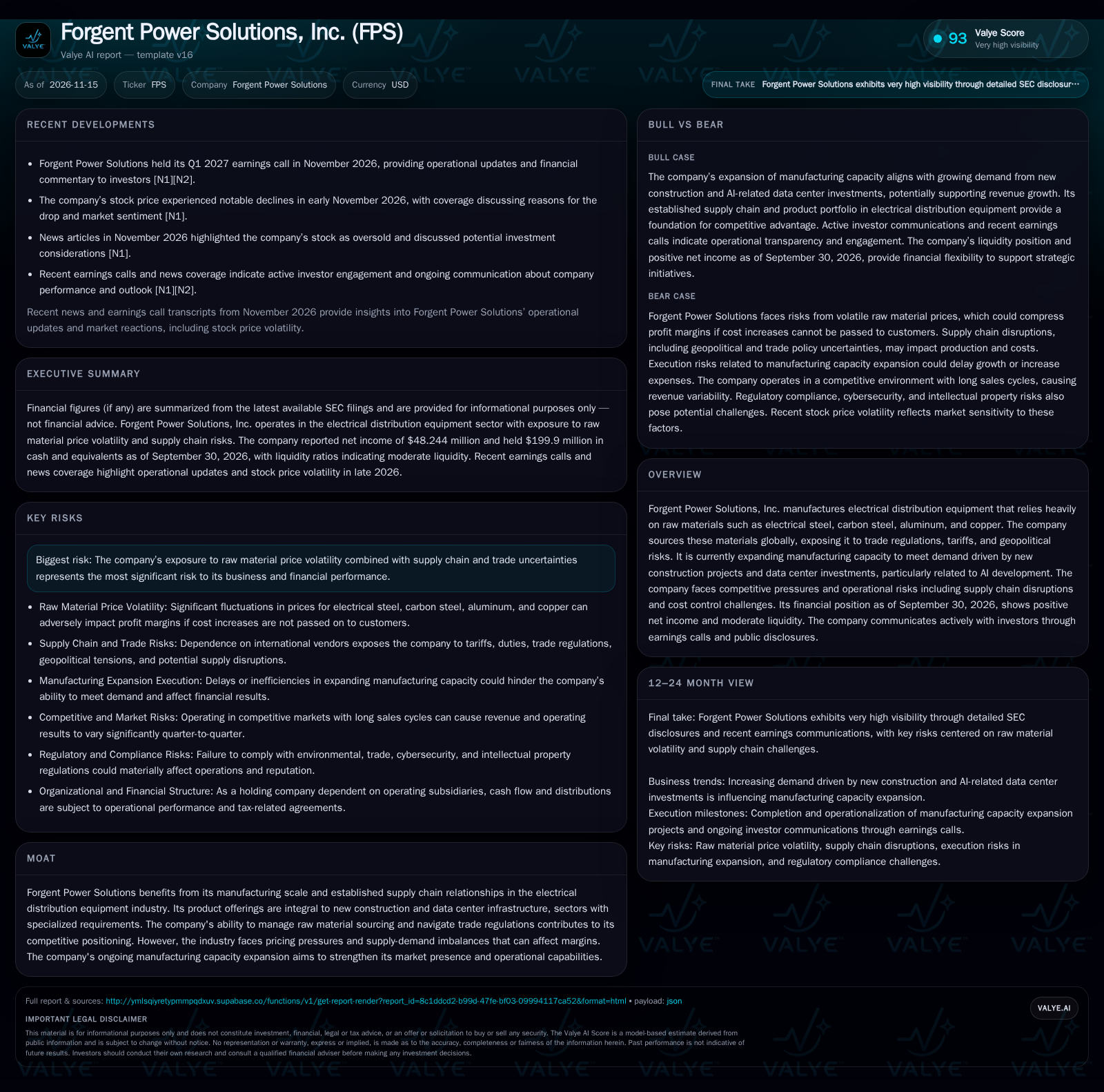
Forgent Power Solutions is expanding manufacturing to capture demand from construction and AI-focused data centers, reporting $48.2M in net income and $199.9M in cash as of September 2026. However, its exposure to raw material price swings, supply chain disruptions, and long sales cycles introduces significant variability and risk. The company's ability to execute its expansion while protecting margins will likely determine its trajectory over the next several quarters. [S1] [S2] [N1] [N2]
Forgent Power Solutions, Inc. is seeking to capitalize on surging demand for electrical distribution equipment, particularly from the rapid buildout of AI-enabled data centers and new construction projects. The company’s recent profitability and manufacturing expansion plans suggest a bid to scale up in a sector experiencing both strong structural demand and severe input cost volatility. Yet with global sourcing of key metals and exposure to tariffs and supply chain risks, Forgent’s next phase will test its ability to balance growth ambitions with margin preservation. Execution on capacity expansion, cost pass-through, and operational discipline will likely determine whether Forgent can convert current momentum into sustainable value creation.
Recent Profitability, Capacity Expansion, and Market Volatility: The State of Play
Forgent Power Solutions reported net income of $48.244 million and held $199.9 million in cash and equivalents as of September 30, 2026, per its latest SEC filings. The company’s liquidity ratios—current ratio of 1.46 and cash ratio of 0.27—indicate reported liquidity position but do not suggest excess balance-sheet strength or distress. Manufacturing capacity expansion is underway, targeting demand from new construction and AI-driven data center projects. However, news headlines in November 2026 highlight notable declines in Forgent’s stock price, reflecting investor concern about operational risks, margin pressures, and execution uncertainties. The company continues to communicate actively with investors through earnings calls and public disclosures. [S1] [S2] [N1] [N2]
How Scale, Input Prices, and Project Cycles Shape Forgent’s Earnings Power
Forgent’s core business generates revenue from manufacturing and selling electrical distribution equipment—a capital- and material-intensive segment. Pricing is often contract-based, with some end customers (such as large construction and data center clients) wielding purchasing power that can compress margins if raw material costs spike. Volume growth is currently linked to secular infrastructure and AI data center trends, but the company’s long sales cycle means that revenue and earnings can swing substantially from quarter to quarter.
Gross margins are highly sensitive to prices for electrical steel, carbon steel, aluminum, and copper. If Forgent can pass cost increases through to customers—typically via contractual price-adjustment clauses or index-linked pricing—margin impact is muted. However, in competitive environments or with rigid contracts, cost spikes may be absorbed by the company, pressuring profitability. Expansion of manufacturing capacity could deliver operating leverage if volumes rise and fixed costs are spread over more units, but missteps in execution or demand shortfalls would undermine this benefit. Capital needs are significant: expanding manufacturing requires upfront investment in plant, equipment, and inventory, which can weigh on cash flow if not carefully managed.
Working capital swings are a persistent feature: the need to hold inventory and manage receivables/payables in a long-cycle project environment introduces cash flow variability, especially during periods of rapid expansion or supply chain disruption.
Industry Pressures, Substitution Risks, and the Role of Supply Chain Resilience
Forgent operates in a highly competitive market for electrical distribution equipment, facing rivals ranging from large, vertically integrated manufacturers to specialized regional players. Product differentiation is often modest, with performance, reliability, and cost being the chief axes of competition. However, the company’s scale in sourcing and manufacturing, as well as its established supply chain relationships, can provide some cost and delivery advantages—assuming supply chain disruptions are managed effectively.
The rise of AI data centers and electrification in construction creates a temporary demand tailwind, but also attracts new entrants and encourages customers to seek alternative suppliers or negotiate aggressively. Substitution risk is relatively low for core equipment, but rapid advances in materials science or distributed energy architectures could alter the long-term demand profile or shift value to integrated solutions providers.
Forgent’s global sourcing strategy introduces both opportunity (cost-effective procurement) and risk (exposure to tariffs, trade policy changes, and geopolitical tensions). The company’s ability to navigate these externalities, maintain timely delivery, and manage input costs will be critical in defending its market position.
Margin Expansion and Market Share Gains if Execution Matches Demand Tailwinds
If Forgent successfully brings new manufacturing capacity online without major delays or cost overruns, it could capture a disproportionate share of new construction and AI data center demand. This would allow fixed costs to be leveraged across higher sales volumes, potentially expanding operating margins. Effective supply chain management—such as hedging raw material costs, securing long-term vendor contracts, or passing input price increases through to customers—would further protect profitability.
A favorable scenario would also see the company’s active investor communications and transparency translating to improved market confidence and a recovery in stock price. Evidence confirming this upside would include: sustained revenue growth outpacing peers, improving gross and operating margins despite commodity price volatility, successful on-time ramp-up of new manufacturing lines, and customer wins or contract extensions in high-growth verticals.
Falsification would be indicated by persistent execution delays, margin compression despite rising revenues, or loss of key accounts to competitors.
Navigating Volatility: Moderate Growth and Margin Pressures in a Cyclical Market
The most plausible trajectory for Forgent over the next 12-24 months is one of steady, albeit uneven, revenue growth driven by secular demand for electrical infrastructure—tempered by ongoing margin pressures from input cost volatility and competitive pricing. Manufacturing expansion proceeds, but with some delays or cost overruns typical of capital projects in this sector. The company is able to pass some, but not all, raw material cost increases through to customers, resulting in stable-to-slightly declining gross margins.
Quarter-to-quarter financial results remain volatile due to the long sales cycle and project-driven revenue recognition. Investor sentiment is mixed, with stock price volatility reflecting uncertainty around execution and the macro environment. Confirmation would come from reported results showing revenue and profit growth in line with industry averages, stable working capital metrics, and no major supply chain or regulatory disruptions.
This scenario would be challenged if there are major project execution failures, sudden loss of major customers, or an external shock (such as a spike in tariffs or a sharp downturn in construction activity).
How Raw Material Spikes and Execution Shortfalls Could Erode Value
A negative cycle could unfold if prices for electrical steel, copper, or aluminum rise suddenly and Forgent is either contractually unable or competitively unwilling to pass these increases through to customers. Margin compression would be severe, especially if coinciding with delays or cost overruns in the manufacturing expansion program. Supply chain disruptions—whether from geopolitical events, trade policy changes, or vendor failures—could further impede timely delivery, resulting in lost orders or penalty payments.
Under this scenario, working capital demands spike, cash flow turns negative, and potential financial flexibility is strained. Investor confidence deteriorates, reflected in further stock price declines and potentially higher cost of capital. Evidence for this downside would include: declining gross margins despite flat or rising revenues, negative operating cash flow, inventory build-ups, missed construction or data center project milestones, and customer attrition.
A partial falsification of this scenario would be rapid recovery in margins and working capital efficiency following a raw material shock, or successful mitigation of supply chain disruptions through alternate sourcing or contractual renegotiation.
Milestones That Will Shape Forgent’s Trajectory in an Uncertain Input Environment
Completion dates and operational ramp-up of new manufacturing capacity—delays or cost overruns would signal execution risk.
Quarterly gross margin trends, especially relative to raw material price movements—a useful metric would be margin resilience during commodity spikes.
Revenue growth attributable to AI data center and new construction sectors—if disclosed, this would clarify demand drivers and market share gains.
Working capital swings, including inventory and receivables levels—a spike could indicate supply chain or customer risk.
Customer retention and new contract wins in core and growth verticals—evidence of competitive positioning.
Updates on supply chain resilience, including alternate sourcing strategies or long-term vendor agreements.
Disclosures on hedging or price-adjustment mechanisms for key raw materials—details here would help test the company’s ability to manage input volatility.
Any regulatory or geopolitical developments affecting trade, tariffs, or environmental compliance—these could materially alter cost structure or market access.
Disclaimer: This is research-only, informational analysis and not investment advice. It may include AI-generated interpretation and general industry context. Always verify important details using primary sources.

Comments