
flyExclusive’s Liquidity Crunch, Legal Uncertainties, and the Economics of Private Jet Charter
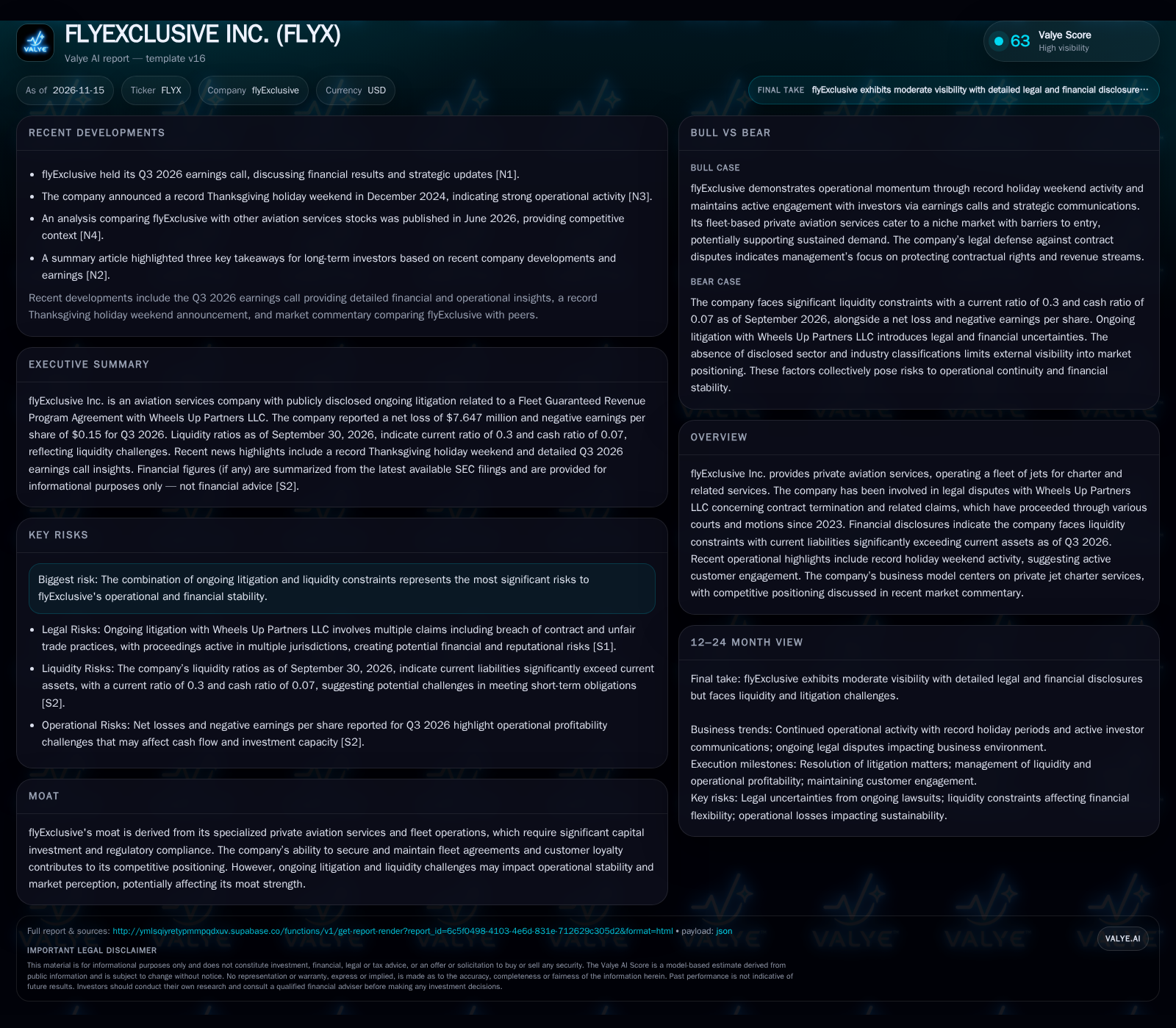
flyExclusive confronts a sharp liquidity squeeze and ongoing litigation just as operational activity signals customer demand. The company’s ability to translate holiday surges into sustainable cash flow—and to weather legal and financial headwinds—will determine whether it can remain a viable player in private aviation.
Ongoing litigation with Wheels Up Partners LLC adds legal uncertainty. While the company saw record operational activity during the 2024 Thanksgiving holiday, the sustainability of such surges is unclear. The viability of its business model now hinges on its ability to secure funding, resolve legal disputes, and maintain customer engagement amid industry competition. [S2] [S1] [N3]
While a record Thanksgiving holiday in 2024 demonstrated that demand for private jet charter remains robust, the company’s Q3 2026 financials point to a widening gap between operational activity and sustainable economics. Ongoing litigation with Wheels Up Partners LLC further clouds visibility. Whether flyExclusive can convert episodic demand spikes into a reliable, profitable business model—while surviving near-term cash pressures and legal risk—will determine its future as a contender in the capital- and credibility-intensive private aviation sector.
Acute Liquidity Pressure and Legal Overhang Define Near-Term Reality
As of September 30, 2026, flyExclusive reported $19.56 million in cash and equivalents against $284.27 million in current liabilities, resulting in a current ratio of 0.3 and a cash ratio of 0.07. These figures indicate that the company’s liquid resources are insufficient to cover short-term obligations, placing it in a precarious financial position. [S2]
The company’s net loss for Q3 2026 was $7.647 million, with negative basic and diluted EPS of $0.15 per share, underscoring ongoing operational losses. [S2]
Ongoing litigation with Wheels Up Partners LLC, centering on a Fleet Guaranteed Revenue Program Agreement, continues to generate legal and financial uncertainty. Multiple motions and filings have been documented through 2025 and 2026, with no resolution yet disclosed. [S1]
Despite these headwinds, flyExclusive reported a record Thanksgiving holiday weekend in late 2024, suggesting continued customer engagement and operational throughput, albeit with unclear implications for recurring profitability or cash flow. [N3]
Fleet-Based Charter Model: High Fixed Costs and Margin Sensitivity
flyExclusive’s business model centers on providing private jet charter services—an industry characterized by high fixed costs (aircraft acquisition/lease, crew, maintenance, insurance) and variable costs (fuel, catering, ground handling). Revenue is typically driven by flight hours sold, membership programs, and on-demand charter bookings.
Pricing power in this market is often constrained by intense competition, customer price sensitivity, and the cyclical nature of discretionary travel spending. While premium service can command higher rates, price wars and empty-leg discounts erode margins, especially for operators lacking scale or unique value propositions.
Operating leverage is significant: incremental revenue from higher asset utilization can flow through to margins, but underutilization quickly exposes the company to losses due to the fixed cost base. In such a model, liquidity is critical both for day-to-day operations and for weathering demand shocks or unexpected legal/maintenance costs.
Capital needs are structurally high. The company reported cash and liquidity metrics for the period; these figures do not by themselves establish operating runway, investment capacity, financial flexibility, or financing capacity. When liquidity is constrained, as is presently the case, fleet upkeep and growth initiatives become harder to sustain, potentially leading to service degradation or reputational risk.
Barriers to Entry Offset by Scale and Brand of Larger Rivals
The private jet charter sector features meaningful barriers to entry: regulatory approvals, capital requirements for fleet, and the need for a credible safety record. flyExclusive’s fleet operations and regulatory compliance are necessary but not sufficient for durable differentiation.
Competitive intensity remains elevated, with peer aviation services providers (including larger integrated operators and tech-enabled charter platforms) leveraging greater scale, broader customer networks, and—often—stronger balance sheets. These players can weather price competition and invest in technology or customer experience enhancements that smaller operators may find difficult to match.
Switching costs for customers are typically low, as loyalty programs and service quality matter but do not lock in high-net-worth clients. The risk is that episodic surges in demand (e.g., holiday periods) are captured by whichever operator has availability and pricing, not necessarily by flyExclusive’s brand or platform.
Legal entanglements, like the ongoing dispute with Wheels Up Partners LLC, may further weaken customer and partner confidence, especially if they signal instability or distract management from operational excellence.
If flyExclusive Converts Demand Spikes into Sustained Cash Flow
A favorable outcome for flyExclusive would involve converting episodic demand surges—such as the record 2024 Thanksgiving period—into higher recurring utilization rates, strengthening customer loyalty, and expanding premium memberships. If the company can do this while managing costs and securing new sources of working capital, operating leverage could allow for rapid margin improvement as fixed fleet costs are amortized over more billable hours.
Settlement or favorable resolution of the Wheels Up litigation would remove a major overhang, freeing management bandwidth and potentially unlocking settlement cash or future business opportunities.
Evidence confirming this scenario would include: a multi-quarter trend of rising flight hours or memberships, improvement in gross and operating margins, fresh capital raised or debt refinanced on favorable terms, and resolution of legal disputes. Announcements of new large customer relationships or innovative membership programs would further support the thesis.
Cash Squeeze Limits Strategic Choices Despite Operational Activity
The most plausible trajectory is that flyExclusive continues to face acute liquidity stress and legal distractions, limiting its ability to invest in fleet, technology, or marketing. Operational activity may remain robust during peak travel windows, but inconsistent utilization and margin pressure persist due to competition and high fixed costs.
The company may be forced to seek external capital—potentially on unfavorable terms—or to restructure operations, divest assets, or renegotiate contracts to survive. Operational losses continue, though periodic demand spikes provide temporary relief.
Confirmation would come from continued negative net income, persistent low liquidity ratios, and ongoing legal disclosures without resolution. If the company maintains customer engagement but fails to show improvement in cash flow or asset efficiency, the base scenario remains intact. Any delays in litigation or inability to secure new financing would reinforce the view.
Legal and Financial Pressures Trigger Operational Retrenchment
In a negative scenario, the convergence of legal liabilities (from an adverse litigation outcome or settlement costs) and ongoing cash burn could force flyExclusive into severe operational retrenchment or even bankruptcy protection. Asset sales, drastic cost cuts, or fleet reductions would likely follow, further eroding customer confidence and market presence.
Reputational damage from legal disputes or service interruptions could accelerate customer churn and make it difficult to attract new business or partners. Inability to access new capital or refinance existing obligations would make a going-concern warning or creditor intervention plausible.
Evidence confirming this downside includes: public disclosure of covenant breaches, auditor going-concern warnings, material asset sales, drastic headcount or fleet reductions, or court-mandated outcomes from the Wheels Up litigation. A sharp drop in operational activity or loss of key customers would be further red flags.
Benchmarks for Testing flyExclusive’s Resilience and Turnaround Prospects
Quarterly trends in fleet utilization rates and total billable flight hours—if disclosed—would signal whether operational momentum is translating into better asset efficiency.
Gross and operating margin progression, especially during both peak and off-peak periods, would help assess whether the company is capturing sustainable economics or relying on one-off demand spikes.
Resolution status and disclosed financial terms of the Wheels Up Partners LLC litigation: a clear settlement or dismissal would materially affect risk and flexibility.
Updates on capital-raising, refinancing, or new credit facilities would clarify how the company plans to address its liquidity gap.
Any notable asset sales, fleet reductions, or operational restructuring moves would signal the degree of financial distress or strategic pivot.
Customer retention rates, membership renewals, or new large client wins—if disclosed—would indicate whether the company’s value proposition is resonating in a competitive market.
Management commentary on strategic priorities, cost control, and legal risk mitigation during earnings calls or filings would provide insight into real-time decision-making and adaptability.
Disclaimer: This is research-only, informational analysis and not investment advice. It may include AI-generated interpretation and general industry context. Always verify important details using primary sources.

Comments