
Mobility Global Inc.: Leading Automotive Data with Subscription Innovation and Platform Growth Potential
Mobility Global Inc. (MBGL) leverages its CARFAX consumer brand and B2B automotive data platforms to serve a spectrum of OEM, dealer, and insurance clients.
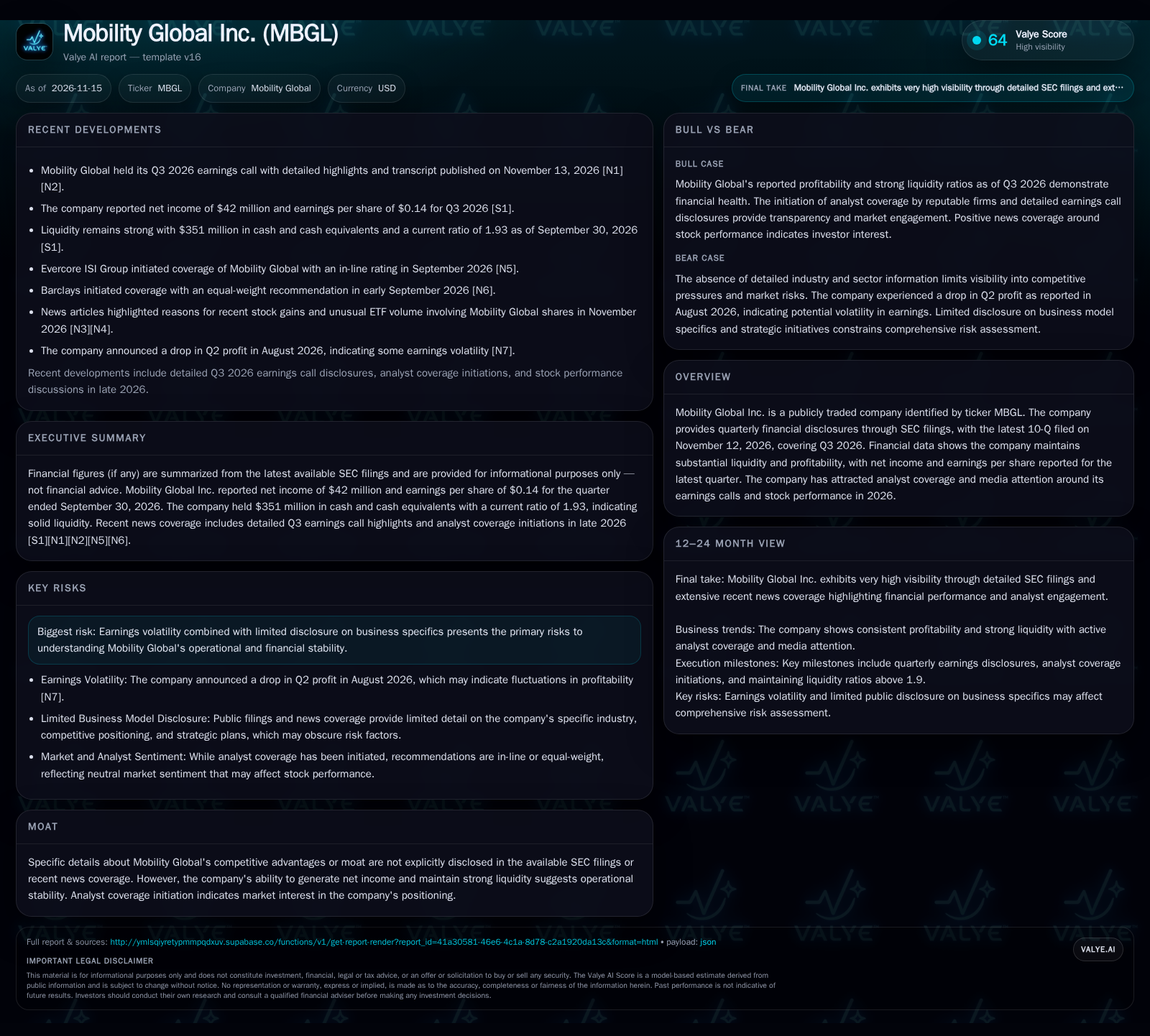
Mobility Global Inc. reported Q3 2026 net income of $42 million and maintains a reported cash position. Its business spans the CARFAX consumer vehicle-history platform and B2B subscription analytics for OEMs, suppliers, and dealers. The company’s growth hinges on expanding its product suite, deepening customer integration, and navigating rising customer-acquisition costs and competitive pressures.
Mobility Global Inc. stands at the intersection of automotive data, digital consumer engagement, and enterprise analytics. With a foundation built on the CARFAX brand and a B2B suite serving global OEMs, suppliers, and dealers, the company has demonstrated ongoing profitability and reported liquidity position as of Q3 2026. However, as vehicle complexity rises and competition intensifies, Mobility Global’s ability to sustain growth will depend on deepening its integration into customer workflows, expanding its product suite, and managing the rising costs of brand and customer acquisition.
Q3 2026 Results Confirm Strong Profitability, Liquidity, and Market Presence
Mobility Global Inc. reported net income of $42 million for Q3 2026, with both basic and diluted earnings per share at $0.14 [S1]. As of September 30, 2026, the company held $351 million in cash and cash equivalents, alongside a current ratio of 1.93 and a cash ratio of 1.09, indicating a reported liquidity position [S1]. These financials reflect operational profitability and balance sheet strength. The company also attracted analyst attention, with Evercore ISI Group and Barclays initiating coverage in September 2026 at in-line and equal-weight ratings, respectively [N5] [N6]. Recent news coverage has highlighted both stock performance and unusual ETF volume activity, suggesting heightened investor interest [N3].
Monetization Strategies for Automotive Data and Insights Across the Value Chain
Mobility Global’s economics are grounded in two primary business segments: CARFAX and B2B data/analytics. The CARFAX segment generates revenue primarily through dealer subscription products (such as Advantage, Car Listings, and CARFAX For Life), with key levers being the number of enrolled dealer locations, average monthly price per location, and the monetization of banking and insurance group (BIG) customers [S1]. For consumers, CARFAX’s brand strength drives direct engagement, which in turn supports pricing power and retention among dealer customers. The B2B segment provides subscription-based sales and planning tools to OEMs, dealer groups, and suppliers, with revenue largely recurring but also featuring selective transactional elements (e.g., campaign execution, VIN pulls) [S1].
Both segments benefit from operating leverage, as incremental customers and data products can be delivered at relatively low marginal cost once core data assets and platforms are established. However, fixed costs—particularly in data acquisition, technology infrastructure, and brand investment—remain substantial. The company must continually invest in proprietary data and technology delivery, especially as vehicle complexity rises with EV, AV, and software-defined vehicle (SDV) trends. Rising digital advertising costs are increasing customer-acquisition expenses for CARFAX, potentially pressuring margins if not offset by higher pricing or greater retention.
Capital needs are moderate for a data-centric business, but ongoing technology and data investments are essential to maintain differentiation and customer relevance. The company reported cash and liquidity metrics for the period; these figures do not by themselves establish operating runway, investment capacity, financial flexibility, or financing capacity. [S1]
Balancing Brand Authority and Data Depth Amid Intensifying Rivalry and Alternatives
Mobility Global’s competitive position relies on a combination of brand recognition (notably CARFAX), proprietary data assets, and integration into customer workflows. CARFAX is a premier consumer brand, widely trusted for vehicle history and valuation information, which underpins dealer and consumer loyalty. In the B2B segment, Mobility Global differentiates through its unique data estate—combining registration, ownership, pricing, VIN specs, and global forecast data—and its ability to embed analytics into OEM and supplier decision processes [S1].
Key counterforces include intensifying competition from both established data/analytics providers and new entrants leveraging alternative data sources or advanced AI/ML techniques. The rise of Chinese OEMs in global markets increases the complexity and urgency for Western automotive players to access real-time, comprehensive data, which could boost demand for Mobility Global’s offerings but also expose the company to new competitors and regulatory complexities. Substitution risk is present if OEMs or dealers shift to alternative platforms, develop in-house analytics, or if new forms of vehicle data (enabled by connected cars and direct telematics) disrupt traditional data aggregation models.
Switching frictions for enterprise customers may be moderate to high due to workflow integration and data continuity needs, but price competition and new technology could erode these barriers over time.
Potential Gains from Expanded Products and Enhanced Customer Integration
A favorable scenario for Mobility Global involves successful expansion of its product suite—both in CARFAX and B2B—resulting in higher wallet share from existing customers and penetration of new customer segments, including EV, SDV, and emerging-market OEMs. Enhanced brand investment could further increase consumer leads for dealers, reinforcing the value of dealer subscriptions and supporting pricing power. On the B2B side, deeper integration of analytics into OEM and supplier workflows could drive higher retention and enable upselling of premium or adjacent data products.
This virtuous cycle would be confirmed by accelerating growth in dealer subscription revenue, rising average revenue per dealer, expanding B2B customer counts, and increasing contribution from new product launches. Evidence of geographic expansion, particularly successful entry into Canada and Europe with local product-market fit, would further validate the upside. Sustained or rising operating margins despite higher brand investment would suggest effective operating leverage and strong competitive differentiation.
Recurring Revenue Growth and Margin Challenges Amid Acquisition Cost Pressures
The most plausible middle path for Mobility Global is continued steady growth in both the CARFAX and B2B segments, driven by incremental dealer and OEM customer adds, modest pricing increases, and ongoing product enhancements. Recurring revenue remains the dominant model, with high retention but some offset from rising customer-acquisition costs, especially in paid digital channels for CARFAX. Operating margins remain stable, reflecting operating leverage but tempered by the need for ongoing investment in brand and technology.
This scenario would be confirmed by consistent quarterly revenue and net income growth, stable or slightly improving EBITDA margins, and evidence that price increases or new products are offsetting higher customer-acquisition costs. Analyst coverage remains neutral unless a step-change in growth or margin trajectory is observed.
Risks of Margin Decline, Customer Loss, and Platform Disintermediation
A negative scenario could unfold if rising digital advertising costs materially outpace Mobility Global’s ability to raise prices or retain customers, leading to margin compression in the CARFAX business. Increased competitive intensity—either from alternative data providers, direct OEM/telematics solutions, or disruptive AI-powered platforms—could accelerate customer churn, particularly among dealer and B2B clients. If new product launches fail to gain traction or if regulatory/geopolitical shifts limit expansion into new markets, revenue growth could stagnate.
This scenario would be confirmed by declining dealer or OEM customer counts, falling average revenue per customer, shrinking operating margins, and slower adoption or revenue contribution from new products. Negative revisions from analyst coverage or adverse news highlighting customer losses would further support the downside case.
Factors Influencing Mobility Global’s Competitive Edge and Financial Outcomes
Quarterly dealer subscription counts and average revenue per dealer location, if disclosed, to assess the health and momentum of the CARFAX segment.
B2B customer retention rates and net new customer adds, which would illuminate the stickiness and expansion potential of enterprise analytics offerings.
Trends in customer-acquisition costs—especially digital advertising spend as a percentage of revenue—to evaluate the impact on CARFAX margins.
Product launch cadence and revenue contribution from new products or adjacent market entries, as evidence of innovation and addressable market expansion.
Geographic revenue breakdowns and international customer adoption, particularly in Canada, Europe, and emerging EV/SDV markets.
Margin trajectory (gross and operating), particularly in the face of rising brand and technology investment requirements.
Disclosures or commentary on competitive dynamics, customer wins/losses, or regulatory changes affecting global data flows in the automotive sector.
Disclaimer: This is research-only, informational analysis and not investment advice. It may include AI-generated interpretation and general industry context. Always verify important details using primary sources.

Comments