
Falcon’s Beyond Global: Growth in Experiential Entertainment Meets the Realities of Liquidity Constraints and Technological Ambition
Falcon’s Beyond Global is expanding its footprint in the experiential entertainment sector, driven by new attraction contracts, strategic acquisitions, and technology integration.
Falcon’s Beyond Global has doubled revenue in the last year through new attraction contracts and acquisitions, while also integrating AI into its offerings. The thesis hinges on Falcon’s ability to convert its growth pipeline into sustained profitability before financial constraints force retrenchment or restructuring.
Falcon’s Beyond Global, Inc. is positioning itself as a modern leader in the experiential entertainment and attractions industry, showcasing sharp revenue growth and technology-forward ambitions. The company’s recent financials highlight a doubling of revenue on the back of new contracts and acquisitions, alongside a high-profile push into AI-enabled services. The core strategic question is whether the company’s expansion and innovation can translate into sustainable profitability before liquidity pressures or operational setbacks force a strategic reset.
Liquidity Squeeze, Growth Momentum, and Strategic Shifts
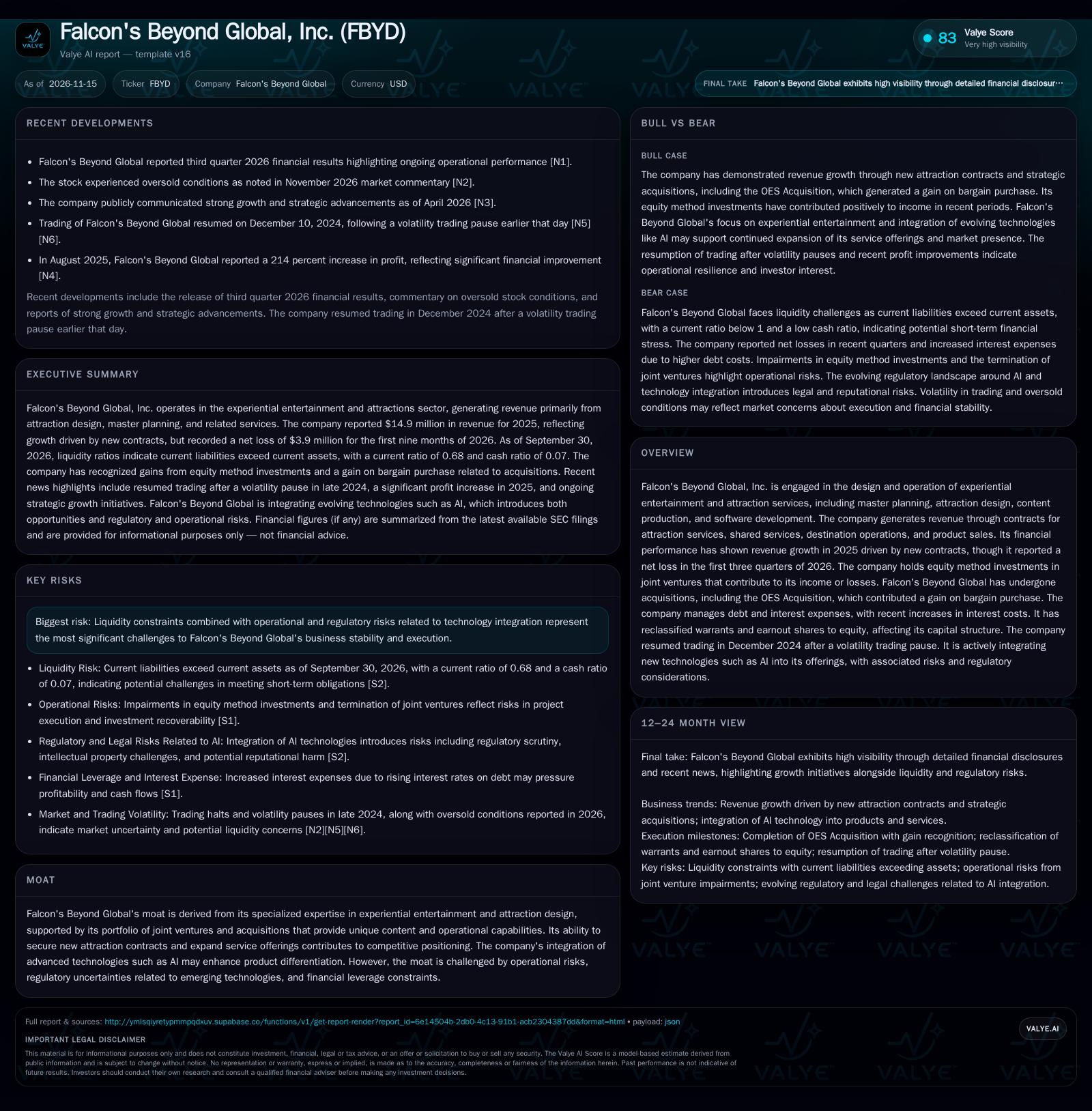
Falcon’s Beyond Global reported $14.9 million in revenue for 2025, up from $6.7 million in 2024, underscoring the impact of new attraction contracts and the OES Acquisition [S1]. The company’s net loss for the first nine months of 2026 was $3.9 million, with negative EPS, indicating that profitability remains elusive [S2]. [S2] The financial structure has been further complicated by increased interest expenses and the reclassification of warrants and earnout shares to equity, reflecting ongoing capital structure evolution [S1].
The interplay between growth momentum and liquidity constraints creates a dynamic tension that shapes Falcon’s strategic decision-making. While new contracts and acquisitions fuel top-line expansion, the timing of cash inflows relative to the outflows for project development and operational expenses is critical. Delays in milestone payments or unexpected cost overruns can quickly erode liquidity buffers, forcing management to prioritize short-term cash management over longer-term innovation or market expansion.
How Falcon’s Makes—and Could Lose—Money in Experiential Entertainment
Falcon’s Beyond Global’s revenue model is anchored in contracts for master planning, attraction design, destination operations, and content production, with revenue recognized both over time and at point of delivery [S1]. The economics of these projects typically involve high upfront design and production costs, with potential for recurring service revenue if Falcon’s retains operational responsibilities or shares in downstream economics (e.g., ticketing, merchandising, or licensing). However, when projects are one-off or milestone-based, revenue can be lumpy and margin visibility is limited.
The company also generates income (or losses) from equity method investments in joint ventures, which contributed a $17 million gain in 2025 but have historically been volatile, with impairments and write-downs [S1]. Operating leverage is plausible if Falcon’s can scale its destination and attraction services pipeline, but the business is exposed to high fixed costs (payroll, professional fees, occupancy) that increased in 2025 to support growth [S1]. The integration of AI and technology could create new software or platform revenue streams, but commercial mechanics—such as whether these are subscription-based, licensing, or bundled with physical experiences—are not fully disclosed. Capital intensity remains high, and the company’s low liquidity ratios suggest a need for external financing or rapid conversion of contracts into cash to avoid operational stress.
The revenue recognition model’s dependence on milestone achievements introduces volatility that complicates financial forecasting and resource allocation. If Falcon’s can successfully negotiate contracts with more predictable, recurring revenue components—such as ongoing operational services or licensing fees—it could smooth revenue streams and improve margin visibility. However, this shift requires building client relationships that extend beyond project delivery into long-term partnerships, which may demand upfront investments in service infrastructure and support capabilities. Additionally, the integration of AI-driven offerings could transform the cost structure by enabling scale through software platforms, yet the initial R&D and regulatory compliance costs could offset near-term margin improvements, especially if monetization models remain unproven.
Specialization, Technology, and the Limits of Differentiation
Falcon’s Beyond Global competes in a fragmented experiential entertainment market, where barriers to entry are moderate but differentiation hinges on creative expertise, proprietary content, and the ability to deliver turnkey attraction solutions. The company’s moat is rooted in its specialized knowledge of attraction design and master planning, bolstered by its portfolio of joint ventures and acquisitions [S1]. Integration of AI and interactive technologies may enhance product differentiation, allowing Falcon’s to pitch more immersive or personalized experiences.
However, larger established players, nimble boutique design firms, and in-house teams at destination operators all represent competitive threats. The company’s financial constraints could hinder its ability to out-invest peers in technology, marketing, or business development. Furthermore, as AI and digital experiences become table stakes in the industry, any early-mover advantage may erode unless Falcon’s can demonstrate superior execution or unique IP. Regulatory and reputational risks tied to AI adoption add another layer of competitive uncertainty.
In a market where creative differentiation is essential, Falcon’s ability to leverage proprietary AI applications could be a double-edged sword. While these technologies may provide enhanced customer engagement and operational efficiencies, they also require continuous innovation to stay ahead of competitors who can rapidly adopt similar tools. The company’s moderate barriers to entry imply that competitors can replicate core offerings, making sustained differentiation reliant on unique intellectual property, deep client relationships, and execution excellence. Moreover, the regulatory environment surrounding AI introduces compliance costs and potential liabilities, which could disproportionately impact smaller players with limited legal and financial resources, thereby influencing competitive dynamics and investment priorities.
If Contract Wins, AI Integration, and JV Upside Converge
A favorable outcome for Falcon’s would see its pipeline of attraction contracts converting into multi-year, high-margin engagements, with project execution driving repeat business and referrals. If the company’s AI-enabled offerings succeed in commanding premium pricing or recurring software revenues, Falcon’s could shift from lumpy, project-based income toward a more predictable, scalable model. Additional upside could come from equity method investments: if joint ventures mature without further impairments, they may deliver both cash flow and strategic value, as seen with the $17 million gain in 2025 [S1]. Confirmation would come from sustained revenue growth, a shift to positive operating cash flow, and disclosure of recurring or multi-year contracts for new AI-driven solutions.
Balancing Growth Ambitions with Financial Constraints
The most plausible path is that Falcon’s continues to grow revenue through new contracts and technology-driven expansion, but faces persistent margin and liquidity pressure. The company will likely need to prioritize projects with faster payback or negotiate more favorable payment terms to reduce working capital strain. Joint ventures may contribute intermittent gains, but also carry risk of impairment and unpredictability.
Operating costs are likely to remain elevated as the company invests in talent and technology to support its pipeline. If external funding is required to bridge liquidity gaps, dilution or higher interest costs could further pressure equity holders. This scenario would be confirmed by moderate revenue growth, continued net losses or marginal profitability, and ongoing working capital stress, as evidenced by low current and cash ratios.
Liquidity Crunch and Project Setbacks Force a Strategic Reset
In an adverse scenario, Falcon’s fails to convert its project pipeline into timely cash flow, while cost overruns, delayed customer payments, or project cancellations exacerbate liquidity stress. The low cash and current ratios as of September 30, 2026, suggest limited margin for error [S2]. If equity method investments produce further impairments or joint ventures are terminated, non-operating gains could turn negative, deepening losses.
Regulatory delays or reputational harm from AI integration could slow adoption or result in costly litigation. Should Falcon’s be unable to secure additional financing or renegotiate terms with creditors and vendors, forced retrenchment—such as asset sales, JV exits, or even restructuring—becomes increasingly likely. Evidence would include further deterioration in liquidity metrics, missed project milestones, and negative disclosures around JV performance or regulatory investigations.
Milestones That Will Determine If Falcon’s Growth Outruns Its Constraints
Net operating cash flow: Whether Falcon’s can turn positive cash flow from operations, reducing reliance on external financing.
Contract conversion and backlog: Disclosure of multi-year or recurring contracts, and the pace at which the project pipeline is converted to revenue and cash.
Liquidity ratios: Quarterly updates on the current and cash ratios, especially if they improve or deteriorate from 0.68 and 0.07, respectively.
Equity method investment outcomes: Gains or losses from joint ventures, and whether impairments or exits occur.
AI-enabled product performance: Evidence of customer adoption, pricing power, or regulatory setbacks tied to new technology offerings.
Interest expense trajectory: The impact of debt costs on profitability and whether interest expense stabilizes or continues to rise.
Cost discipline: SG&A and payroll trends relative to revenue growth, as further increases could undermine operating leverage.
External financing events: Any new debt, equity raises, or asset sales, and their terms, as these will indicate the company's ability to manage liquidity under stress.
Disclaimer: This is research-only, informational analysis and not investment advice. It may include AI-generated interpretation and general industry context. Always verify important details using primary sources.

Comments