
Theriva Biologics: The Stakes of a Focused Bet on Oncolytic Viruses in Pancreatic Cancer
Theriva Biologics has streamlined its pipeline and strategy around VCN-01, its oncolytic virus candidate for metastatic pancreatic cancer, achieving key clinical and regulatory milestones but facing a short runway and urgent need for capital. Success hinges on clinical validation and the company’s ability to secure funding before early 2027.
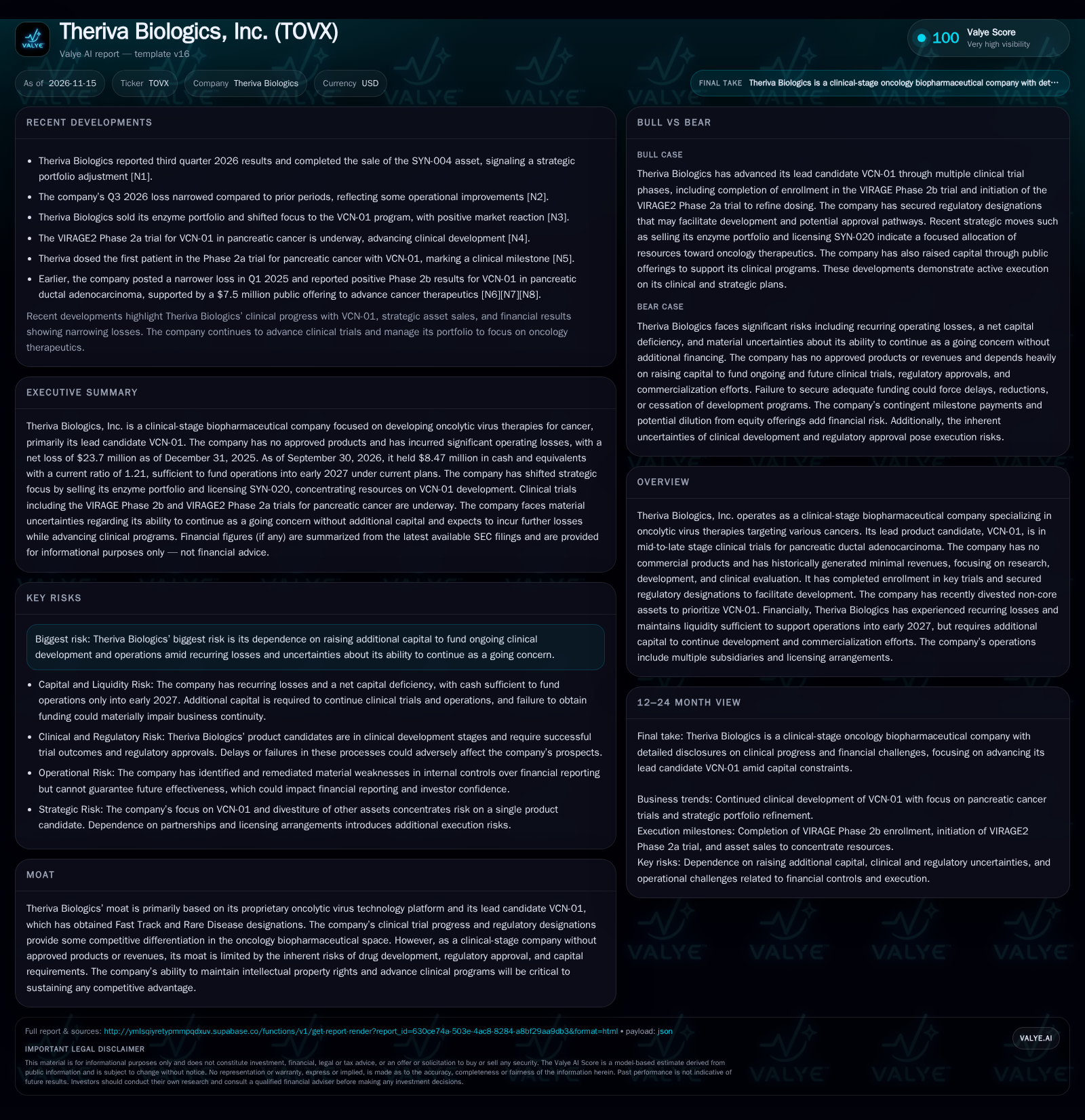
Theriva Biologics has sold non-core assets and concentrated resources on advancing VCN-01 for pancreatic cancer, completing major trial enrollments and securing regulatory designations. [S2] [N1] [N3] [N4]
Theriva Biologics stands at a critical crossroads after a year of strategic refocusing and measured clinical progress. The company has divested non-core assets and streamlined its pipeline to concentrate on VCN-01, an oncolytic virus candidate targeting metastatic pancreatic cancer—a notoriously difficult indication. While regulatory designations and trial milestones offer a potential fast track, the company faces a narrowing cash runway and heightened single-asset risk. The next 12 months will test whether Theriva can convert scientific promise into clinical proof and secure the capital necessary for survival and growth. [S2] [N3] [N4]
Theriva’s Strategic Pivot: Clinical Progress and Financial Constraints
Theriva Biologics has executed a decisive shift in strategy, selling its enzyme portfolio and licensing out SYN-020 to focus resources on VCN-01, its lead oncolytic virus candidate for metastatic pancreatic cancer. This streamlining has been accompanied by concrete progress: the company completed enrollment in the pivotal VIRAGE Phase 2b trial and initiated the VIRAGE2 Phase 2a dosing study, with the first patient dosed in the latter. VCN-01 has also received Fast Track and Rare Disease designations, potentially expediting regulatory review. Material uncertainties about the company’s ability to continue as a going concern without new capital persist, compounded by contingent acquisition milestone liabilities. [S2] [N1] [N3] [N4] [N5]
How the Economics of Oncolytic Virus Development Shape Theriva’s Prospects
Theriva’s business model is typical of clinical-stage biotech: heavy upfront R&D and trial costs, no commercial revenue, and reliance on external capital. With the entire pipeline now effectively centered on VCN-01, the company’s economics are binary: success in clinical trials could unlock high-margin oncology revenues if VCN-01 reaches approval, but failure would leave Theriva with little fallback. Oncolytic virus therapies, if effective, could command premium pricing in metastatic pancreatic cancer due to high unmet need and lack of alternatives, but market access would depend on demonstrating a meaningful survival benefit and safety profile.
Fixed costs remain significant, driven by clinical operations and regulatory overhead, while variable costs may escalate if Theriva moves into later-stage trials or eventual commercialization. The current $8.47 million cash position is insufficient for Phase 3 trials or launch, implying a need for substantial further capital—likely through dilutive equity, partnerships, or licensing. The company also faces up to $70.2 million in contingent acquisition milestone payments, which, if triggered, would further increase capital requirements. [S2]
Operating leverage could be substantial if VCN-01 succeeds, as incremental sales in oncology often require modest additional costs after approval. However, absent diversification, the company’s economics are highly sensitive to trial outcomes and financing terms.
Competitive Landscape and the Challenges to Differentiation
Theriva competes in a crowded and high-risk segment: innovative oncology therapeutics for hard-to-treat solid tumors. Its proprietary oncolytic virus platform and VCN-01’s regulatory designations offer some differentiation, but the clinical landscape includes established and emerging players developing both oncolytic viruses and alternative immunotherapies for pancreatic cancer. Key competitive factors include clinical efficacy, safety, duration of response, and the ability to combine with standard of care or other novel agents.
Barriers to entry in oncolytic virotherapy are significant due to manufacturing complexity, regulatory scrutiny, and the need for robust intellectual property. However, switching costs for oncologists and payers are low unless a therapy demonstrates clear superiority. Theriva’s moat is thus conditional: if VCN-01 demonstrates strong efficacy and safety in pivotal studies, it could carve out a defensible niche; if not, the company risks being outcompeted by other modalities or more advanced candidates. The single-asset focus magnifies competitive vulnerability, as there is no pipeline depth to absorb setbacks.
What Success Would Look Like: Clinical Validation and Strategic Capital Infusion
The most favorable outcome for Theriva would be positive and clinically meaningful results from the ongoing VIRAGE2 Phase 2a and previously completed Phase 2b trials, supporting advancement to a pivotal Phase 3 study. If VCN-01 demonstrates improved survival or response rates in metastatic pancreatic cancer, this could attract licensing partners, non-dilutive funding, or even acquisition interest from larger oncology players.
Confirmation of this scenario would come from robust, peer-reviewed clinical data showing statistically significant and clinically relevant benefits. In parallel, successful capital raises—via equity, partnerships, or grants—extending the cash runway well beyond 2027 would be necessary. Regulatory milestones, such as Breakthrough Therapy designation or fast-tracked Phase 3 planning, would further support the upside case. Commercial terms for any partnership should ideally be non-restrictive and provide Theriva with both upfront and downstream economics.
Falsification would come from negative or equivocal clinical data, delays in trial enrollment, or inability to raise sufficient capital on favorable terms.
Most Likely Near-Term Outcome: Incremental Progress, Persistent Uncertainty
The most plausible scenario for Theriva over the next 12-18 months is continued advancement of VCN-01 through mid-stage clinical development, with incremental clinical updates and ongoing efforts to secure financing. The company may achieve additional operational improvements, further narrowing losses as non-core assets are offloaded and cost structure is streamlined.
Evidence confirming this scenario would include timely clinical trial milestones, successful patient enrollment, manageable operating losses, and completion of modest capital raises that extend operations into late 2027 or beyond. A lack of transformative clinical data or partnership announcements would keep the company in a holding pattern, with value largely tied to the binary outcome of VCN-01’s pivotal trials.
A deviation from this path—such as a failed trial, inability to secure capital, or adverse regulatory events—would shift Theriva into the downside scenario.
The Consequences of Clinical or Financial Setbacks
The primary risk facing Theriva is that VCN-01 fails to demonstrate sufficient efficacy or safety to justify further development, or that clinical progress is delayed beyond the available cash runway. In this situation, the company may be forced to suspend trials, delay regulatory filings, or undertake a strategic review that could include asset sales, restructuring, or liquidation.
Confirmation of the downside would come from negative clinical readouts, missed enrollment or regulatory milestones, or public disclosures indicating difficulties in raising additional capital. Triggering of contingent milestone liabilities without offsetting inflows could accelerate cash depletion. Under such stress, existing shareholders could face significant dilution, debt financing on unfavorable terms, or loss of equity value in a restructuring scenario.
A partial mitigation would be the ability to out-license VCN-01 or other residual assets, but the value realized in a distressed context would likely be limited.
Concrete Milestones That Will Shape Theriva’s Trajectory
Progress and data readouts from the VIRAGE2 Phase 2a trial of VCN-01 in pancreatic cancer—timing, enrollment pace, and efficacy signals, if disclosed.
Updates on the regulatory path for VCN-01, including any new designations, feedback from the FDA or EMA, or initiation of Phase 3 planning.
Quarterly cash burn and remaining runway, as reported in future financial statements.
Announcements of equity offerings, partnerships, or non-dilutive funding that extend operational runway beyond early 2027.
Disclosure of any contingent milestone payments triggered or deferred, and their impact on liquidity.
Remediation progress and future assessments of internal controls over financial reporting.
Asset sale proceeds and any new out-licensing or collaboration agreements for non-core or legacy assets, if applicable.
Changes in operating loss trajectory as the company further streamlines or scales up clinical operations.
Disclaimer: This is research-only, informational analysis and not investment advice. It may include AI-generated interpretation and general industry context. Always verify important details using primary sources.

Comments