
Vivani Medical’s NanoPortal Ambitions: Clinical Progress, Financing Imperatives, and the Path to Commercialization
Vivani Medical advances proprietary subdermal drug implants with positive Phase 1 data and a Novo Nordisk collaboration, but persistent operating losses, lack of commercial revenue, and the need for substantial further funding keep the company in a high-risk, high-reward phase.
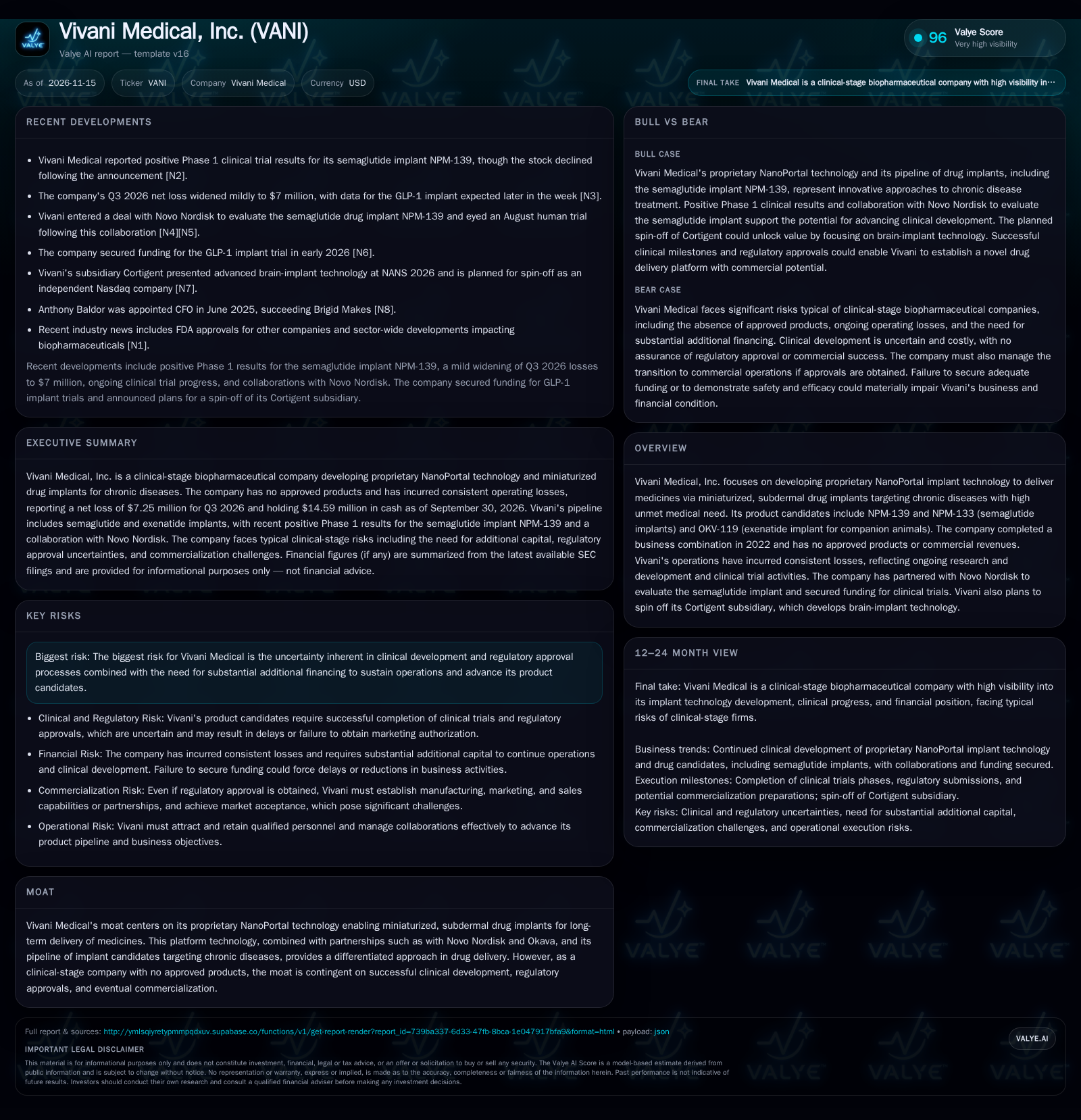
Vivani Medical reported positive Phase 1 results for its semaglutide implant NPM-139 and is collaborating with Novo Nordisk, but with no approved products and ongoing operating losses, its future depends on further clinical success, regulatory approvals, and access to capital. The planned Cortigent spin-off and companion animal pipeline offer additional optionality, but the core thesis remains tightly linked to clinical and funding milestones. [S2] [N2] [N4] [N5]
Vivani Medical sits at a familiar inflection point for clinical-stage biopharmaceutical firms: promising technology, positive early clinical data, and high-profile partnerships balanced against a lack of commercialized products and pressing funding needs. The company’s NanoPortal implant platform, highlighted by recent Phase 1 trial results for its semaglutide candidate NPM-139 and a collaboration with Novo Nordisk, has the potential to disrupt chronic disease management by enabling long-term subdermal drug delivery. The planned spin-off of Cortigent and a pipeline extension into veterinary medicine add further strategic complexity and optionality, underscoring the multifaceted but high-risk nature of the investment proposition. [S2] [N2] [N3] [N4] [N5] [N7]
Recent Clinical Results, Novo Nordisk Collaboration, and Funding Status Shape Vivani’s Outlook
Vivani Medical reported positive Phase 1 results for its lead candidate, semaglutide implant NPM-139, marking a key clinical milestone for its NanoPortal platform. Despite the data, the stock declined, reflecting market skepticism about the path to commercialization and near-term dilution or funding risk. The company reported cash and liquidity metrics for the period; these figures do not by themselves establish operating runway, investment capacity, financial flexibility, or financing capacity. A collaboration with Novo Nordisk to evaluate the semaglutide implant lends external validation and potential future partnership leverage but does not guarantee downstream revenue or commercial rights. Additionally, Vivani is planning to spin off its Cortigent subsidiary, focused on brain-implant technology, which could unlock value or reduce corporate cash burn depending on execution and market conditions. [S2] [N2] [N3] [N4] [N5] [N7]
Implant Economics: Long-Term Delivery, Reimbursement, and the Funding Imperative
Vivani’s core business model envisions revenue from proprietary subdermal drug implants, targeting chronic diseases where sustained drug delivery offers clinical and adherence advantages. If approved, products like the semaglutide implant could command premium pricing relative to oral or injectable therapies by delivering year-long efficacy and reducing patient burden. Margins in implantable therapeutics can be attractive if volume scales, given high fixed R&D and regulatory costs but relatively low variable manufacturing cost per unit post-approval. However, current operations are entirely expense-driven: Vivani has no product revenue and reported a net loss of $20.4 million for the first nine months of 2026, with an accumulated deficit of $168.9 million as of September 30, 2026. Funding needs are acute and ongoing; substantial additional capital will be required to complete clinical development, pursue regulatory submissions, and build commercial infrastructure. The company’s ability to secure non-dilutive funding or partnership support could meaningfully influence future economics. [S2]
The reimbursement landscape for implantable drug delivery systems is complex and varies significantly by geography and payer type, which could materially impact Vivani’s pricing power and market access. Payers may require robust health economic data demonstrating not only clinical efficacy but also cost-effectiveness relative to existing therapies, especially given the premium pricing likely associated with long-acting implants. Additionally, payer acceptance will depend on real-world adherence improvements and potential reductions in healthcare utilization, such as fewer hospitalizations or physician visits. Navigating these reimbursement hurdles will require strategic engagement with payers early in the clinical development process to align trial endpoints with payer expectations and ensure the value proposition resonates with budget holders.
Manufacturing scale-up for implantable devices involves unique challenges distinct from traditional oral or injectable pharmaceuticals. The integration of drug formulation with device engineering necessitates stringent quality control and validation processes to ensure consistent drug release profiles and device reliability over extended periods. Any variability in manufacturing could lead to clinical setbacks or regulatory scrutiny, emphasizing the importance of early investment in scalable, robust manufacturing platforms. Furthermore, supply chain complexities, including sourcing of specialized materials and components, may introduce risks that need to be mitigated through diversified supplier relationships and contingency planning. The capital intensity of manufacturing scale-up adds another layer to Vivani’s funding requirements, potentially influencing partnership or financing strategies.
NanoPortal Differentiation and the Challenges of Entrenched GLP-1 Delivery
Vivani’s competitive thesis is built on the NanoPortal platform’s ability to deliver drugs like semaglutide and exenatide via miniaturized, long-acting implants—a differentiated alternative to daily or weekly injections. This could address major pain points in chronic disease management such as medication adherence and patient convenience. However, the GLP-1 receptor agonist market is dominated by large pharmaceutical incumbents with established injectable products, deep distribution, and strong payer relationships. The partnership with Novo Nordisk, a category leader, provides credibility but also underscores the potential for competitive dependency. Barriers to switching for patients and providers could be high unless the implant demonstrates clear superiority in efficacy, safety, or convenience. There is also the risk of rapid innovation in non-implant sustained-release formulations or oral GLP-1 alternatives, which could erode the differentiated value proposition of Vivani’s approach. The company’s companion animal program (OKV-119) opens a less crowded, adjacent market but faces its own adoption curve and regulatory hurdles.
Pathway to Value: Clinical Success and Strategic Partnerships Drive Platform Adoption
Vivani’s upside scenario centers on successful advancement of the NPM-139 semaglutide implant through pivotal trials, resulting in robust efficacy and safety data that supports regulatory approval and payer reimbursement. Positive clinical outcomes could catalyze a strategic partnership or licensing agreement with Novo Nordisk or another major pharma, providing non-dilutive capital and commercial reach. If the NanoPortal platform proves versatile, Vivani could expand into additional indications or molecules, increasing the addressable market. Early revenue from the companion animal implant (OKV-119) could provide a modest funding bridge and proof of platform utility. Evidence confirming this scenario would include: announced late-stage clinical trial initiations; licensing or co-development deals with upfront payments; regulatory submission milestones; and clear guidance on manufacturing scale-up and reimbursement strategy.
Clinical Progress Continues, but Financing and Commercial Uncertainty Persist
The most plausible near-term scenario is continued clinical development of NPM-139, with incremental data releases but no immediate regulatory submissions or commercial launches. Vivani will likely seek additional funding—either through equity issuance, strategic partnerships, or non-dilutive grants—to extend runway. The Novo Nordisk collaboration may lead to further joint studies but not necessarily a full commercial partnership absent later-stage validation. The Cortigent spin-off could modestly bolster Vivani’s balance sheet or reduce cash burn, but its ultimate impact is uncertain. Confirmation of this scenario would include ongoing trial progress, timely financing announcements, and measured operating expense control. Falsification would be signaled by stalled trials, inability to raise capital, or adverse clinical events.
Funding Gaps, Clinical Setbacks, or Regulatory Delays Force Strategic Retrenchment
In a downside scenario, Vivani faces one or more adverse events: negative or inconclusive trial results for NPM-139, regulatory setbacks, or slow enrollment and delays in clinical timelines. If capital markets remain tight or data fail to attract partnership interest, the company could exhaust its cash and be forced to delay, shrink, or terminate programs. The absence of near-term revenue and ongoing fixed costs would amplify dilution risk in any emergency fundraising. The Cortigent spin-off might be delayed or fail to unlock value if market conditions are unfavorable. Evidence of this scenario would include: clinical holds or negative trial readouts; missed financing windows; layoffs or significant cost-cutting; and warnings about going concern risk in future filings.
Milestones That Will Define Vivani’s Trajectory in Drug Implant Commercialization
Progression of NPM-139 into Phase 2 or pivotal trials, including clear safety and efficacy updates, will be critical for de-risking the lead program.
Details of any expanded collaboration or licensing agreement with Novo Nordisk—including financial terms, development milestones, and commercial rights—would clarify partnership economics.
Updates on the regulatory pathway for both human and companion animal implants, including pre-IND or IND submissions and FDA feedback, would provide visibility on timelines.
Evidence of manufacturing scale-up capabilities or third-party manufacturing partnerships would help test readiness for commercialization if approval is obtained.
Execution of the Cortigent spin-off—timing, structure, and cash impact—will affect both financial runway and strategic focus.
If disclosed, early commercial traction or partnership announcements for the OKV-119 companion animal implant would signal platform optionality and risk diversification.
Disclaimer: This is research-only, informational analysis and not investment advice. It may include AI-generated interpretation and general industry context. Always verify important details using primary sources.

Comments