
Avidity Biosciences: Transforming RNA Therapeutics Through Strategic Merger and Innovation
Avidity Biosciences stands at a pivotal juncture as it advances its proprietary AOC platform in rare neuromuscular diseases, executes a complex merger with Novartis, and orchestrates the spin-off of its precision cardiology assets. The outcomes of these strategic moves will reshape its business model, risk profile, and value realization for current shareholders.
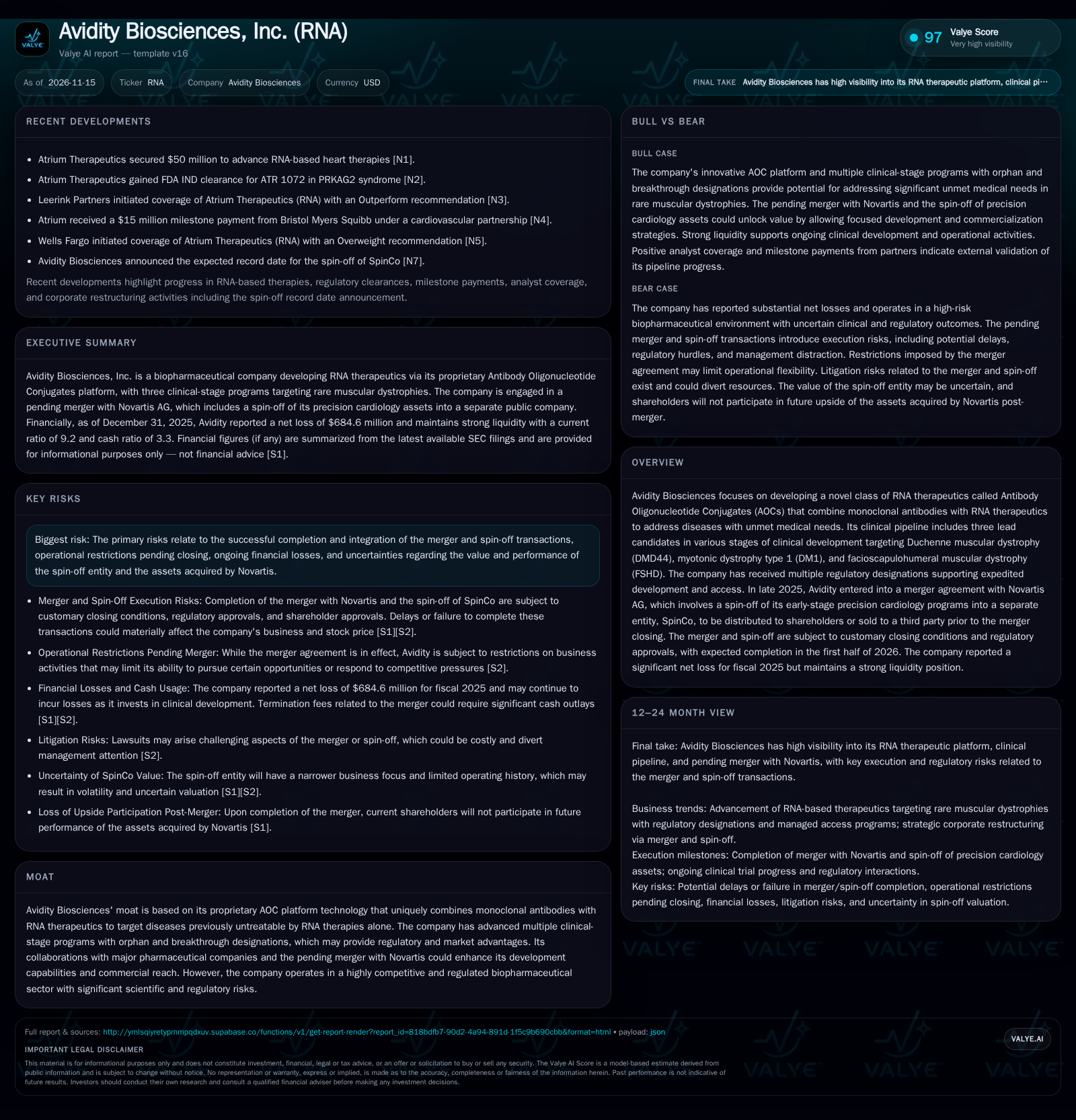
Avidity Biosciences is implementing a two-pronged strategy: merging with Novartis to advance its clinical-stage muscular dystrophy programs while spinning off early-stage cardiology assets into an independent entity, SpinCo. The company’s lead assets have received multiple regulatory designations, but execution risks are high given the complexity of the transactions, substantial ongoing losses, and operational restrictions ahead of deal closure. The long-term value realization for shareholders will depend on successful regulatory approvals, clinical outcomes, and the future performance of both Avidity under Novartis and the new SpinCo entity. [S1] [S2] [N7]
Avidity Biosciences is redefining its future through a high-stakes merger with Novartis and the spin-off of its precision cardiology programs, setting the stage for a bifurcated value proposition. With three clinical-stage programs targeting rare muscular diseases and a proprietary technology platform, Avidity has attracted significant regulatory attention and external validation. However, the company faces considerable execution risks—from integration and regulatory hurdles to the uncertain valuation of its soon-to-be-independent SpinCo. The outcome of these transactions will determine not just the fate of Avidity’s current pipeline, but also the strategic direction and risk profile for shareholders as the business splits its focus across two separate entities.
Merger, Spin-Off, and Clinical Pipeline Mark a Defining Phase for Avidity
Avidity Biosciences is in the midst of a transformative period marked by three defining developments. First, it has entered into a merger agreement with Novartis AG, under which Avidity will become an indirect wholly owned subsidiary of Novartis, pending customary closing conditions, regulatory, and shareholder approvals. Second, as a prerequisite to the merger, Avidity will spin off its early-stage precision cardiology programs and select collaboration agreements into a standalone public company, SpinCo, with the record date for this spin-off expected in early 2026. Third, the company's pipeline features three clinical-stage programs—del-zota for DMD44, del-desiran for DM1, and del-brax for FSHD—all of which have received Orphan Drug status and, for the first two, additional Fast Track and Breakthrough Therapy designations from both the FDA and EMA. These developments are critical because they will reshape Avidity’s business scope, determine future value capture for shareholders, and test the scalability and commercial potential of its proprietary AOC platform [S1] [N7].
Economic Drivers Behind Avidity’s RNA Therapeutics and Strategic Shift
Avidity’s business model centers on its Antibody Oligonucleotide Conjugates (AOC) platform, which aims to deliver RNA therapeutics with greater tissue specificity by leveraging monoclonal antibodies. In principle, this could enable premium pricing and addressable markets in rare diseases with significant unmet need—where orphan drug pricing dynamics, expedited regulatory paths, and limited competition can support high margins for successful therapies. The company’s current economics are dominated by R&D investment: for fiscal 2025, Avidity reported a net loss of $684.6 million, reflecting heavy spending on clinical trials, platform development, and regulatory activities [S1]. Fixed costs are likely high until commercialization, but should operating leverage materialize, gross margins could be attractive if lead assets are approved and commercialized.
The merger with Novartis could fundamentally alter Avidity’s cost structure and funding requirements. As a Novartis subsidiary, Avidity would gain access to greater capital resources, commercial infrastructure, and global regulatory expertise, potentially accelerating development and reducing per-unit commercialization risk for its lead assets. Conversely, SpinCo—carrying cardiology assets and collaborations—will operate independently with a narrower focus and will need to secure its own funding and partnerships to advance development. The economics for SpinCo will be more speculative, as early-stage programs typically require several years of investment before revenue generation, and the entity’s valuation will depend on pipeline progress, partnership milestones, and potential out-licensing.
Assessing Avidity’s Competitive Edge: AOC Technology and Regulatory Landscape
Avidity’s core competitive proposition is its proprietary AOC platform, designed to overcome delivery barriers that have historically limited the reach of RNA therapeutics—especially in muscle and other hard-to-target tissues. This platform, if clinically validated, could confer meaningful differentiation versus conventional oligonucleotide or gene therapy approaches. The company’s regulatory achievements—multiple orphan drug, Fast Track, and Breakthrough Therapy designations—provide potential market exclusivity, faster development timelines, and enhanced dialogue with regulators, all of which could translate into commercial advantages.
However, the competitive landscape in rare neuromuscular diseases is intensifying. Other biopharmaceutical firms, including large established players and emerging RNA/gene therapy companies, are pursuing parallel approaches for DMD, DM1, and FSHD. Barriers to entry for AOC-like platforms are high due to technical complexity and intellectual property, but the risk of technological obsolescence or competitive leapfrogging remains. Moreover, after the spin-off, SpinCo will compete in the precision cardiology space—a field with growing interest from both established pharma and venture-backed biotechs, as seen in recent funding activity [N1]. The ability of both Avidity (under Novartis) and SpinCo to retain a moat will depend on ongoing clinical success, IP protection, and the ability to translate platform potential into differentiated, approvable products.
Potential Gains from a Smooth Merger Coupled with Clinical Breakthroughs
If Avidity successfully closes the Novartis merger and SpinCo launches smoothly, the combined effect could be significant value realization for shareholders. Under Novartis, Avidity’s lead programs could benefit from accelerated global development, access to commercial expertise, and scale-driven efficiencies, potentially leading to faster approvals and robust launch trajectories for del-zota, del-desiran, and del-brax. Should these assets demonstrate compelling efficacy and safety in ongoing or upcoming registrational trials—especially given their orphan and breakthrough designations—Avidity could capture significant market share in rare neuromuscular disorders, with pricing and reimbursement advantages typical of first-in-class therapies.
The upside for SpinCo, meanwhile, hinges on its ability to advance cardiology programs and secure additional partnerships or non-dilutive funding. If SpinCo demonstrates early clinical proof of concept or signs meaningful collaboration deals, its valuation could rise independently of Avidity’s legacy business. Confirmation of this scenario would include regulatory approvals for the lead AOC programs, rapid post-merger integration with Novartis, positive clinical readouts, and partnership or milestone announcements from SpinCo.
Navigating a Lengthy Transition Amid Value Uncertainty
The most plausible outcome is that Avidity completes the merger and spin-off with delays or incremental adjustments but without catastrophic disruption. The company continues to report substantial operating losses as it advances its three lead programs through late-stage clinical development, with regulatory approvals and commercial launches likely staggered over several years. As a Novartis subsidiary, Avidity benefits from increased resources, but the integration process absorbs management attention and slows decision-making.
For SpinCo, early-stage assets require continued investment and face the typical hurdles of drug development: scientific risk, capital constraints, and the need to establish independent infrastructure. Shareholders experience a period of value uncertainty as the market digests the split and awaits concrete clinical or partnership milestones from both entities. Evidence supporting this scenario would be timely—but not accelerated—progress on regulatory and operational milestones, continued clinical spending, and measured updates on SpinCo’s strategy and financing.
Risks from Merger Setbacks, Clinical Challenges, and Spin-Off Execution
Several adverse developments could materially impair shareholder value. If the merger or spin-off faces regulatory obstacles, litigation, or shareholder opposition, either transaction could be delayed or terminated, triggering significant termination fees ($450 million by Avidity under certain conditions, $600 million by Novartis in reverse) [S1]. During this period, Avidity’s operational flexibility is constrained by merger-related restrictions, limiting its ability to adapt to new opportunities or threats [S2].
Clinical setbacks—such as negative or inconclusive data from late-stage trials in DMD44, DM1, or FSHD—would likely diminish the perceived value of the AOC platform and reduce the prospects for both Avidity and SpinCo. If SpinCo struggles to secure adequate funding or fails to advance its pipeline, its valuation could remain depressed or decline, especially given its narrower focus and lack of operating history. Confirming evidence for this scenario would include missed transaction deadlines, adverse clinical trial disclosures, litigation or regulatory delays, and signs of financial strain at SpinCo post-spin.
Key Milestones and External Influences Shaping Avidity’s Future
Closure timing and regulatory approval status for both the Novartis merger and the SpinCo spin-off; delays or denials would materially shift the outlook.
Clinical trial results and regulatory feedback for del-zota (DMD44), del-desiran (DM1), and del-brax (FSHD) in 2026–2027; positive pivotal data would validate the AOC platform.
SpinCo’s initial capitalization, independent funding runway, and ability to form new partnerships or collaborations post-spin.
Operational integration progress and strategic roadmap for Avidity within Novartis, including resource allocation and prioritization of lead programs.
Termination fee triggers and any litigation or regulatory challenges that could impact transaction economics or timelines.
Updates on orphan drug exclusivity, market access, and reimbursement decisions for approved products, if any.
If disclosed, revenue or milestone payments from existing or new collaborations, especially for the spun-off cardiology portfolio, as a proxy for external validation.
Shareholder response to transaction structure—particularly the perceived value and strategic direction of SpinCo relative to legacy Avidity assets.
Disclaimer: This is research-only, informational analysis and not investment advice. It may include AI-generated interpretation and general industry context. Always verify important details using primary sources.

Comments