
Fulcrum Therapeutics: Strategic Reset After Clinical Setbacks and the Slate Merger
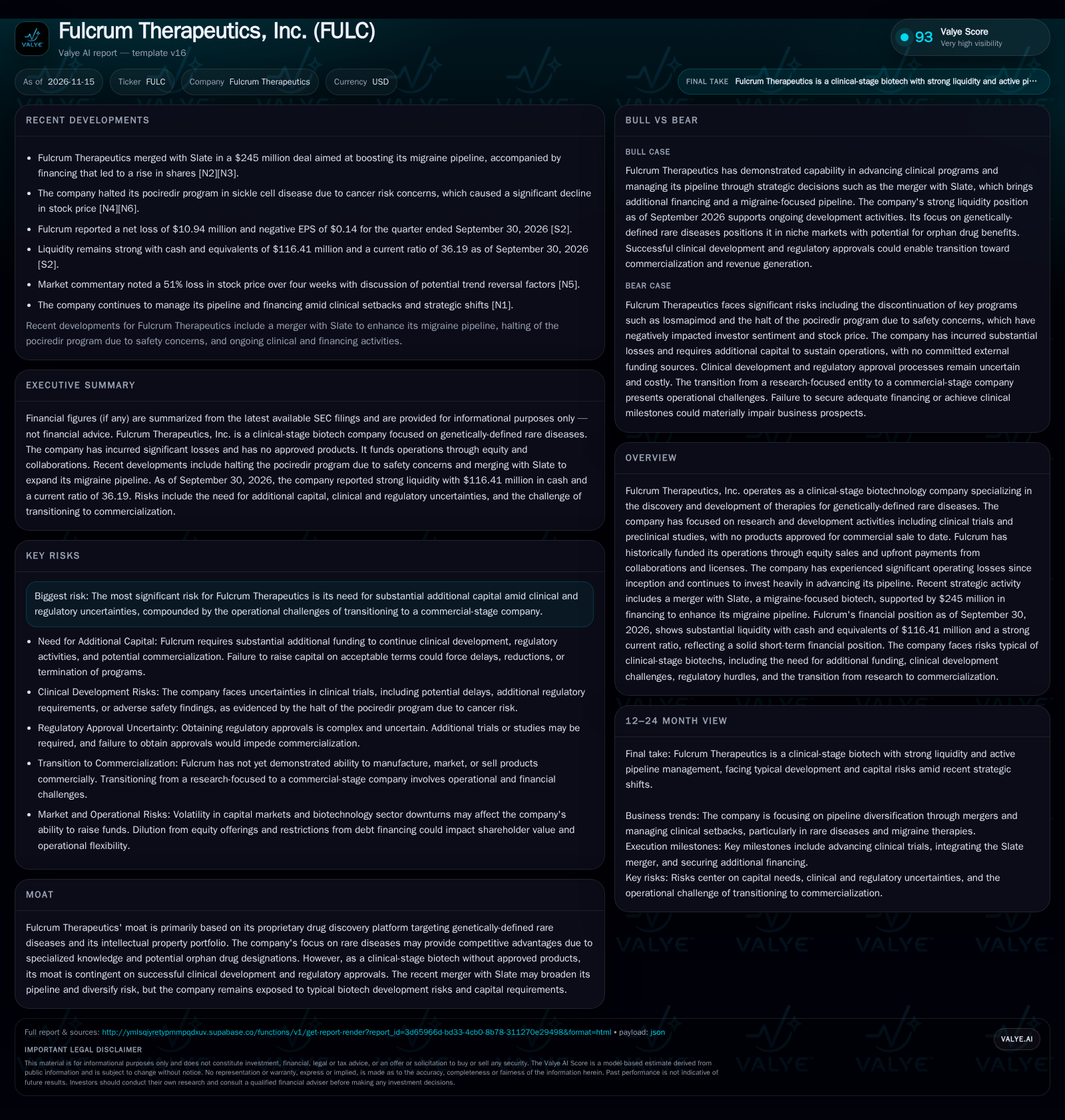
Fulcrum Therapeutics, after halting key clinical programs due to safety concerns and failed efficacy, is repositioning itself through a $245 million merger with Slate to focus on migraine therapeutics.
Fulcrum Therapeutics has exited its lead rare disease programs following safety and efficacy failures, triggering a major strategic pivot via a $245 million merger with migraine-focused Slate. Success will hinge on advancing its migraine pipeline and demonstrating a credible path to commercialization or strategic partnership.
Fulcrum Therapeutics finds itself at a pivotal juncture in late 2026. After abandoning its most advanced programs due to safety and efficacy setbacks, the company has executed a $245 million merger with migraine specialist Slate, aiming to fill its late-stage pipeline void and regain strategic momentum. The coming quarters will test Fulcrum’s ability to both integrate the Slate acquisition and re-establish a credible trajectory toward value creation.
Clinical Setbacks and a Pipeline Overhaul: Where Fulcrum Stands Now
Fulcrum Therapeutics, once focused on genetically-defined rare diseases such as sickle cell disease, has suffered two major clinical program failures in 2026: the discontinuation of its losmapimod program after a Phase 3 trial failure, and the halt of its pociredir program in sickle cell disease due to cancer risk concerns [N4] [N6]. These setbacks left Fulcrum without a late-stage pipeline and led to a sharp stock price decline, with shares losing 51% over four weeks [N5]. In response, Fulcrum merged with Slate, a migraine-focused biotech, in a $245 million deal in August 2026, gaining both a new therapeutic focus and fresh financing [N2] [N3]. [S2] However, Fulcrum remains a clinical-stage company with no approved products and continues to post significant operating losses.
The strategic shift following clinical setbacks also underscores the inherent challenges faced by biotech firms operating in rare diseases, where patient populations are limited and safety margins can be narrow. The pivot to migraine therapeutics, a more prevalent indication, reflects a deliberate attempt to leverage a larger market opportunity with potentially more predictable clinical pathways. However, this transition necessitates not only scientific adaptation but also operational realignment, including the acquisition or development of new expertise in neurology and commercial capabilities tailored to a different therapeutic area. The success of this repositioning will depend on the company's ability to integrate these new competencies while maintaining disciplined resource allocation to mitigate the risks associated with such a fundamental transformation.
Funding R&D in a Pre-Revenue Biotech: Economics and Capital Demands
Fulcrum’s business model centers on drug discovery, clinical development, and the hope of eventual regulatory approval and commercialization. Until a product is approved or out-licensed, the company generates no recurring revenue and funds operations through equity offerings, upfront collaboration payments, and, most recently, merger-related financing. The economics are dominated by high fixed costs—R&D, clinical trial expenses, intellectual property management, and manufacturing scale-up—while variable costs remain low until commercialization. This cost structure creates significant operating leverage once fixed costs are covered by product sales, but exposes the company to prolonged periods of negative cash flow.
Fulcrum reported a net loss of $10.94 million for Q3 2026 and an accumulated deficit of $594.3 million as of December 2025 [S2]. The $245 million in merger-related financing temporarily strengthens the balance sheet, but the capital-intensive nature of clinical development means further funding will likely be required unless a major out-licensing or partnership deal is secured. Future economics may hinge on successfully advancing the migraine pipeline to a value-inflection point attractive to larger pharma partners.
The capital-intensive nature of drug development inherently imposes significant financial risks, especially for companies like Fulcrum that lack diversified revenue streams. The timing and scale of financing events, such as mergers or equity offerings, critically influence the company's runway and strategic flexibility. Moreover, the cost structure's fixed-cost dominance means that delays or failures in clinical trials can disproportionately impact financial stability. Therefore, effective capital management must balance aggressive investment in promising assets with prudent contingency planning. Additionally, the potential for strategic partnerships can serve as a vital non-dilutive funding source, but these arrangements often require demonstrable clinical progress or proprietary advantages, underscoring the importance of milestone-driven development strategies.
Pipeline Realignment: Migraine Market Entry and Competitive Landscape
The pivot to migraine therapeutics positions Fulcrum in a highly competitive but commercially attractive market segment. Migraine is a large, established indication with several approved therapies—including CGRP antagonists, monoclonal antibodies, and small-molecule drugs—marketed by both large pharma and specialty biotech firms. Fulcrum’s competitive position will depend on the clinical differentiation of its acquired migraine assets from Slate, such as novel mechanisms of action, superior efficacy, safety, or patient convenience.
Barriers to entry in migraine are significant: established brands, physician familiarity, and payer dynamics all favor incumbents. However, the market rewards true innovation and unmet needs such as efficacy in refractory patients or improved side effect profiles. Fulcrum’s ability to carve out a niche will depend on demonstrating compelling clinical data, securing intellectual property, and eventually building commercial or partnership capabilities. Without positive trial results or clear differentiation, the company faces the risk of being crowded out by better-funded competitors.
In the migraine therapeutics landscape, differentiation is often achieved through nuanced clinical benefits rather than broad efficacy claims, given the availability of multiple approved therapies. Therefore, Fulcrum's success will likely depend on identifying and targeting specific patient subpopulations or unmet needs where its migraine assets can offer meaningful improvements. For instance, addressing treatment-resistant migraine or reducing adverse effects could carve out a defensible niche. Additionally, payer acceptance and reimbursement dynamics will play a critical role; demonstrating cost-effectiveness or improved patient adherence could facilitate market access. The company's ability to generate robust intellectual property protection around its novel mechanisms or formulations will further influence its competitive moat and attractiveness to potential partners or acquirers.
If the Migraine Pipeline Delivers: Pathways to Renewed Value
The most favorable scenario for Fulcrum would see its new migraine assets deliver strong clinical data in early- and mid-stage trials, validating their differentiation against existing therapies. This could attract the attention of larger pharmaceutical companies seeking to bolster migraine portfolios or diversify CNS pipelines. Success in clinical endpoints—particularly if accompanied by a favorable safety profile—could enable lucrative out-licensing, co-development deals, or even a full acquisition.
Evidence that would confirm this scenario includes positive trial readouts, initiation of pivotal studies, and announcements of strategic partnerships or licensing agreements with established industry players. A significant increase in R&D investment or hiring for commercial functions would also suggest confidence in eventual product launch. Conversely, delays or equivocal results in clinical trials would quickly challenge this upside thesis.
Rebuilding Credibility: Incremental Progress and Persistent Uncertainty
The most probable path forward is one of gradual pipeline rebuilding, as Fulcrum focuses resources on advancing its migraine programs through early clinical development.
In this scenario, Fulcrum may achieve incremental clinical milestones—such as successful Phase 1 or 2 trials—but will remain vulnerable to setbacks given the typical attrition rates in CNS drug development. Confirmation of this trajectory would be ongoing clinical progress, prudent cash management, and clear communication of development timelines. Falsifying evidence would be further trial discontinuations or an inability to secure follow-on funding before cash reserves are depleted.
Further Clinical Failures or Financing Gaps: The Risk of Strategic Exhaustion
The principal risk is that Fulcrum’s new migraine pipeline fails to generate positive clinical data or is beset by unexpected safety concerns, echoing the company’s recent history in rare diseases. Given the lack of approved products and reliance on external capital, any further clinical setback could leave Fulcrum unable to raise additional funds on acceptable terms, forcing program discontinuations, asset sales, or even a wind-down.
Confirmation of this downside scenario would be negative or equivocal trial results, withdrawal of development programs, and the absence of new partnership or financing announcements as cash burn accelerates. A declining cash balance without visible progress or external validation would quickly erode investor confidence and limit strategic options.
How to Test the Rebuild: Concrete Markers for Fulcrum’s Next Chapter
Progress and outcomes of clinical trials in the migraine pipeline, including initiation, enrollment rates, and topline data releases.
Updates on strategic partnerships, out-licensing agreements, or co-development deals that could provide non-dilutive funding or commercial infrastructure.
Cash burn rate and updated guidance on runway, especially as clinical programs advance and fixed costs rise.
Clarity on integration milestones and synergy realization from the Slate merger, including R&D and operational alignment.
Announcements regarding the disposition of remaining preclinical and rare disease assets, which could provide additional liquidity or focus.
Regulatory interactions, such as IND clearances or feedback from health authorities, that may accelerate or delay trial timelines.
If disclosed, retention or turnover of key scientific and executive personnel, which would signal organizational stability or potential disruption.
Disclaimer: This is research-only, informational analysis and not investment advice. It may include AI-generated interpretation and general industry context. Always verify important details using primary sources.

Comments