
ProKidney’s Critical Phase 3 Journey: Funding, Trial Progress, and Commercial Outlook
With Rilparencel’s pivotal trial surpassing 500 patients and a Q2 2027 readout in sight, ProKidney balances reported liquidity position and regulatory alignment against clinical and financial headwinds. The company’s future now hinges on translating late-stage momentum into regulatory approval and eventual market entry amid ongoing losses and capital market reliance.
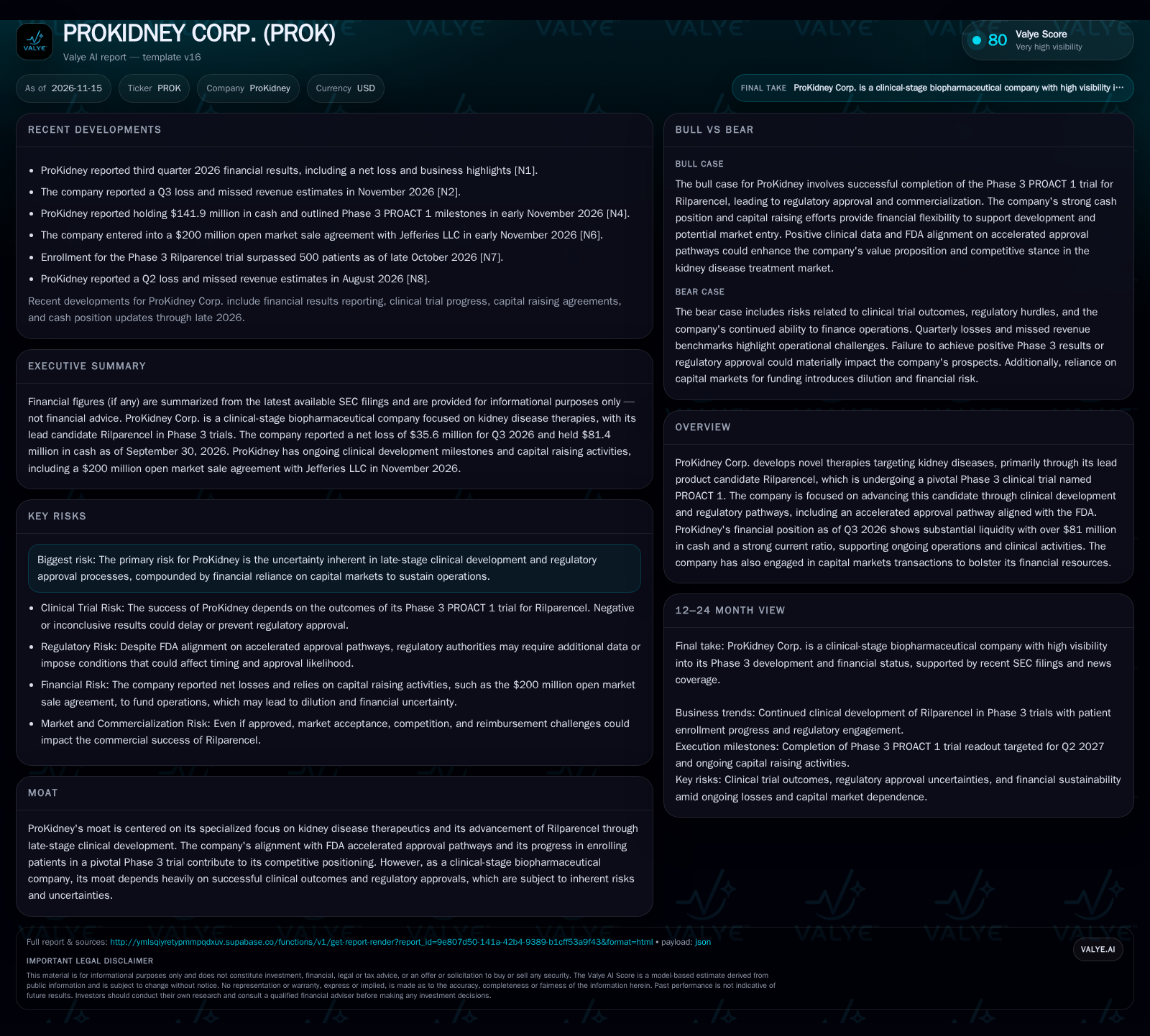
ProKidney Corp. is advancing its lead kidney disease therapy, Rilparencel, through a large Phase 3 trial with over 500 patients enrolled and a key data readout expected in Q2 2027. The company maintains substantial liquidity and has secured an open market sale agreement for up to $200 million, but continues to post quarterly losses and miss revenue estimates. FDA alignment on accelerated approval offers a potential regulatory tailwind, yet the business remains highly sensitive to clinical outcomes, regulatory demands, and ongoing access to capital.[N1] [N2] [N4] [N6] [N7] [S2]
ProKidney Corp. stands at a pivotal juncture in its quest to bring a novel kidney disease therapy to market. The company’s lead candidate, Rilparencel, has moved deep into Phase 3, with over 500 patients enrolled and a critical data readout anticipated in Q2 2027. Yet, persistent losses, recurring revenue shortfalls, and dependence on external funding underscore the binary nature of its near-term future. As the company navigates the final stretch toward potential FDA approval, the stakes—for patients, investors, and the business model itself—are only rising.[N1] [N2] [N4] [N6] [N7] [S2]
Current Clinical Achievements and Financial Standing
ProKidney’s most material developments center on the progress of its lead candidate, Rilparencel, which as of late October 2026 had surpassed 500 patients enrolled in the pivotal Phase 3 PROACT 1 trial.[N7] This milestone solidifies the company’s momentum toward a planned Q2 2027 readout, a crucial inflection point for both regulatory and commercial prospects. The company reported a current ratio of 5.04 for the period. [S2] [N4] [N6]
Projected Economic Changes Following Regulatory Approval
As a clinical-stage company, ProKidney currently generates negligible revenue, with its cost base dominated by R&D and clinical trial expenses.[S2] The economics of the business are highly binary: if Rilparencel achieves regulatory approval, the company could transition to a high-margin, specialty drug model typical of novel biopharma launches. Pricing for innovative kidney disease therapies can be substantial, reflecting both clinical value and the lack of curative options for chronic kidney disease (CKD) patients. However, commercial success depends not just on approval but on payer reimbursement, uptake among nephrologists, and integration into standard-of-care pathways—each of which can introduce delays, require additional investments in commercial infrastructure, and compress margins. Fixed costs may initially rise as commercial teams are built out, but operating leverage could emerge if Rilparencel achieves broad adoption. Until then, ProKidney is reliant on capital markets to fund operations, with dilution risk as a tradeoff for liquidity.[N6] [S2]
The transition from a development-stage to a commercial-stage enterprise involves significant shifts in cost structure and revenue dynamics. While approval would unlock revenue streams, initial sales volumes may be modest as the company establishes payer contracts and educates prescribers. The economics also depend heavily on the competitive pricing environment and the willingness of payers to reimburse at levels commensurate with Rilparencel’s clinical benefit. Should reimbursement negotiations prove challenging, ProKidney may need to invest in health economics and outcomes research to demonstrate value, further increasing upfront costs. Conversely, successful market penetration could lead to economies of scale and improved margins, but this is contingent on effective commercialization strategy execution and the absence of disruptive competitor entries.
Focused Pipeline and Competitive Dynamics in Kidney Disease
ProKidney’s competitive positioning is anchored in its narrow focus on kidney disease therapeutics and its advancement of Rilparencel to late-stage clinical development. This specialization could confer early-mover advantages if Rilparencel demonstrates meaningful efficacy and safety. However, the CKD space is characterized by significant unmet need and active development by both large pharma and emerging biotech firms. Potential substitutes include new drug classes, cell therapies, and even device-based interventions. Larger incumbents may have more resources to navigate commercialization, regulatory hurdles, and payer negotiations, while smaller peers may be pursuing alternative mechanisms or delivery modalities. ProKidney’s FDA alignment on an accelerated approval pathway could provide a temporary lead, but the durability of its moat will ultimately depend on trial outcomes, regulatory acceptance, and the ability to differentiate clinically and economically against future competitors.
Unlocking Value Through Trial Success and Regulatory Advances
If Rilparencel’s Phase 3 data in Q2 2027 demonstrate compelling efficacy and safety, ProKidney could rapidly secure FDA approval under the accelerated pathway. This would validate years of R&D investment and unlock access to the large and underserved CKD patient population. Early uptake by nephrologists, positive real-world outcomes, and favorable payer coverage could drive rapid revenue ramp and operating leverage. Evidence confirming this scenario would include positive top-line data, swift regulatory review, and early signs of commercial adoption. Conversely, delays in regulatory review, tepid physician interest, or payer resistance would weaken the bull case.
Navigating Cash Flow and Approval Risks in Late-Stage Development
The Q2 2027 readout is likely to be the defining event: if results are positive but not transformative, ProKidney may face additional regulatory requests, delayed approval, or the need for further studies. Even in the event of approval, the initial commercial phase could be slow, with adoption gated by reimbursement and clinician education. Evidence supporting this scenario would include steady clinical progress, continued capital raises, and incremental regulatory or commercial updates without dramatic inflection points.
Potential Setbacks from Clinical Challenges and Funding Shortfalls
Should Rilparencel’s Phase 3 data fail to meet efficacy or safety endpoints, ProKidney’s prospects could deteriorate rapidly. Regulatory rejection or a requirement for additional, costly studies would extend the pre-commercial phase and accelerate cash burn. The company’s reliance on open market sales for funding introduces dilution risk, and capital may become harder to access if sentiment sours following negative data. Competitive pressures could intensify if other therapies advance or new entrants emerge, eroding any first-mover advantage. Evidence for this scenario would include negative or inconclusive trial results, regulatory setbacks, a shrinking cash balance, and increased difficulty raising capital on attractive terms.
Upcoming Events and External Influences Impacting ProKidney’s Future
Enrollment pace and retention in the Phase 3 PROACT 1 trial—slower-than-expected progress or elevated dropout rates could signal operational risk.
Top-line efficacy and safety data from the Q2 2027 readout—this is the pivotal binary event for the company.
FDA feedback on the accelerated approval pathway—any requests for additional data or delays would materially affect timing.
Cash burn rate and capital raise cadence—monitor quarterly net loss trends and the frequency/terms of new financing.[S2]
Commercial readiness planning—updates on build-out of sales, market access, and physician education teams (if disclosed) would clarify go-to-market strategy.
Competitive pipeline developments—track progress of rival CKD therapies that could preempt or blunt Rilparencel’s market entry.
Payer and reimbursement landscape—early signals from payers or health technology assessment bodies would help gauge commercial uptake potential.
Regulatory developments in major ex-U.S. markets—if ProKidney pursues global expansion, progress outside the U.S. would be a relevant milestone.
Disclaimer: This is research-only, informational analysis and not investment advice. It may include AI-generated interpretation and general industry context. Always verify important details using primary sources.

Comments