
M3-Brigade Acquisition VI Corp.: SPAC Readiness, Sponsor Track Record, and the Road to a Value-Accretive Deal
With $345 million in trust and no operating business to date, M3-Brigade Acquisition VI Corp. faces the classic SPAC challenge: leverage sponsor expertise and potential financial flexibility to secure a high-quality target before the clock runs out. The outcome for shareholders will hinge on deal discipline, sector focus, and execution in a competitive acquisition landscape.
M3-Brigade Acquisition VI Corp. is a newly formed SPAC with $345 million in trust, seeking a business combination—potentially in disruptive sectors like crypto or blockchain. Its experienced management team and sponsor network offer sourcing advantages, but success will depend on identifying a strong target and executing a deal that justifies shareholder support.
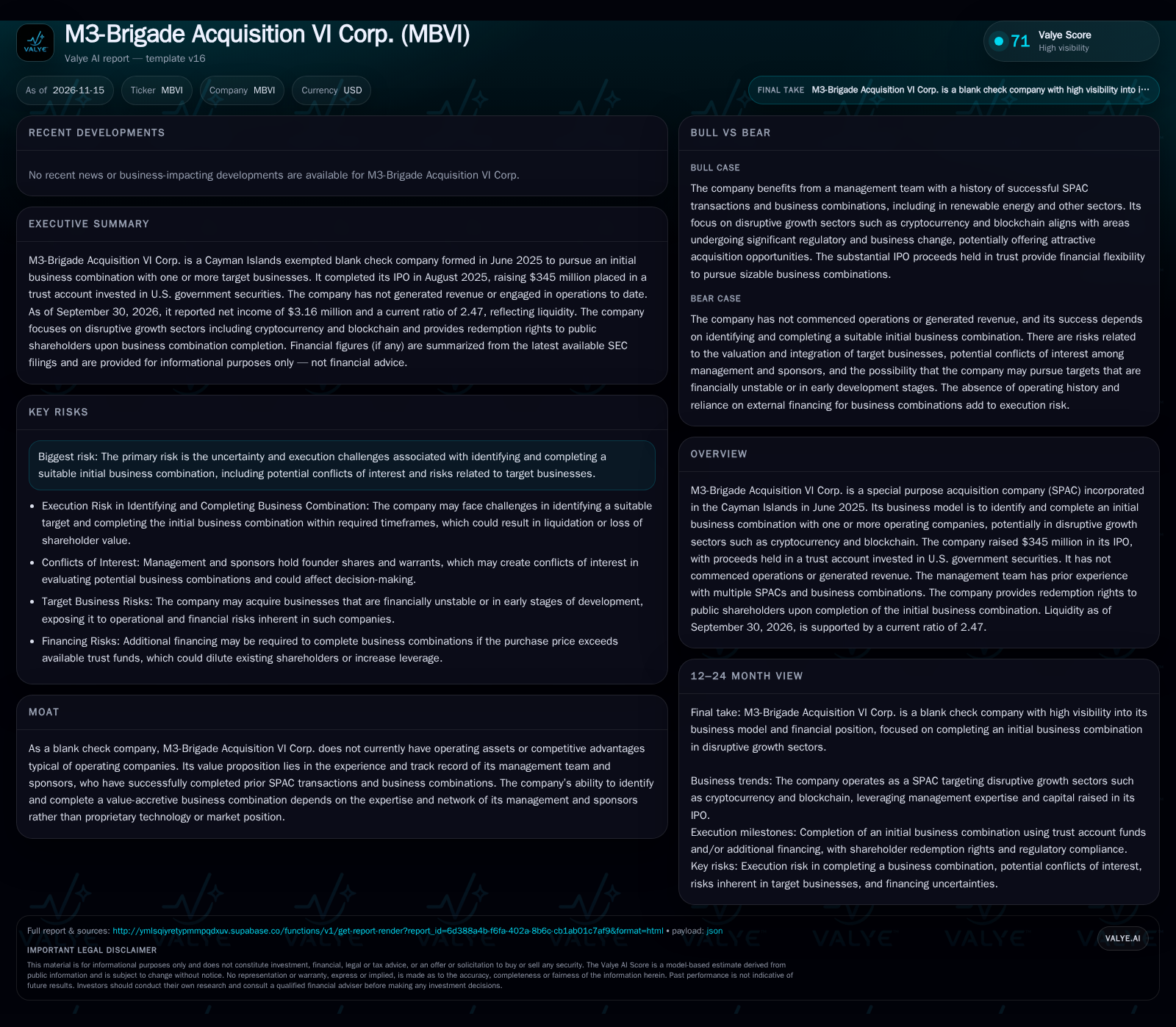
M3-Brigade Acquisition VI Corp. (MBVI) stands at the classic SPAC crossroads: flush with $345 million in trust from its August 2025 IPO and led by a sponsor group with a track record of prior deals, MBVI has yet to identify or announce a target. The company’s focus on disruptive sectors like crypto and blockchain aligns with thematic investor interest but also introduces elevated valuation and regulatory risks. As the search period progresses, MBVI’s ability to secure a compelling deal—and manage the inherent conflicts and execution risks of the SPAC model—will define its value proposition for public shareholders.
IPO Proceeds, Sponsor Pedigree, and the Search for a Target
M3-Brigade Acquisition VI Corp. has not commenced commercial operations or generated revenue since its formation in June 2025. Its core asset is $345 million in gross IPO proceeds, held in a trust account invested in U.S. government securities, which will be deployed to acquire a target business [S2]. As of September 30, 2026, MBVI’s current assets stood at $855,085 with a current ratio of 2.47, indicating reported liquidity position for ongoing administrative and deal-sourcing activities [S2]. The company reported net income of $3.16 million for the quarter, driven by interest income from the trust account, not from operating activities [S2].
The management team and sponsors bring prior SPAC and business combination experience, including deals in renewable energy and other sectors [S1] [S2]. However, as of the latest filing, MBVI has not selected or entered substantive discussions with any specific target, and all activity remains focused on identifying an initial business combination [S2].
SPAC Economics: Fee Structure, Capital Deployment, and the Dilution Equation
The economics of a SPAC like MBVI are fundamentally binary: value is created (or destroyed) based on the quality and terms of the eventual business combination. Until then, the company incurs minimal operating costs, with most IPO proceeds remaining in trust to earn interest. The trust structure is designed to protect public shareholders, who can redeem their shares for a pro-rata portion of the trust if dissatisfied with the proposed deal.
SPAC sponsors typically hold founder shares and warrants, giving them substantial upside if a deal is completed but also creating potential conflict of interest as sponsors may benefit from any transaction, regardless of its quality for public shareholders. Deferred underwriting fees ($16.4 million as of September 2026) and the dilution from both founder shares and public/private warrants mean that the ultimate economics for non-redeeming shareholders depend heavily on post-combination value creation.
If MBVI pursues a target with a purchase price exceeding the trust account, it will likely need to raise additional capital via PIPE investments or debt, introducing further dilution and leverage risk. The economics are thus highly sensitive to deal structure, target quality, and market appetite for the transaction.
Sourcing Advantage or Crowded Field? SPAC Competition and Sponsor Networks
MBVI’s management team and sponsors are experienced in SPAC transactions, potentially offering an edge in sourcing and executing deals, especially in specialized or emerging sectors. Their prior success in renewable energy and financial advisory may help in accessing proprietary deal flow or negotiating favorable terms.
However, the broader SPAC market remains highly competitive, with a large cohort of blank-check companies also seeking attractive targets, particularly in technology-adjacent sectors like crypto, blockchain, and fintech. Many high-quality targets now command premium valuations, and sponsors must compete both on price and on their ability to offer operational support or public-market expertise.
The lack of operating assets or proprietary technology means MBVI’s only differentiators are its financial firepower and the credibility of its sponsor group. This advantage could be eroded if market sentiment toward SPACs weakens, if regulators tighten scrutiny of target sectors, or if too many SPACs chase too few viable targets.
What a High-Quality, Well-Received Deal Could Unlock
In a favorable scenario, MBVI leverages its sponsor network and sector focus to identify a disruptive, high-growth target at a reasonable valuation. The deal is structured to minimize dilution, with strong PIPE investor support and high public shareholder participation (low redemption rate). If the target operates in a sector with positive momentum—such as regulated digital assets infrastructure or a fast-scaling fintech platform—public market enthusiasm could drive a strong re-rating post-merger.
Evidence supporting this scenario would include: announcement of a definitive merger agreement with a credible, growth-stage target; PIPE financing at or above trust value; and limited shareholder redemptions during the approval process. If the target demonstrates robust historical growth, clear unit economics, and a compelling strategic rationale for going public, MBVI could create substantial value for both sponsors and public investors.
Most Likely Outcome: A Deal, But Quality and Shareholder Support Vary
The most plausible scenario is that MBVI ultimately announces a business combination in a broadly defined disruptive sector, following months of due diligence and negotiation. The deal may be with a mid-tier or late-stage private company, with PIPE financing raised to bridge any gap above trust funds. While the sponsor group’s track record may facilitate deal flow, the quality of available targets is likely mixed, and valuation discipline will be tested.
Confirmation of this path would include: a merger announcement with a company that has some operating history but perhaps not clear profitability or market leadership; PIPE financing at or slightly below trust value; and a moderate to high redemption rate among public shareholders. The company would then transition to post-merger integration and face the challenge of delivering on growth projections amid public market scrutiny.
Deal Failure, Heavy Redemptions, or Liquidation: The SPAC’s Structural Risks
Adverse outcomes for MBVI include failing to secure a business combination within the required timeframe, leading to liquidation and the return of trust funds to shareholders (minus expenses). Alternatively, MBVI could announce a deal that is poorly received, triggering high redemption rates and potentially forcing deal renegotiation or abandonment.
Confirming evidence for this scenario would be: repeated extensions of the SPAC’s deadline without a merger announcement; failure to secure sufficient PIPE financing; or public filings indicating that a proposed target has withdrawn or negotiations have collapsed. If MBVI is forced to liquidate, sponsors would lose their at-risk capital and public shareholders would recover only their pro-rata share of the trust, with no upside.
Milestones and Metrics That Will Define MBVI’s Value Creation Path
Announcement of a definitive business combination agreement, including sector, target financials, and transaction structure.
PIPE financing terms—amount raised, investor composition, and pricing relative to trust value.
Shareholder redemption rate at the time of business combination approval; a useful metric would be the percentage of shares redeemed versus outstanding.
Regulatory scrutiny or sector-specific developments, particularly if the target operates in crypto, blockchain, or other high-risk verticals.
Post-announcement market reaction—price action of MBVI shares and warrants following deal news.
Sponsor and management alignment, including any additional capital commitment or lock-up provisions in the merger agreement.
Any extensions or amendments to the SPAC’s lifecycle (e.g., deadline extensions or changes to trust terms), which would signal difficulty in securing a deal.
If disclosed, pro-forma financial projections and unit economics of the target business, to test the credibility of growth claims.
Disclaimer: This is research-only, informational analysis and not investment advice. It may include AI-generated interpretation and general industry context. Always verify important details using primary sources.

Comments