
Assembly Biosciences: From Clinical Promise to Commercial Uncertainty in Antiviral Therapeutics
Assembly Biosciences advances a diverse pipeline targeting viral and liver diseases, buoyed by a Gilead collaboration and reported liquidity position. The company’s transition from early clinical wins to commercial relevance hinges on successful late-stage trials, partner execution, and navigating biotech’s inherent capital and regulatory risks.
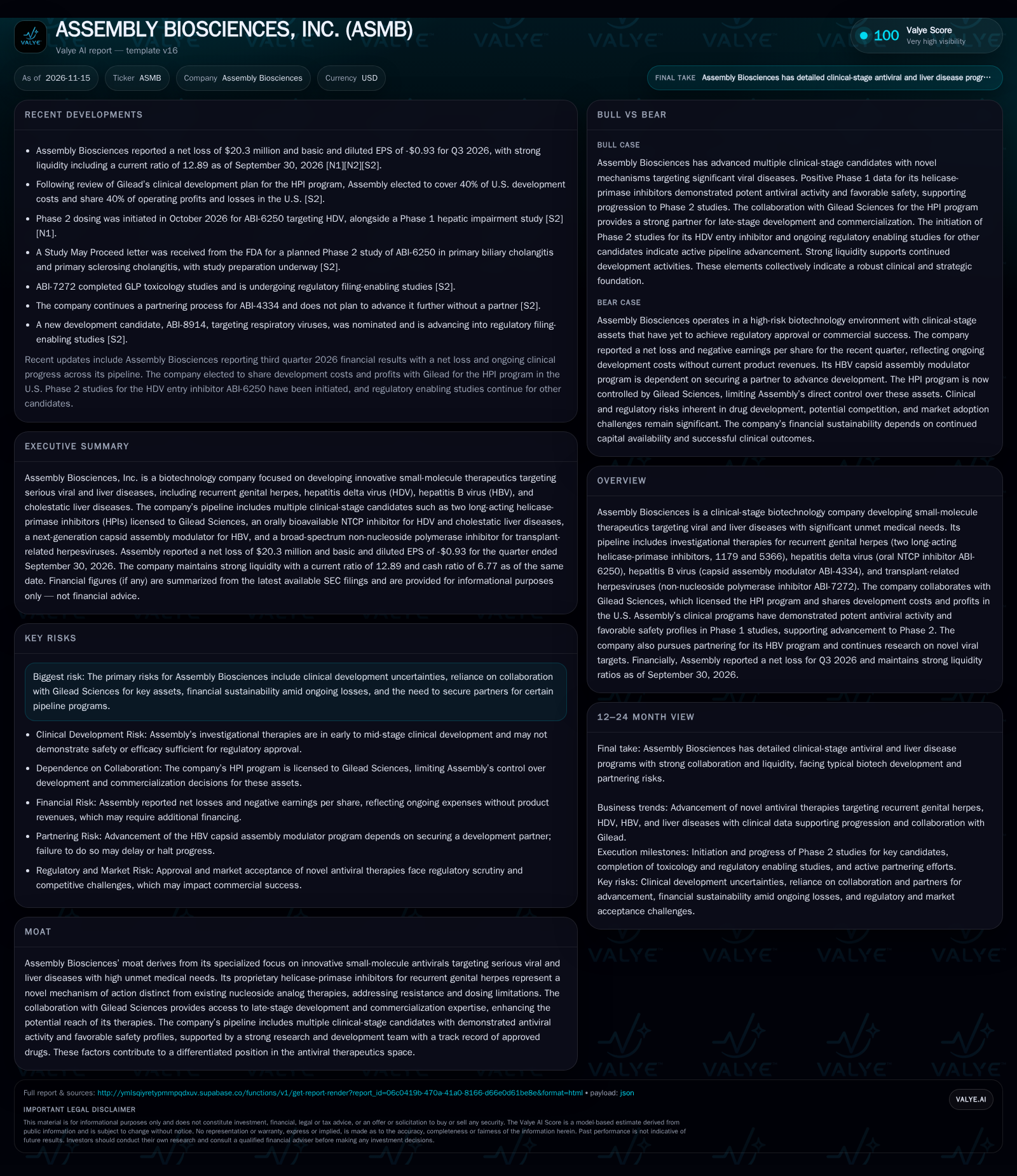
Assembly Biosciences is a clinical-stage biotech with multiple antiviral and liver disease programs, including partnered assets with Gilead Sciences. Reported liquidity position and promising early clinical data underpin the story, but commercial outcomes depend on progressing pivotal trials, securing partners for unpartnered programs, and withstanding sector headwinds of capital intensity and regulatory uncertainty. [N1] [S2]
Assembly Biosciences sits at a pivotal juncture: its broad antiviral and liver disease pipeline has yielded encouraging clinical data and attracted a high-profile partnership with Gilead Sciences for its helicase-primase inhibitor (HPI) program. However, like many biotech peers, Assembly faces a classic set of commercial hurdles—no approved products, persistent losses, and a reliance on both partner execution and external financing to bridge the gap to market. The company’s near-term trajectory will be shaped by the interplay between clinical trial outcomes, the ability to secure and manage additional partnerships, and the realities of drug development’s lengthy, capital-intensive process.
Recent Clinical Progress and Strategic Shifts Define Assembly’s Outlook
Three developments are especially material for Assembly’s current position. First, Gilead Sciences exercised its option to license Assembly’s HPI program (1179 and 5366) in December 2025, with Assembly electing to co-fund 40% of U.S. development costs and share 40% of operating profits and losses. This transition hands operational control to Gilead but ties Assembly’s upside and downside to the partner’s execution, a double-edged sword for value realization. [S2]
Second, the company initiated Phase 2 studies for ABI-6250 in hepatitis delta virus (HDV) and began FDA-cleared preparations for studies in primary biliary cholangitis and primary sclerosing cholangitis, signaling active pipeline advancement beyond the Gilead-partnered assets. [S2] [N1]
Third, Assembly’s balance sheet as of September 30, 2026, showed $29.1 million in cash and a current ratio of 12.89, supporting ongoing R&D but underscoring the capital needs typical of a pre-commercial biotech. Net loss for the quarter was $20.3 million, highlighting the ongoing burn rate in the absence of product revenue. [N1] [S2]
Pipeline Economics: Profit-Sharing, Partner Leverage, and the Capital Intensity Trap
Assembly’s future revenue model is contingent on successful clinical development, regulatory approval, and commercialization of its investigational therapies. For the HPI program, the profit-sharing structure with Gilead in the U.S. means Assembly will bear 40% of development costs and receive 40% of operating profits or losses. This offers participation in a potentially large genital herpes market, but also exposes Assembly to ongoing cash outflows and limited strategic control. The actual economics will depend on Gilead’s execution, the scale of eventual market uptake, and the cost of commercial rollout. [S2]
For unpartnered programs—such as ABI-6250 (HDV/CLDs), ABI-7272 (herpesviruses), and ABI-4334 (HBV)—the path to monetization is less certain. These assets require further clinical investment, with ABI-4334’s progress explicitly dependent on finding a development partner. If successful, these programs could yield milestone payments, royalties, or profit-sharing agreements, but upfront costs remain high and timelines uncertain.
Operating leverage is limited until at least one candidate reaches approval and commercialization. Fixed R&D and overhead costs dominate until then. Even with reported liquidity position, Assembly’s quarterly net loss illustrates the sector’s structural need for repeated capital raises, especially if development timelines extend or pivotal trials fail to deliver.
Innovative Mechanisms Face a Crowded and Evolving Antiviral Landscape
Assembly’s primary differentiation lies in its focus on novel small-molecule antivirals with mechanisms distinct from incumbent therapies. Its helicase-primase inhibitors (HPIs) address recurrent genital herpes, offering a potential alternative for patients resistant to nucleoside analogs and aiming for less frequent dosing. This could expand the addressable market if clinical efficacy and tolerability are proven in larger trials.
In hepatitis delta and B virus, Assembly targets entry inhibition (NTCP) and capsid assembly modulation—mechanisms that, while innovative, operate in crowded therapeutic areas with multiple large pharma and biotech competitors. Many rivals are pursuing gene therapies, RNA interference, or alternative small-molecule approaches. The ability to demonstrate superior efficacy, safety, or convenience will be critical.
The collaboration with Gilead provides access to commercial infrastructure and late-stage development resources, but also means Assembly’s fortunes are partly tied to a partner’s priorities and execution. For unpartnered assets, the competitive challenge is to attract partners before data obsolescence or competitive advances diminish their value.
If Pivotal Data and Partnerships Materialize, Value Could Inflect Rapidly
The bull case for Assembly hinges on several reinforcing outcomes: continued demonstration of strong antiviral efficacy and safety in larger, later-stage trials for its lead candidates; accelerated development and commercialization by Gilead for the HPI program; and the successful partnering of unpartnered programs such as ABI-4334 and ABI-7272.
Evidence that would confirm this scenario includes positive Phase 2/3 data with clinically meaningful endpoints, Gilead’s initiation of pivotal trials or commercial launch preparation, and the announcement of lucrative partnership deals for additional pipeline assets. Rapid recruitment and regulatory progression in HDV and cholestatic liver disease studies would further support the thesis.
If these catalysts are realized, Assembly could transition from a cash-burning development story to a pipeline company with tangible royalty, milestone, and profit-sharing revenue—and a materially higher strategic value.
Most Likely: Incremental Pipeline Progress, Ongoing Losses, and Capital Needs
The most plausible path combines continued pipeline advancement—e.g., completion of Phase 2 trials and progress on regulatory submissions—with ongoing operating losses and periodic capital raises. Gilead’s stewardship of the HPI program should yield steady development updates, but commercial launch remains several years away. For other programs, Phase 2 results and partnering discussions may take longer than hoped.
Evidence consistent with this scenario would include regular but measured clinical milestones, continued net losses, and announcements of additional equity or debt financing. Failure to secure partners for unpartnered assets would reinforce the company’s dependence on external financing and slow the pipeline’s progression.
This scenario does not preclude long-term success, but it reflects the sector’s typical pattern: scientific progress offset by the time, cost, and uncertainty of clinical development.
Development Setbacks or Funding Gaps Could Trigger Value Compression
Adverse outcomes could materialize if key clinical trials fail to meet efficacy or safety endpoints, leading to program discontinuations or delays. Regulatory setbacks, inability to secure new development partners, or a shift in Gilead’s priorities could also undermine value.
Confirming evidence would include negative or inconclusive clinical data, withdrawal of development programs, missed regulatory milestones, or a sudden increase in cash burn without replenishment. If Assembly is forced to halt programs or issue equity at distressed valuations, shareholder value would likely be impaired.
Broader market shifts—such as changes in FDA guidance, new competitive entrants with superior data, or macro funding constraints—could amplify these risks.
Milestones That Will Shape Assembly’s Transition from Pipeline to Portfolio
Progression and readouts from Phase 2 and potential Phase 3 trials for HPI assets and ABI-6250—positive efficacy and safety data would validate the pipeline.
Updates on Gilead’s clinical and commercial plans for the HPI program, including trial initiations, enrollment rates, and regulatory filings.
Announcements of new development or commercialization partnerships for ABI-4334, ABI-7272, and the newly nominated ABI-8914.
Cash burn rate and runway disclosures—quarterly updates on R&D expenses and projected liquidity relative to pipeline milestones.
Regulatory interactions—FDA feedback, Study May Proceed letters, and progress on international filings for pipeline assets.
Adverse event reports or clinical holds in ongoing trials, which could signal setbacks or safety concerns.
If disclosed, partner milestone or royalty payments, and the timing/structure of any new licensing agreements.
Recruitment speed and retention in ongoing clinical studies, which affect trial timelines and data visibility.
Disclaimer: This is research-only, informational analysis and not investment advice. It may include AI-generated interpretation and general industry context. Always verify important details using primary sources.

Comments