
Arcadia Biosciences: Balancing Profitability Gains with Listing Compliance Uncertainty
Arcadia Biosciences’ recent return to net profitability and sales growth marks a critical operational inflection—but persistent Nasdaq compliance pressures and capital constraints pose ongoing strategic risks. The interplay between improving core performance and the threat of delisting will determine whether the company can leverage its plant science assets for long-term value creation.
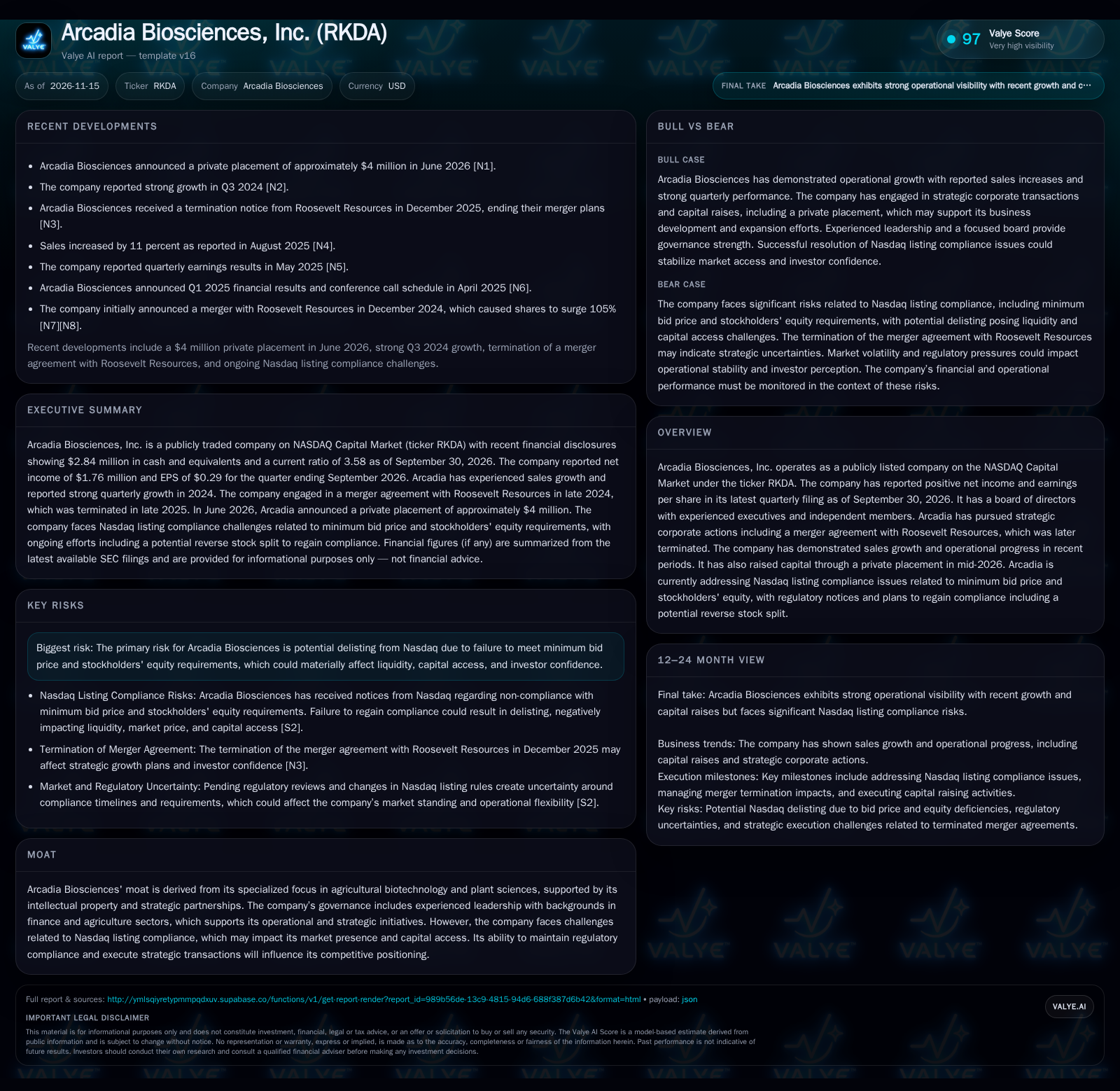
Arcadia Biosciences has achieved positive net income, double-digit sales growth, and strengthened its balance sheet with a private placement, but faces existential risks from ongoing Nasdaq listing compliance issues. The company’s ability to maintain market access, secure additional capital, and capitalize on its biotech platform will be decisive for its future trajectory. [S2] [N4] [N1]
Arcadia Biosciences stands at a pivotal crossroads: the company’s resurgence into profitability and sales growth in 2026 offers new strategic optionality, yet persistent Nasdaq listing compliance threats and reported cash balance cast a long shadow. With recent capital infusion and an experienced board, Arcadia’s next moves will determine whether it can sustain its operational turnaround, secure ongoing access to public markets, and realize value from its agricultural biotech platform. The stakes are high, as both financial execution and regulatory navigation will shape the company's long-term relevance.
Recent Profitability and Compliance Challenges Define the Strategic Landscape
Arcadia Biosciences reported net income of $1.76 million and earnings per share of $0.29 for the third quarter of 2026, a notable shift toward profitability after a period of operational challenges [S2]. Sales momentum is evident, with an 11% increase reported in August 2025 [N4]. The company’s cash and equivalents stood at $2.84 million as of September 30, 2026, supported by a $4 million private placement completed in June 2026 [N1] [S2].
Despite these improvements, Arcadia faces ongoing Nasdaq listing compliance issues, specifically related to minimum bid price and stockholders’ equity. These unresolved deficiencies could result in delisting, jeopardizing liquidity, capital access, and investor confidence [S2]. The board has authorized a potential reverse stock split as part of its compliance strategy, highlighting the precarious balance between operational progress and existential regulatory risk.
Revenue Model, Operating Leverage, and Capital Constraints
Arcadia Biosciences operates in the agricultural biotechnology sector, with revenues likely derived from a mix of proprietary plant traits, seed sales, and possibly licensing or partnership arrangements. The company’s recent return to net profitability suggests either improved gross margins, effective cost containment, or a favorable sales mix—though the specific drivers are not disclosed [S2]. If higher-margin product lines (such as licensed traits or specialty ingredients) are gaining traction, incremental revenue could meaningfully expand operating profits given the sector’s typical fixed-cost base.
However, with only $2.84 million in cash and a history of private placements to shore up liquidity, Arcadia’s capital structure remains fragile [S2] [N1]. The need to maintain public listing status is not merely cosmetic; delisting could increase capital costs, restrict institutional participation, and reduce strategic flexibility. The company’s ability to fund R&D, commercial expansion, and regulatory compliance may be constrained unless top-line growth accelerates or new financing is secured on favorable terms.
The company’s revenue model likely exhibits inherent operating leverage, characteristic of biotech firms with substantial fixed R&D and regulatory compliance costs. This implies that once a critical sales volume or licensing milestone is reached, incremental revenues can disproportionately enhance profitability. However, this leverage also means that any stagnation or decline in sales could quickly erode margins and cash reserves. Given the capital-intensive nature of agricultural biotech development, the timing and scale of product commercialization are crucial. Delays in regulatory approvals or slower-than-expected market adoption could compress operating leverage benefits, necessitating careful cash flow management and prioritization of high-return projects.
Capital constraints also influence strategic flexibility, particularly regarding investment in innovation pipelines and market expansion. If external financing becomes more costly or less accessible due to listing uncertainties, the company may need to defer or downscale R&D initiatives, potentially impacting long-term competitiveness. Conversely, a disciplined capital allocation approach focusing on near-term revenue-generating activities could stabilize operations but might limit breakthrough innovation. Therefore, the balance between sustaining current profitability and investing for future growth is delicate; missteps could either exhaust resources prematurely or leave growth opportunities unexploited.
Intellectual Property and Niche Focus Amid Intensifying AgBio Competition
Arcadia’s moat appears rooted in its specialized focus on agricultural biotechnology and plant sciences, supported by intellectual property and a history of strategic partnerships. These factors may enable differentiated offerings compared to commodity seed companies or generic ingredient suppliers. However, the broader agbiotech landscape is increasingly competitive, with large incumbents, nimble startups, and multinational agribusinesses all vying for share in specialty traits, gene editing, and sustainable crop solutions.
Switching costs for customers in this space are typically moderate, depending on the regulatory environment, crop cycle, and the proprietary nature of the trait or product. If Arcadia can demonstrate clear agronomic or economic benefits to growers and downstream partners, it may sustain a premium position. Conversely, lack of scale, capital, or regulatory setbacks could erode its competitive relevance.
In an increasingly competitive agbiotech landscape, intellectual property protection and regulatory positioning serve as critical barriers to entry and sources of differentiation. The durability of Arcadia’s competitive advantage depends not only on patent strength but also on the ability to navigate complex regulatory frameworks efficiently. Regulatory delays or adverse policy shifts could erode first-mover advantages or allow competitors to catch up. Moreover, partnerships and licensing agreements can amplify market reach but also introduce dependency risks. If key collaborators face their own challenges or shift strategic priorities, Arcadia’s market position could be vulnerable, underscoring the importance of diversified alliances and internal capabilities.
Sustained Profitability and Compliance Unlock Platform Leverage
Successful resolution of Nasdaq compliance issues—whether by organic equity growth, reverse split, or improved market sentiment—would preserve access to public capital and institutional investors.
This scenario likely requires that high-margin business lines continue to grow, cost discipline persists, and new partnerships or licensing deals are secured. Confirmation would come from at least two more consecutive quarters of positive net income, stabilization or improvement in cash balances, and explicit disclosure of new commercial agreements or expanded product adoption. Evidence of regulatory clarity, such as formal Nasdaq compliance, would further strengthen the thesis.
Momentum Moderates as Compliance Efforts Dominate Management Focus
The most plausible trajectory is that Arcadia maintains modest operational improvement—sustaining or slightly growing revenues, but with profitability remaining marginal and cash burn fluctuating. Management’s attention is divided between driving sales and executing compliance maneuvers, such as a reverse stock split or targeted capital raises. In this scenario, the company remains publicly listed but under continued scrutiny, with periodic capital infusions required to fund operations and meet listing standards.
Confirmation would come from flat-to-moderate sales growth, break-even or slightly positive/negative net income, and recurring discussion of compliance in filings or press releases. Falsification would be a pronounced return to losses, rapid cash depletion, or definitive Nasdaq delisting.
Delisting and Capital Shortfall Trigger Strategic Reset
A negative chain of events could unfold if Arcadia fails to regain Nasdaq compliance—resulting in delisting, a sharp drop in trading liquidity, and diminished access to conventional capital markets. In such a scenario, the company may be forced to pursue alternative funding options (such as private placements on punitive terms or asset sales) or even strategic alternatives including M&A or wind-down.
Warning signs would include failure to execute a reverse split, deteriorating current ratios, accelerating net losses, or regulatory filings indicating imminent delisting. Prolonged inability to raise capital or material customer/partner defections would compound the risk of operational contraction or insolvency.
Milestones and Metrics That Will Shape Arcadia’s Strategic Outlook
Resolution of Nasdaq listing compliance, including formal notice of regained compliance or successful execution of a reverse stock split, would be pivotal.
Consecutive quarters of positive net income and operating cash flow would indicate the durability of the current operational turnaround.
Quarterly revenue growth rates—especially if broken down by product line or business segment—would help clarify the sustainability of top-line momentum, if disclosed.
Cash and equivalents at each quarter’s end: a useful metric would be the trend in absolute cash, as well as any new capital raises or financing events.
Announcement of new commercial partnerships, licensing deals, or customer wins would support the case for platform leverage and competitive differentiation.
Any regulatory or legal developments affecting core product lines or market access would materially impact both risk and opportunity.
Board and management commentary on strategic priorities—particularly around capital allocation, compliance strategy, and product pipeline progress—would help test the thesis.
Disclaimer: This is research-only, informational analysis and not investment advice. It may include AI-generated interpretation and general industry context. Always verify important details using primary sources.

Comments