
Serina Therapeutics: Parkinson’s Pipeline Progress and the High-Stakes Reality of Early-Stage Biotech Funding
Serina Therapeutics has advanced its lead Parkinson’s candidate, SER-252, through early clinical milestones while fortifying CNS-focused governance. However, the company faces acute capital constraints, concentrated control, and the classic uncertainties of clinical-stage drug development, making its next financing and trial results pivotal to its future.
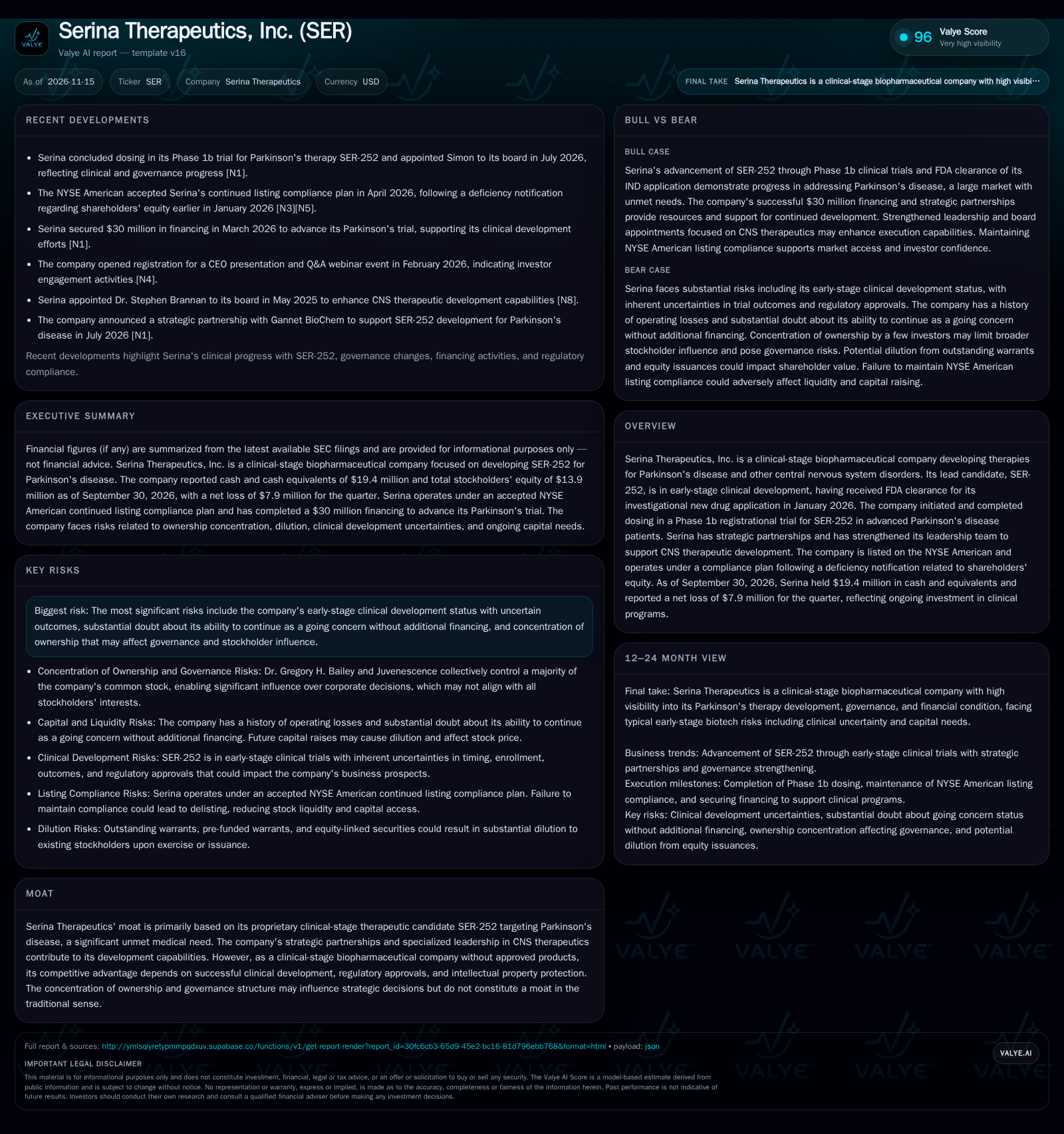
Serina Therapeutics has completed dosing in a Phase 1b trial for its lead Parkinson’s therapy, SER-252, and strengthened its board with CNS expertise. Despite reported liquidity position, its $19.4 million cash position is not sufficient for 12 months of operations, and majority voting control rests with two investors. The company’s future now hinges on securing additional capital and achieving positive clinical outcomes for SER-252, amid substantial dilution and going-concern risks. [S2] [N1]
Serina Therapeutics, Inc. has reached a pivotal juncture in its pursuit of novel CNS therapies, having completed dosing in a Phase 1b trial of its lead compound for advanced Parkinson’s disease. While the company’s bolstered governance and recent clinical progress offer near-term momentum, Serina’s business model is under acute pressure from limited financial runway, substantial ownership concentration, and the binary risks inherent to clinical-stage drug development. The coming quarters will test whether Serina can secure the capital and clinical validation necessary to transition from promise to sustainability in a fiercely competitive neurological therapeutics landscape.
Recent Clinical, Financial, and Governance Developments Set the Stage for a Tense Next Phase
Serina Therapeutics completed dosing in the Phase 1b clinical trial of SER-252, its lead candidate for advanced Parkinson’s disease, in July 2026. This milestone follows FDA clearance of its investigational new drug (IND) application in January 2026, positioning SER-252 as a credible early-stage contender in a high-need therapeutic area. [N1]
As of September 30, 2026, Serina reported $19.4 million in cash and equivalents, a net loss of $7.9 million for the quarter, and stockholders’ equity of $13.9 million. [S2]
The company remains listed on the NYSE American under a compliance plan after a deficiency notice regarding shareholder equity. Failure to maintain compliance could restrict access to public capital markets. [N3] [N5]
Control of the company is highly concentrated: Dr. Gregory H. Bailey and Juvenescence together own more than 60% of the common stock, enabling them to determine the outcome of most corporate matters, including strategic direction and financing terms. [S2]
The Economics of Early-Stage CNS Drug Development: High Upfront Investment, Binary Outcomes
Serina’s business model is typical for a clinical-stage biopharma: large upfront R&D and regulatory costs with no commercial revenue, dependent on external capital to progress pipeline assets. The company’s quarterly net loss of $7.9 million reflects the expense intensity of running early clinical trials and maintaining a lean but specialized organization. [S2]
SER-252, as a CNS therapeutic targeting Parkinson’s disease, addresses a substantial market with significant unmet need. If successful, pricing power could be strong, especially for differentiated disease-modifying therapies. However, commercial upside is entirely contingent on passing multiple clinical and regulatory hurdles, with each successive phase requiring greater capital deployment.
Fixed costs—primarily R&D personnel, trial operations, and intellectual property maintenance—dominate at this stage, while variable costs will only become material if the company advances to late-stage trials or commercialization. Serina’s capital needs are therefore lumpy and escalate with clinical progress, necessitating timely and often dilutive equity or structured financings.
Operating leverage will only materialize if SER-252 or a follow-on asset achieves approval and commercial launch, which is likely years away. Until then, the company’s economics remain negative, with dilution risk heightened by the need for repeated capital raises.
Where Serina Stands in the CNS Therapeutics Race
Serina’s primary asset, SER-252, targets advanced Parkinson’s disease—one of the most competitive and scientifically challenging indications in neurology. While several large pharma and established biotechs are pursuing similar targets, the field remains open due to limited efficacy of current therapies and the complex biology of neurodegeneration.
Potential competitive advantages for Serina could stem from proprietary delivery technologies, differentiated clinical endpoints, or novel mechanisms of action if disclosed in future data. However, without late-stage results or commercial partnerships, Serina’s position remains speculative.
Switching costs in CNS therapeutics are typically high for approved products due to patient and physician risk aversion, but until a product is on the market, barriers to entry primarily hinge on intellectual property, clinical execution, and capital access.
Strategic partnerships or licensing deals with larger pharmaceutical companies are a potential pathway for Serina to mitigate risk and access commercial infrastructure, but such deals usually depend on clear clinical proof-of-concept, which is still pending.
If SER-252 Delivers: How Clinical Success and Strategic Funding Could Transform Serina
A favorable outcome for Serina would hinge on positive clinical data from the Phase 1b trial of SER-252, demonstrating safety and at least early signals of efficacy in advanced Parkinson’s disease patients. Such results would likely catalyze interest from larger pharma, potentially leading to licensing, co-development, or acquisition offers.
The company could then raise new capital on improved terms, reducing dilution and enabling progression to Phase 2/3 pivotal studies. Strong board governance and CNS expertise could further enhance execution and credibility with partners.
Upside confirmation would come from peer-reviewed publication or regulatory feedback validating the clinical results, successful negotiation of non-dilutive funding or collaborative deals, and evidence of sufficient runway to complete the next phase of development.
This scenario would be falsified by inconclusive or negative clinical data, inability to secure additional funds, or failure to attract external interest post-Phase 1b.
Realities of Clinical Development and Capital Markets: Most Likely Outcomes for Serina
The most plausible path for Serina involves mixed Phase 1b outcomes—demonstrating safety but only limited efficacy signals—necessitating further trials and incremental data generation before any transformative partnership or licensing deal.
The high concentration of voting control may streamline decision-making but could also deter some prospective investors wary of governance risk.
Serina’s ability to maintain its NYSE American listing and avoid operational disruptions will hinge on timely capital raising and strict compliance with listing standards.
Evidence confirming this scenario would include modest clinical updates, routine but dilutive financing transactions, and continued focus on operational execution rather than breakthrough announcements.
How Clinical Setbacks or Failed Financing Could Trigger a Strategic Crisis
A negative scenario would unfold if SER-252’s Phase 1b data show safety concerns or fail to demonstrate any efficacy, eroding confidence from both investors and potential partners. In this case, Serina may struggle to raise additional capital on reasonable terms, precipitating a cash crunch and potential workforce reductions or program discontinuations.
Should the company fail to maintain NYSE American listing compliance, public market liquidity and visibility would deteriorate further, making private or rescue financings the only option—typically at punitive terms for existing shareholders.
Ownership concentration could accelerate a strategic pivot, such as asset sales or a distressed merger, but minority shareholders would have little influence over the process or outcome.
Downside confirmation would include adverse clinical disclosures, delayed or failed financings, loss of listing status, and explicit going-concern warnings in regulatory filings.
Milestones and Developments That Will Determine Serina’s Trajectory
Final readout and peer-reviewed publication of Phase 1b clinical trial results for SER-252—especially any efficacy signals or safety concerns.
Announcements regarding new financing transactions, including terms, size, and resulting dilution; a useful metric would be post-financing runway if disclosed.
Maintenance or loss of NYSE American listing status, and any updates on compliance with shareholder equity requirements.
Progression to next-stage (e.g., Phase 2) clinical trials for SER-252, with clear regulatory guidance or feedback.
Strategic partnership or licensing agreements, particularly with larger pharmaceutical firms or CNS-focused investors.
Changes in board composition or governance structure, especially any further alignment with major shareholders like Juvenescence.
Disclosure of additional pipeline assets or research programs beyond SER-252 that could diversify risk.
Disclaimer: This is research-only, informational analysis and not investment advice. It may include AI-generated interpretation and general industry context. Always verify important details using primary sources.

Comments