
Heartflow’s AI Cardiac Platform: Clinical Validation, Reimbursement, and the Stakes of Scaling Adoption
Heartflow’s AI-powered platform for coronary artery disease diagnosis has achieved broad clinical endorsement and payer coverage, but profitability remains elusive as the company invests heavily in market expansion and product development. The next phase will test whether guideline support and a growing product portfolio can drive sustainable margins amid intensifying competition and evolving reimbursement dynamics.
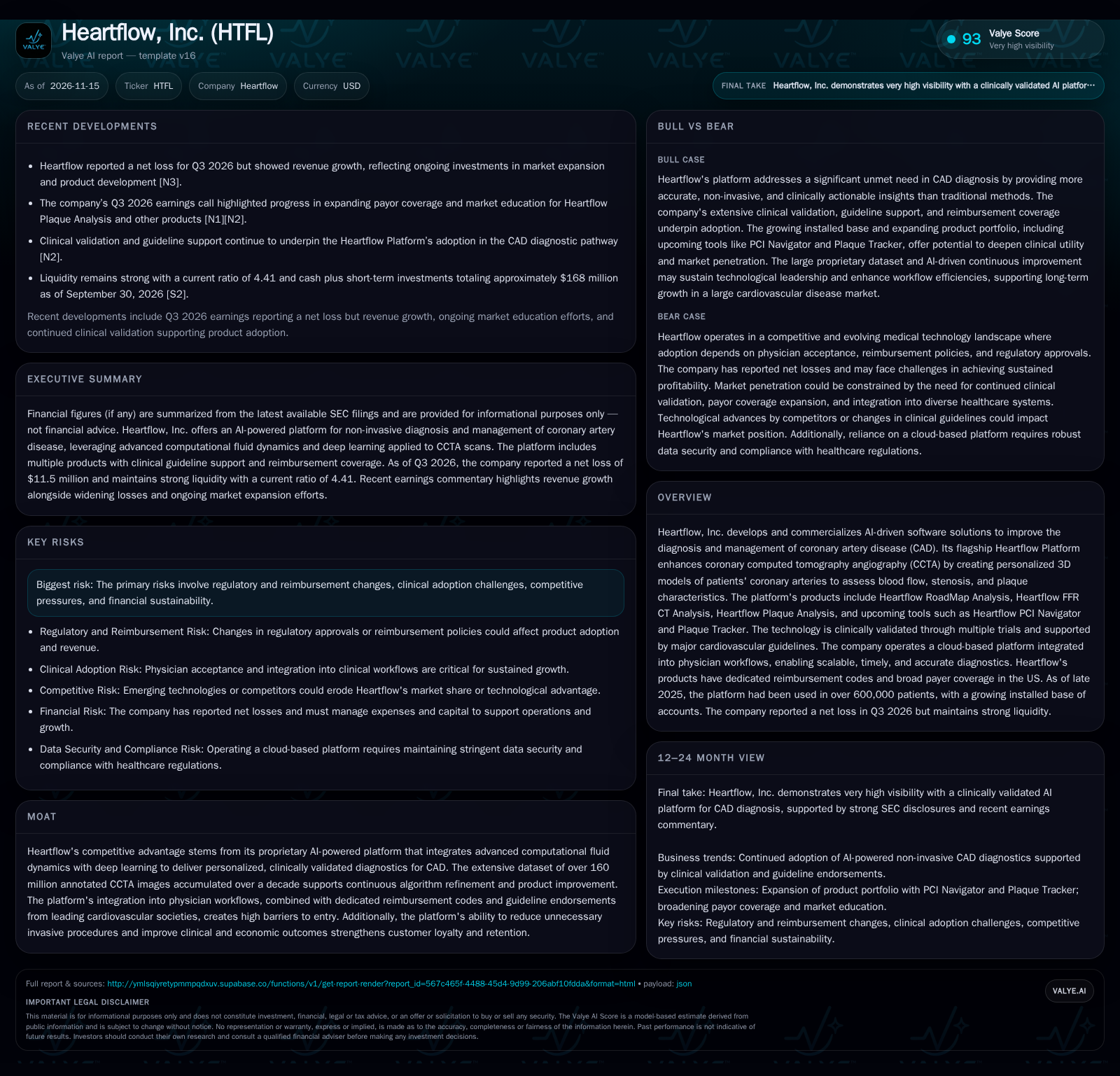
Heartflow’s non-invasive AI platform for CAD diagnosis continues to gain clinical and payer traction, with over 600,000 patients assessed and recent expansion of reimbursement codes. Despite reported liquidity position and growing revenue, losses are widening as the company prioritizes market education and product expansion, leaving profitability and durable adoption as central open questions. Competitive pressure and changes in guidelines or reimbursement could materially impact the long-term thesis. [S1] [S2] [N1] [N2] [N3] [N8]
Heartflow, Inc. stands at a pivotal juncture as its AI-powered platform for diagnosing and managing coronary artery disease (CAD) gains clinical and payer validation, with over 600,000 patients assessed to date. The company’s flagship FFR CT Analysis dominates revenue, but product expansion and increased payer coverage for new tools promise to broaden its economic base. Yet, as Heartflow continues to invest in market education and R&D, net losses are widening, posing questions about the path to sustainable profitability—especially as the competitive landscape and reimbursement environment remain dynamic.
Clinical Guidelines, Reimbursement Expansion, and Persistent Losses: The 2026 Operating Snapshot
The most material recent developments for Heartflow are its expanding payer coverage for both its flagship FFR CT Analysis and the newer Plaque Analysis product, now each supported by dedicated CPT codes in the US as of 2024 and 2026, respectively. These reimbursement milestones pave the way for broader adoption and signal increasing institutional acceptance. Clinical validation and guideline support remain robust: the Heartflow Platform is backed by the American Heart Association and American College of Cardiology, with CCTA as Class 1, Level A and Heartflow FFR CT Analysis as Class 2a, Level B for CAD diagnosis. [S1]
Operationally, Heartflow’s platform has been used on more than 600,000 patients, with 219,000 cases in 2025, demonstrating growing utilization. Yet, FFR CT Analysis continues to account for the vast majority (98%) of revenue, indicating concentration risk. [S1]
Financial results for Q3 2026 show a net loss of $11.5 million and reported liquidity position, with $31.6 million in cash and $136.1 million in short-term investments, yielding a current ratio of 4.41. However, revenue growth has been accompanied by widening losses, reflecting heavy investment in product development and market education. [S2] [N1] [N3] [N8]
How Heartflow’s Platform Model Could Capture Value—And Where the Economics Are Most Exposed
Heartflow’s core business model is built around selling AI-enabled diagnostic analyses for coronary artery disease, primarily as a per-case, software-as-a-service (SaaS)-like offering integrated into hospital and physician workflows. The value proposition is to reduce unnecessary invasive procedures and streamline the diagnostic pathway, which can create strong clinical and economic incentives for adoption if payers and providers recognize and reimburse the additional value.
The company’s economics are currently dominated by its FFR CT Analysis, which accounted for 98% of 2025 revenue, suggesting that diversification—both in terms of product mix and customer use cases—remains a work in progress. The addition of CPT codes for Plaque Analysis and planned launches of PCI Navigator and Plaque Tracker could shift the revenue mix toward a broader platform play, but the timing and magnitude of this transition are unproven. [S1]
Fixed costs are significant, reflecting high R&D, regulatory, and market education expenses. Gross margins may be structurally attractive over time due to the digital, cloud-based delivery model and AI-driven operating leverage, but these benefits are currently offset by high go-to-market and clinical validation costs. The path to profitability likely requires both continued volume growth and a more favorable mix of reimbursed, higher-margin products.
The company reported cash and liquidity metrics for the period; these figures do not by themselves establish operating runway, investment capacity, financial flexibility, or financing capacity. [S2]
Defensible Data, Clinical Validation, and the Realities of the AI Medtech Arms Race
Heartflow’s competitive moat is built on a proprietary, clinically validated AI platform underpinned by an extensive dataset of more than 160 million annotated CCTA images. This data flywheel enables continuous refinement of its algorithms, a barrier that is difficult for new entrants to quickly replicate. Guideline endorsements and dedicated reimbursement codes further entrench Heartflow’s position within standard-of-care pathways. [S1]
However, the landscape is evolving rapidly. Competing solutions—including alternative non-invasive diagnostic software, advanced imaging modalities, and even emerging blood-based biomarkers—are vying for physician mindshare and payer dollars. Large medical device manufacturers and imaging companies, some with deeper pockets and established distribution, are credible threats should they develop or acquire similar AI-based platforms.
Switching costs for hospitals may be moderate, given integration into workflow and reimbursement processes, but not insurmountable if a competitor offers superior accuracy, workflow integration, or economics. The question is whether Heartflow’s head start in data, regulatory acceptance, and clinical evidence can sustain its lead as AI capabilities commoditize and competitive intensity increases.
If Platform Expansion and Guideline Momentum Drive Network Effects and Margin Expansion
In the most favorable scenario, Heartflow leverages its clinical validation, guideline support, and expanded reimbursement to drive rapid adoption of not only FFR CT Analysis but also new products like Plaque Analysis, PCI Navigator, and Plaque Tracker. As more hospitals and health systems adopt the full platform, network effects could emerge: richer data improves algorithm performance, which in turn enhances clinical utility and reinforces provider and payer preference.
Revenue mix would shift toward multiple reimbursed products per patient case, raising average revenue per user and enabling significant operating leverage given the low variable cost of digital delivery. Gross and operating margins would expand as fixed go-to-market and R&D costs are amortized over a larger, more diverse revenue base.
Evidence supporting this scenario would include accelerating adoption rates for new products, sustained or expanding reimbursement levels, and a clear inflection point in margin trajectory—potentially marked by narrowing losses or positive operating cash flow alongside revenue growth.
Clinical Adoption Grows, but Product Mix and Profitability Improve Only Gradually
The most plausible near-term outcome is that Heartflow continues to see incremental growth in FFR CT Analysis usage, with Plaque Analysis and other new tools gaining traction more slowly as market education, workflow integration, and payer adoption progress. Revenue continues to grow, but the mix remains heavily weighted toward the original flagship product for several more quarters or years.
Gross margins improve modestly as volume increases, but operating losses persist due to ongoing investments in R&D and commercial infrastructure.
This scenario would be confirmed by steady, single-digit to low double-digit percentage growth in patient volumes, gradual increases in the proportion of revenue from new products, and stable or slowly improving operating margins—but ongoing net losses and the need for close capital management. [N1] [N2] [N3] [N8]
If Competitive Pressure, Slower Reimbursement Uptake, or Guideline Shifts Erode Momentum
A negative scenario could emerge if new technologies or better-capitalized incumbents offer superior diagnostic accuracy, workflow integration, or economic value, eroding Heartflow’s share of new and existing accounts. Alternatively, if payers delay or restrict reimbursement for Plaque Analysis or other new tools, the anticipated revenue diversification and margin expansion may not materialize.
Clinical guideline changes—such as a downgrade in support for FFR CT Analysis—or new evidence favoring alternative diagnostic approaches could meaningfully reduce demand.
Confirmation of this scenario would include stagnating or declining usage volumes, a reversal in reimbursement trends, flat or shrinking gross margins, and accelerating cash burn relative to current reserves.
Milestones That Could Shift Heartflow’s Clinical and Economic Trajectory
Quarterly patient volume growth for both FFR CT Analysis and new products—especially the pace at which Plaque Analysis and future tools gain adoption—would help test the expansion thesis if disclosed.
The proportion of total revenue contributed by products other than FFR CT Analysis; a rising share would indicate successful platform diversification.
Gross margin trends, as improved product mix and digital scale effects should eventually translate into higher profitability.
Updates on payer coverage, reimbursement rates, and any changes to CPT code status for both existing and new products.
Clinical guideline updates from major cardiovascular societies, which could either reinforce or diminish the platform’s role in standard CAD diagnosis.
Evidence of competitive product launches, new clinical validation data from rivals, or large-scale hospital system contracts awarded to competitors.
Cash burn rate and runway relative to current reserves, as persistent operating losses could eventually test the company’s ability to self-fund growth.
Announcements regarding the commercial launch, initial uptake, and payer acceptance of PCI Navigator and Plaque Tracker.
Disclaimer: This is research-only, informational analysis and not investment advice. It may include AI-generated interpretation and general industry context. Always verify important details using primary sources.

Comments