
Streamex Corp.: Tokenized Gold Ambition, Early Revenue, and the Stakes of Platform Adoption
Streamex’s pivot to tokenized real-world assets—anchored by its GLDY gold token—has generated initial revenue and improved liquidity, but the company’s long-term viability depends on institutional uptake, regulatory clarity, and execution in a highly competitive and evolving digital asset landscape.
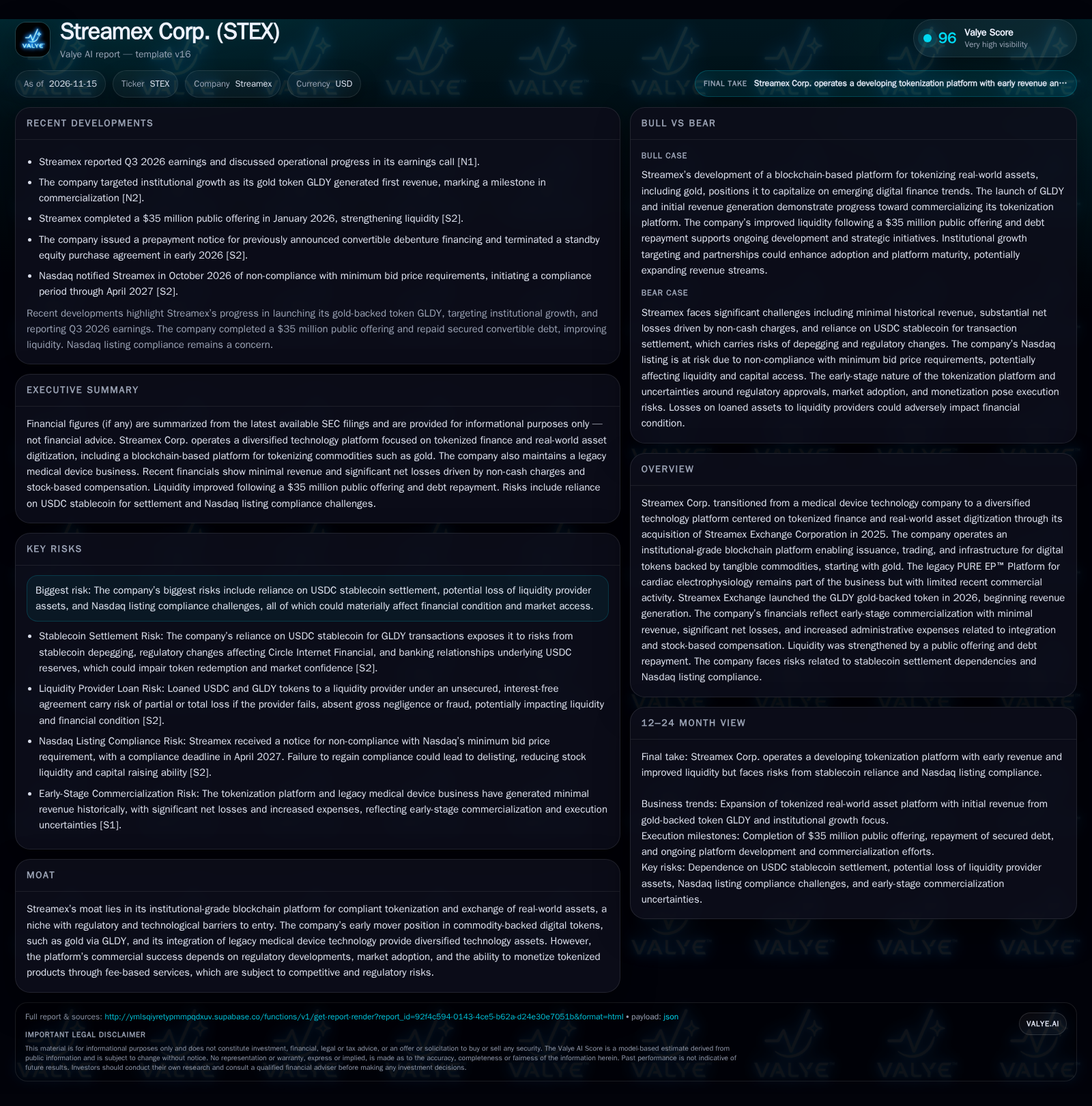
Streamex Corp. has transitioned from medical technology to a blockchain-based platform for tokenizing real-world assets, launching its first gold-backed token (GLDY) and earning inaugural revenue in 2026. The path forward hinges on scaling token adoption, diversifying revenue streams, and navigating regulatory and counterparty uncertainties.
Streamex Corp.’s transformation from a medical device company to a digital asset platform is now at a critical juncture. With the launch of the GLDY gold-backed token, Streamex has begun to monetize its vision of real-world asset (RWA) tokenization, targeting institutional growth and new revenue streams. Yet, the company’s early-stage financials reveal minimal recurring income and substantial losses, while its reliance on USDC for settlement and a looming Nasdaq delisting risk highlight the fragility of its current position. Whether Streamex can scale its platform and establish itself as a durable player in the tokenized finance ecosystem will depend on adoption, operational execution, and the company’s ability to navigate an evolving regulatory and competitive landscape.
GLDY Launch, First Revenue, and Balance Sheet Reset: Recent Developments That Define Streamex’s Trajectory
Streamex Corp. entered a new commercial phase in 2026 by launching the GLDY gold-backed token, which generated its first revenue—a milestone for the company’s pivot into tokenized finance [S1] [N2]. The business reported $145 thousand in gold lease income for Q3 2026, all tied to a single counterparty, indicating early but concentrated adoption. The company reported cash and liquidity metrics for the period; these figures do not by themselves establish operating runway, investment capacity, financial flexibility, or financing capacity. [S2] Despite these improvements, the company posted a net loss of $462.8 million in 2025, largely due to non-cash charges related to derivative liabilities and stock-based compensation [S1]. Streamex also received a Nasdaq notice for minimum bid price non-compliance, with a deadline of April 2027 to regain compliance [S2]. The combination of early-stage revenue, significant losses, and regulatory overhang frames both the opportunity and the risks ahead.
How Streamex’s Tokenized Asset Model Could Turn Scale into Profitability
Streamex’s core business model is to monetize the tokenization and exchange of real-world assets, starting with gold, through its blockchain-based platform. The GLDY token is designed to represent fractional ownership of physical gold, with revenue potential from origination fees, transaction fees, and income derived from leasing gold assets. In Q3 2026, all reported revenue stemmed from leasing company-owned gold to a single third-party, suggesting that platform-driven, recurring transaction or management fees from a broader user base are not yet material [S2].
The company’s cost structure currently skews heavily toward fixed costs, especially general and administrative expenses—driven in large part by stock-based compensation and integration costs from the acquisition of Streamex Exchange [S1]. Variable costs may increase as transaction volumes rise, but the underlying infrastructure should offer operating leverage if token adoption scales and transaction frequency increases.
Capital requirements are non-trivial: Streamex must acquire and securely store physical gold to back GLDY issuance, requiring working capital and robust custody arrangements. The company has also extended loans of USDC and GLDY to liquidity providers to facilitate secondary-market trading, introducing counterparty risk [S2]. Future expansion into other RWAs or token types would likely require additional capital and regulatory compliance investment. The path to profitability hinges on rapidly growing adoption, diversifying revenue streams beyond gold leasing, and managing fixed costs as the business scales.
Can Streamex Build Durable Advantages in the Crowded Tokenization Arena?
Streamex is attempting to carve out a niche in the burgeoning market for tokenized real-world assets, a space attracting attention from both crypto-native players and established financial institutions. The company’s platform differentiates itself through compliance features and institutional-grade infrastructure, with GLDY positioned as a gold-backed digital asset intended to appeal to investors seeking on-chain exposure to tangible value.
However, the competitive landscape is intense. Entrants range from regulated exchanges, fintechs, and blockchain consortia to decentralized autonomous organizations (DAOs) offering similar tokenized gold products. Larger competitors may have deeper capital reserves, broader user bases, and established regulatory relationships, potentially allowing them to scale more quickly or offer lower fees. Substitution risk is high: investors and institutions can already access gold exposure via ETFs, futures, or other digital gold tokens. Streamex’s moat may depend on seamless compliance, superior custody solutions, liquidity depth, and the ability to attract institutional partners.
Switching costs for customers are likely low unless Streamex can build network effects via liquidity, integrations, or unique asset offerings. As the ecosystem matures, the company’s ability to secure regulatory clarity and foster trust—especially around the stability of settlement layers like USDC—will be crucial for sustained differentiation.
If Institutional Adoption Accelerates, Streamex’s Platform Could Achieve Operating Leverage and Broaden Its Asset Base
In the most favorable scenario, Streamex’s compliance-first infrastructure and early GLDY success attract institutional investors seeking regulated, on-chain exposure to gold and other RWAs. As platform adoption grows, transaction volume increases, generating recurring fee income from origination, trading, and asset management. Operating leverage emerges as fixed costs are spread over a larger revenue base, and Streamex leverages its gold program to launch additional asset-backed tokens (e.g., real estate, other commodities).
Key confirming evidence would include: multi-counterparty revenue growth from transaction and management fees (not just gold leasing), partnerships with institutional asset managers or custodians, sustained increases in issued GLDY tokens with robust secondary-market liquidity, and announcements of new tokenized asset classes. Regulatory clarity—particularly around USDC and the treatment of digital securities—would further validate the model. A return to Nasdaq compliance and positive operating cash flow would signal the transition from early-stage risk to scalable business.
Early Traction but Slow Scaling: Streamex Stays Niche as RWA Tokenization Proves Complex
The most plausible near-term outcome is that Streamex continues to generate modest, concentrated revenue from GLDY-related leasing and limited platform activity, while broader institutional adoption remains slow due to regulatory uncertainty, competition, and customer inertia. The company’s cost base stays high due to ongoing platform development, compliance, and administrative overhead, resulting in continued net losses and periodic capital needs.
Evidence supporting this scenario would include flat or only gradually rising revenue, continued reliance on a small number of counterparties, and a lack of major new partnerships or asset launches. If Nasdaq compliance is regained but only through short-term measures like a reverse stock split rather than organic share price recovery, that would also support a base-case view of incremental rather than transformative progress. A useful falsification would be a sudden acceleration in transaction volumes or a significant institutional deal that materially alters the revenue mix.
If Settlement, Counterparty, or Listing Risks Materialize, Streamex’s Platform Could Be Disrupted Before Scaling
Several adverse outcomes could derail Streamex’s ambitions. Regulatory action or technical failure affecting USDC could disrupt GLDY settlement, undermining user confidence and liquidity. A failure or default by the company’s liquidity provider (to whom substantial USDC and GLDY have been loaned) could result in asset loss, impairing both operations and market confidence. If the single counterparty for gold leasing withdraws, Streamex could lose its only current revenue source, forcing further dilution or downsizing.
Failure to regain Nasdaq compliance by April 2027 would likely result in delisting, reducing share liquidity and access to capital markets. If expenses remain elevated without a clear path to diversified revenue, the company could face a cash crunch and be forced to curtail development or seek distressed financing. Evidence confirming this scenario would include regulatory developments that negatively impact stablecoins, counterparty defaults, abrupt revenue declines, or delisting notices.
Milestones and Metrics That Will Reveal Streamex’s Platform Trajectory
The number of active counterparties and total revenue from GLDY transactions—tracking whether platform adoption is broadening beyond a single relationship (if disclosed).
Transaction volume and fee income from the Streamex Exchange platform, especially recurring versus one-off revenue streams (would help test the thesis).
Regular updates on the company’s Nasdaq listing status and any actions taken to regain compliance.
Exposure to USDC settlement risk: monitoring regulatory actions affecting Circle Internet Financial and the stability of USDC as a settlement layer.
Counterparty concentration of gold leasing income and any expansion to additional lessees or asset classes.
Evidence of new partnerships with institutional investors, custodians, or asset managers, suggesting greater market acceptance.
Cash flow from operations relative to capital expenditures and ongoing working capital requirements, as a test of business sustainability.
Announcements regarding the launch of tokenized assets beyond gold, which would indicate platform scalability and ambition.
Disclaimer: This is research-only, informational analysis and not investment advice. It may include AI-generated interpretation and general industry context. Always verify important details using primary sources.

Comments