
SES AI: Battery Innovation, Cash Reserves, and the Stakes of Commercial Execution in a Competitive EV Supply Chain
SES AI Corporation sits at the intersection of advanced battery R&D and the unforgiving realities of public markets. With a substantial liquidity buffer and a founder-led team of scientists, the company confronts persistent financial losses, NYSE compliance hurdles, legal headwinds, and intense competition as it pursues commercial traction for its electric vehicle battery technology.
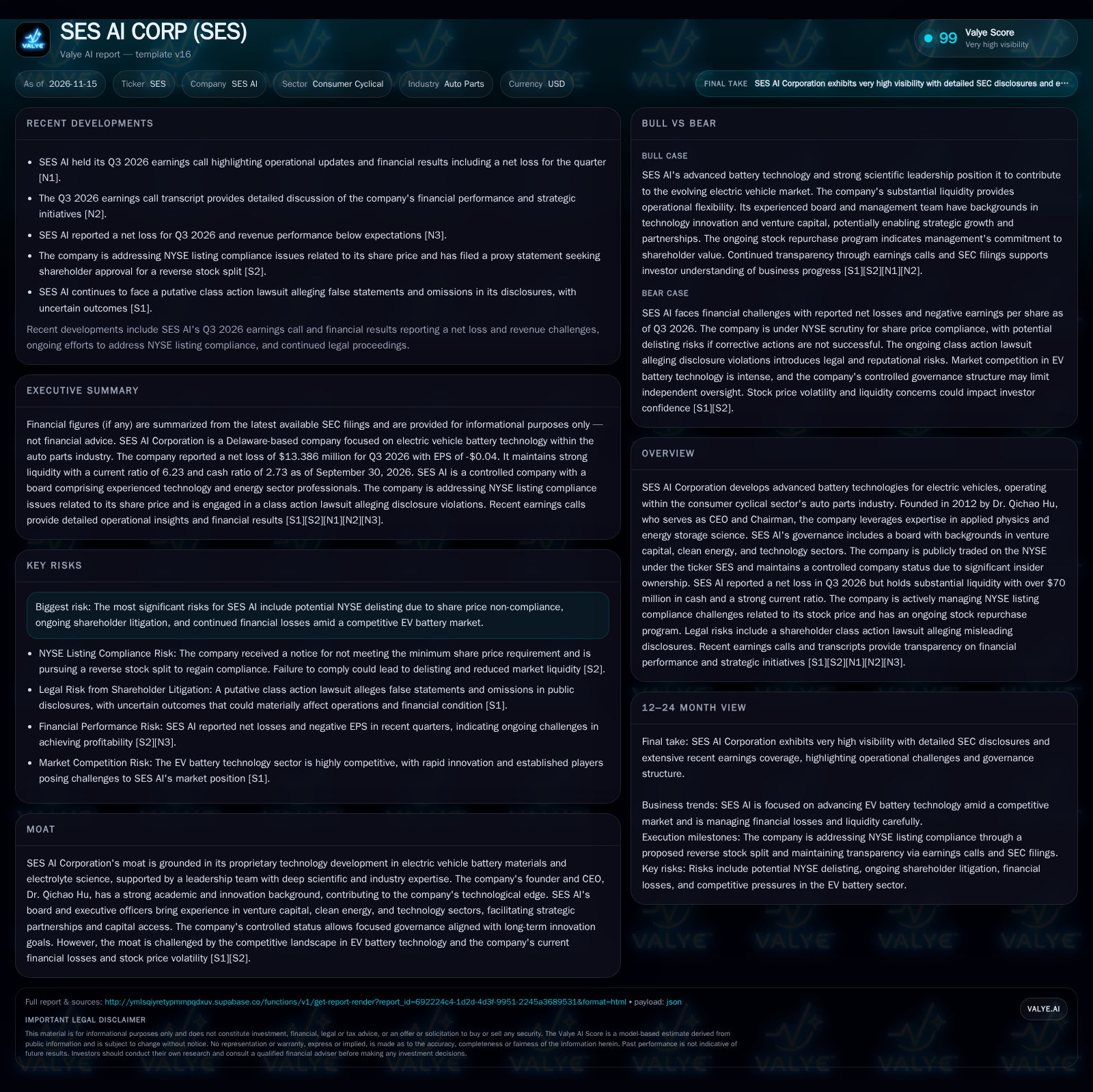
SES AI is a cash-rich, founder-led battery innovator facing net losses, stock price compliance challenges, and a shareholder lawsuit. The company’s ability to translate its technology into commercial wins amid a fiercely competitive EV battery landscape will likely determine its long-term value [S1] [S2] [N3].
As an innovator in electric vehicle battery technology, SES AI must prove it can transition from R&D to scalable, profitable commercialization in a sector dominated by well-capitalized incumbents. The coming quarters will test whether its proprietary science and founder-led vision can overcome financial headwinds, regulatory scrutiny, and the competitive intensity of the EV supply chain [S1] [S2] [N3].
Financial Losses and Stock Price Compliance Shape SES AI’s Immediate Outlook
SES AI reported a net loss of $13.4 million for Q3 2026, translating to negative earnings per share and revenue that lagged expectations [S2] [N3]. This persistent loss profile highlights the ongoing challenge of funding advanced battery R&D prior to meaningful commercial ramp. [S2] However, the company’s share price fell below NYSE minimum requirements, triggering a compliance notice and prompting a proposed reverse stock split to avoid delisting [S2]. Overlaying these operational and market pressures is a putative class action lawsuit alleging false statements and omissions in public disclosures, which adds legal and reputational uncertainty [S1]. Collectively, these facts frame a business with technical promise but facing acute execution and capital market scrutiny.
How SES AI’s Battery R&D Could Become a Scalable Business—And Where the Bottlenecks Lie
SES AI’s business model centers on the development and potential commercialization of advanced lithium-metal battery technology for electric vehicles. In principle, value creation could come from licensing proprietary materials science, supplying battery components or cells, or forming joint development agreements with automakers and tier-1 suppliers. The mix of revenue sources—whether high-margin licensing, capital-intensive manufacturing, or hybrid models—remains undisclosed, making it difficult to assess the likely margin structure or capital intensity.
If SES AI pursues direct cell manufacturing, the economics hinge on scaling up pilot lines to volume production, which typically involves high upfront capex, rigorous quality control, and long lead times before positive gross margins. Alternatively, a licensing or JV model could reduce fixed costs and working capital needs but may cap upside if SES AI cannot capture a meaningful share of value-added. Operating leverage could be substantial if SES AI achieves high-volume adoption, as R&D and SG&A are largely fixed relative to eventual production output. However, persistent net losses suggest the company has yet to achieve meaningful revenue scale, and the path to breakeven will likely depend on both technical validation and commercial contracts with major EV OEMs or battery integrators.
Competing for EV Battery Relevance: SES AI’s Moat Versus Industry Giants
SES AI’s core competitive asset is its proprietary battery technology, supported by a founder-CEO with a PhD in applied physics and a board heavy on technical and venture expertise [S1]. The company’s moat rests on the potential performance advantages of its lithium-metal cell chemistry—such as higher energy density, faster charging, or improved safety—relative to incumbent lithium-ion designs. However, the EV battery ecosystem is dominated by established giants with formidable scale, entrenched customer relationships, and deep pockets for R&D (e.g., CATL, LG Energy Solution, Panasonic, and automotive OEM in-house efforts).
Switching costs in EV battery supply are significant due to long qualification cycles, safety/regulatory hurdles, and OEM risk aversion. Even with superior technology, SES AI must convince automakers to adopt its chemistry, which likely requires multi-year testing and validation. The company’s controlled status allows for focused long-term decision-making, but could also limit independent oversight and responsiveness to public shareholders. In sum, SES AI’s ability to carve out a durable competitive position will depend on both the demonstrable superiority of its technology and its success in forging deep, durable relationships with OEMs or tier-1 suppliers.
What a Commercial Breakthrough Could Look Like—and the Evidence That Would Confirm It
The most favorable scenario for SES AI would involve technical validation of its battery platform by a major automaker or tier-1 supplier, followed by a commercial supply agreement or licensing deal. This could trigger a step-change in revenue, provide external validation of the technology, and potentially attract further strategic investment. If SES AI’s chemistry offers a clear and sustainable edge in energy density, cost, or cycle life compared to incumbent lithium-ion or solid-state alternatives, it could position itself as a critical enabler in the next generation of EVs.
Concrete evidence would include the announcement of a multi-year commercial contract with a blue-chip OEM, disclosure of large-scale pilot production orders, or publicized joint ventures with industry leaders. Early signals could also come from disclosed customer validation milestones, expanded pilot deployments, or data from third-party testing showing superior performance. Falsification would occur if SES AI’s technology lags on key metrics, fails to attract credible partners, or if announced pilots do not progress to commercial scale.
Incremental Progress and Persistent Losses as SES AI Seeks Commercial Validation
The most plausible near-term scenario is that SES AI continues to invest heavily in R&D and pilot-scale validation while running operating losses. The company likely seeks to extend its cash runway through disciplined cost management, opportunistic financing, or further stock repurchases to support its share price. Progress may be measured by incremental technical milestones, pilot agreements, or research collaborations, but without a transformative commercial contract, revenue growth would remain modest and losses could persist.
Evidence confirming this trajectory would include ongoing cash burn with only gradual increases in revenue or partnership disclosures, continued references to technical milestones rather than commercial contracts in earnings calls, and further efforts to maintain NYSE compliance. A shift toward profitability or major commercial wins would falsify this scenario, while a deterioration in liquidity or adverse legal outcomes could tip the trajectory toward distress.
When Innovation Isn’t Enough: What Could Derail SES AI’s Strategy
The most adverse scenario involves SES AI failing to secure commercial adoption for its battery technology, leading to continued losses and eventual depletion of its liquidity buffer. In this case, the company could face delisting if share price compliance is not restored, further eroding investor confidence and limiting access to capital markets. The unresolved class action lawsuit could result in material financial or reputational damage, compounding the company’s challenges.
This scenario would be confirmed by accelerating cash burn without revenue inflection, failure to announce new partnerships or contracts, negative legal developments, and the need for dilutive financing or asset sales. A loss of key personnel, especially from the technical leadership, or evidence that competitors have leapfrogged SES AI’s technology would further undermine the long-term outlook.
Milestones That Will Define SES AI’s Transition from R&D to Commercial Viability
Disclosure of commercial contracts or multi-year supply agreements with major automakers or tier-1 suppliers would be a crucial indicator of real market traction.
Updates on pilot production capacity, customer validation milestones, or third-party performance data would clarify technical progress and readiness for scaling.
Sustained cash burn rates and cash runway projections, if disclosed, would help test whether SES AI can bridge the gap to commercialization without further dilution.
Resolution or escalation of the ongoing shareholder class action lawsuit, as any material settlement or adverse ruling could directly impact the balance sheet and investor perception.
Progress on NYSE share price compliance—specifically, the outcome of the proposed reverse stock split and whether the company avoids delisting.
Management turnover, particularly within the technical or executive leadership ranks, would signal either risk or strategic realignment.
Partnerships, joint ventures, or investment from established industry players would serve as external validation and potentially de-risk the commercial path.
If disclosed, customer retention rates or repeat business metrics would help assess the stickiness of SES AI’s technology within its target markets.
Disclaimer: This is research-only, informational analysis and not investment advice. It may include AI-generated interpretation and general industry context. Always verify important details using primary sources.

Comments