
Journey Medical: Commercial Dermatology Portfolio Faces Pressure to Deliver Amid Margin and Market Realities
Journey Medical Corp’s diverse dermatology product lineup—anchored by recently launched Emrosi and established brands like Qbrexza and Accutane—positions the company to address large prescription markets. However, persistent net losses, competitive intensity, and product concentration risks highlight the challenge of translating portfolio breadth and patent protection into sustained profitability.
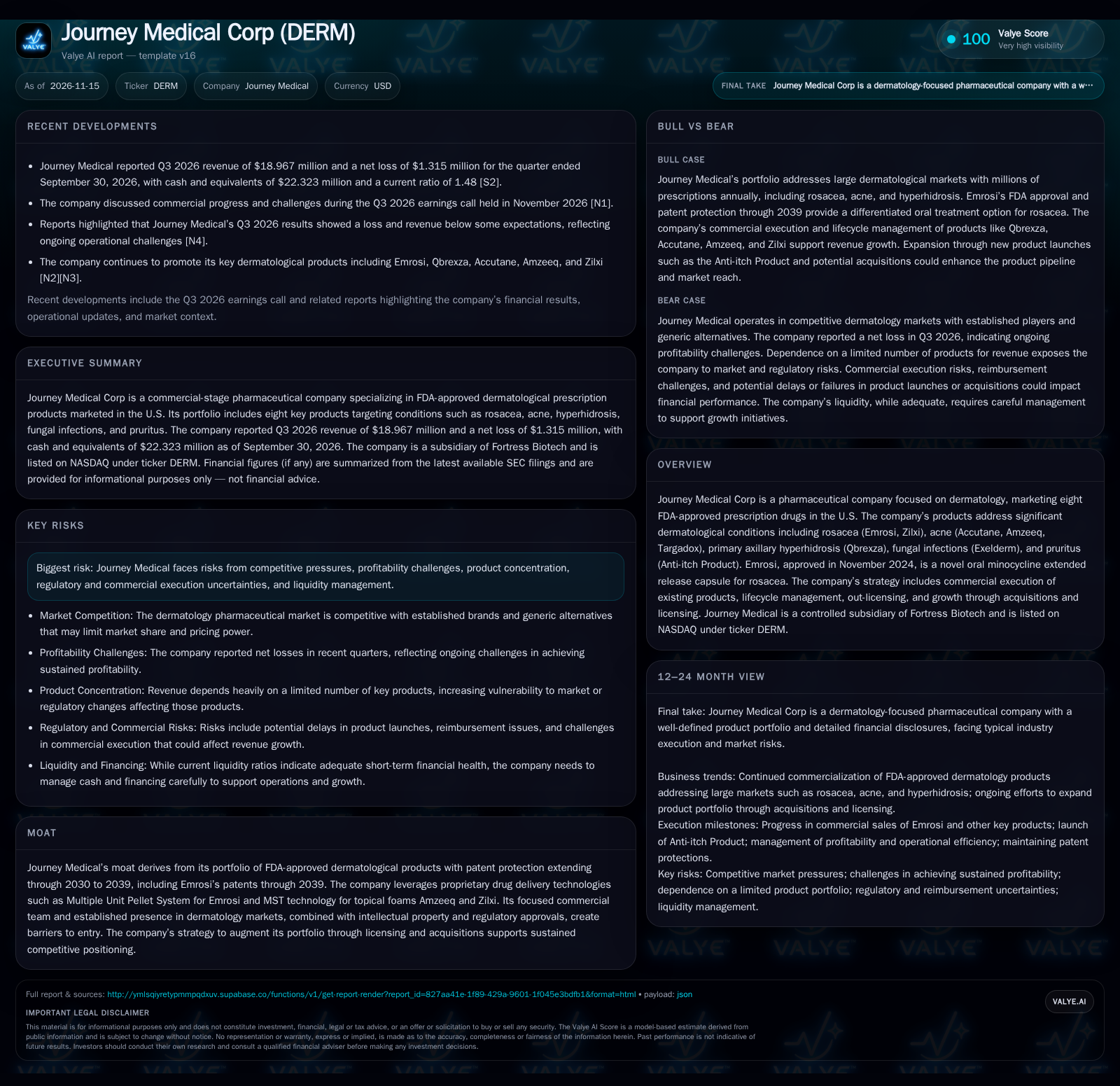
Journey Medical’s Q3 2026 revenue of $18.97M and net loss of $1.32M reflect the ongoing struggle to scale its dermatology drug portfolio into durable profits. With Emrosi’s launch targeting the large rosacea market and several products under patent protection, the company’s near-term trajectory will hinge on commercial execution, product adoption, and margin management in a crowded field. Watch for progress on new launches, profitability milestones, and signs of product or market expansion.
Journey Medical Corp sits at a critical juncture, balancing a broadened portfolio of FDA-approved dermatology products against the unyielding pressures of competition, margin erosion, and operational scale.
Recent Financials and Portfolio Developments Define the Stakes
Journey Medical reported Q3 2026 revenue of $18.967 million and a net loss of $1.315 million, illustrating ongoing challenges in achieving profitability despite a broadened product portfolio [S2]. Emrosi, a novel oral minocycline for rosacea, was approved in late 2024 and has been actively promoted since April 2025, expanding the company’s addressable market with patent protection extending through 2039. [S2] The product lineup now covers several major dermatological indications, but sales remain concentrated and margins are pressured by competitive dynamics [N4].
How Journey Medical’s Commercial Model Drives (and Limits) Value Creation
Journey Medical’s business model is anchored in commercializing a portfolio of FDA-approved dermatology drugs, most of which are acquired or in-licensed, rather than internally discovered. Revenue is generated from direct sales to U.S. dermatologists and pharmacies, with reimbursement dynamics playing a critical role in realized pricing—especially in indications like rosacea, acne, and hyperhidrosis where generics and established brands are entrenched. The company’s cost structure combines relatively fixed salesforce and marketing overhead (to drive prescription growth and awareness) with variable costs of goods sold, creating potential for operating leverage if product adoption scales.
However, persistent net losses suggest that either gross margins are compressed by payor rebates and competitive discounting, or that SG&A required to sustain and grow the portfolio remains high relative to current revenue [S2]. The addition of Emrosi and the anticipated launch of the Anti-itch Product introduce opportunities for incremental volume and revenue mix improvement, but the path to profitability likely requires either a step-change in sales productivity, margin expansion through lifecycle management (e.g., new formulations, exclusivity extensions), or a reduction in commercial and administrative overhead.
A critical factor influencing Journey Medical’s commercial scalability is the interplay between salesforce efficiency and reimbursement environment volatility. Given the specialized nature of dermatology prescribing, the company’s investment in a knowledgeable salesforce is necessary but costly, and the return on this investment depends heavily on payor acceptance and formulary positioning. If reimbursement policies tighten or shift unpredictably, the company may face pressure to increase discounting or rebates, which would further compress gross margins. Conversely, establishing strong payer relationships and securing favorable formulary tiers could enhance pricing power and reduce the need for aggressive sales incentives, thereby improving overall profitability.
Moreover, the lifecycle management of existing products through formulation improvements, new indications, or delivery mechanisms could serve as a lever to extend exclusivity and defend margins. However, such strategies require upfront R&D and regulatory investment, which must be balanced against the company’s current financial constraints. The timing and success of these initiatives are inherently uncertain and contingent on market acceptance and regulatory approval processes. Effective lifecycle management could also mitigate risks associated with patent cliffs by smoothing revenue declines and providing incremental growth, but failure to innovate or differentiate may accelerate revenue erosion in the face of generic competition.
Competitive Landscape: Differentiation, Generics, and Barriers to Entry
Journey Medical competes in a highly fragmented and competitive U.S. dermatology market, contending with both large branded pharmaceutical firms and a wide array of generics. Its current advantages stem from a portfolio of FDA-approved products with patent protection—most notably Emrosi (patents through 2039), Amzeeq, Zilxi, and Qbrexza, each with multiple Orange Book-listed patents extending into the next decade. These protections offer a window of exclusivity and support for premium pricing, particularly for newer or differentiated formulations.
However, the market for conditions like rosacea and acne is crowded, and switching costs for prescribers and patients are typically low unless a product offers marked clinical or convenience benefits. As a result, sustained commercial success will depend on Journey Medical’s ability to demonstrate superior efficacy, tolerability, or patient preference relative to both branded competitors and lower-priced generics.
Out-licensing and lifecycle management provide potential avenues for extending the economic life of key assets, but ultimately, the company’s position is vulnerable to new entrants, generic erosion post-patent expiry, and formulary/reimbursement shifts that could undermine pricing power.
In addition to patent protection, Journey Medical’s ability to maintain differentiation will depend on generating robust clinical evidence and real-world outcomes data that resonate with prescribers and payors. Demonstrating superior safety profiles, convenience, or adherence benefits can justify premium pricing and support formulary placement. However, the cost and time required to generate such data can be substantial, and the competitive response from incumbents or generics may include rapid introduction of alternative formulations or aggressive pricing strategies. Consequently, the company’s competitive positioning is not static but requires ongoing investment in clinical development and market access activities to sustain differentiation.
Emrosi Adoption and Portfolio Expansion Unlock Margin Upside
A favorable outcome for Journey Medical would see Emrosi gain significant market share in the rosacea segment, leveraging its oral minocycline extended release profile and long patent runway to capture prescriber attention and drive sustained prescription growth. If the company can achieve strong commercial uptake—supported by positive physician feedback, formulary wins, and minimal generic competition—this could translate into higher-margin revenue and improved operating leverage as fixed costs are spread over a larger sales base.
In parallel, successful launch and adoption of the Anti-itch Product and further portfolio expansion via licensing or acquisition could diversify revenue streams and reduce concentration risk. Evidence that would confirm this scenario includes accelerating revenue growth attributable to new products, gross margin improvement, and a positive inflection in operating cash flow. A marked reduction in quarterly net losses or a transition to profitability would be strong validation.
Portfolio Breadth Offsets Some Pressure, But Margins Remain Tight
The most plausible trajectory sees Journey Medical maintaining moderate revenue growth as Emrosi, Amzeeq, and Zilxi gain incremental share, but with commercial headwinds—such as competitive discounting, reimbursement hurdles, and slow adoption—limiting gross margin expansion. The company’s operating losses may narrow but persist, as incremental sales are offset by the ongoing cost of a specialized salesforce and marketing required to support branded dermatology drugs in a crowded market.
Product launches and lifecycle management efforts provide some buffer against revenue concentration, but the overall economics are constrained by the need to invest continually in promotion, compliance, and new product access. Confirmation of this scenario would include modest but steady revenue increases, stable or slightly improving gross margins, and continued—though potentially shrinking—operating losses over the next several quarters.
Competitive Erosion and Execution Risks Threaten the Path to Profitability
In an adverse scenario, Journey Medical fails to achieve meaningful uptake for Emrosi and other newer products, either due to entrenched competition, limited differentiation, or reimbursement setbacks. If established brands and generics successfully defend share or force aggressive discounting, the company could see stagnant or declining revenue, further margin compression, and potentially widening net losses.
Additional risks include delays or disappointments in new product launches (such as the Anti-itch Product), regulatory setbacks, or failure to realize anticipated synergies from acquisitions or licensing deals. Evidence supporting this scenario would be flat or falling sales, declining gross margins, persistent or growing operating losses, and potential signals of liquidity management stress, such as reduced cash balances or the need for dilutive financing.
Milestones and Metrics That Will Signal Whether Journey Medical Can Deliver Durable Growth
Sustained sequential revenue growth attributable to Emrosi and new product launches, with product-level sales breakdowns if disclosed.
Gross margin trends on a quarterly basis—expansion would indicate improved pricing power or cost control, while contraction may signal competitive or reimbursement pressures.
Operating cash flow and net income progression, with a focus on whether losses are narrowing or the company approaches breakeven.
Commercial traction for the Anti-itch Product following its planned launch in the first half of 2026, as measured by prescription volume and market share if available.
Updates on out-licensing deals, acquisitions, or other portfolio expansion efforts that could diversify revenue and reduce product concentration risk.
Signals of pricing or formulary access changes for key brands, particularly Emrosi, Qbrexza, and Accutane.
Disclaimer: This is research-only, informational analysis and not investment advice. It may include AI-generated interpretation and general industry context. Always verify important details using primary sources.

Comments