
Kodiak Sciences at a Crossroads: Late-Stage Retinal Pipeline Progress, Financial Pressures, and the Stakes of Differentiation
Kodiak Sciences nears pivotal clinical readouts for its extended-durability retinal therapies, with Zenkuda and bispecific biologics positioned to challenge incumbents in diabetic retinopathy and wet AMD. Yet persistent net losses and looming capital needs underscore the high stakes: success or setback in upcoming data could redefine Kodiak’s trajectory.
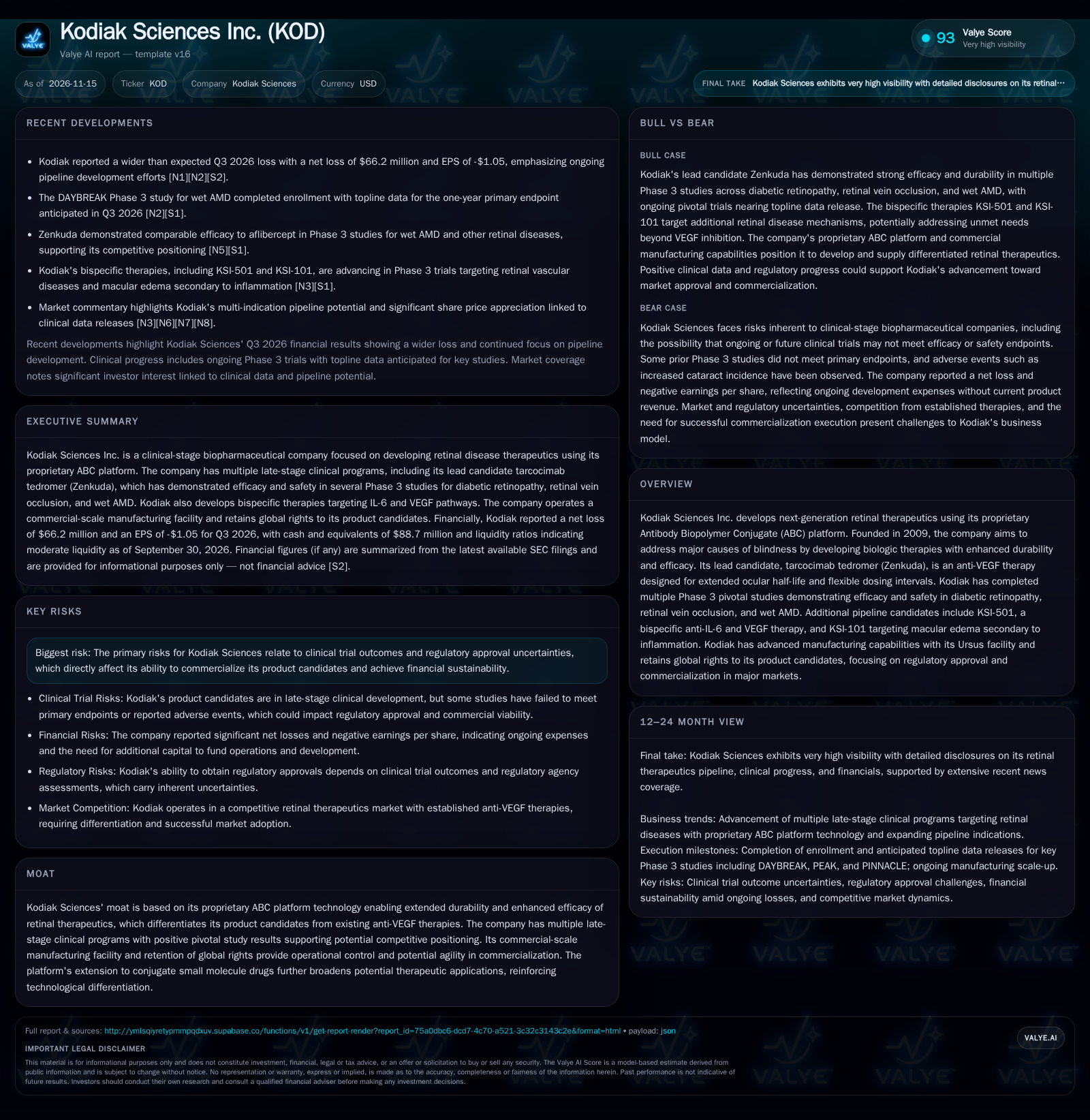
Kodiak Sciences is approaching critical late-stage data releases for its lead retinal disease candidates, including Zenkuda and novel bispecific antibodies. Recent Phase 3 results suggest efficacy competitive with existing therapies, but the company continues to report steep losses and reported liquidity position. The commercial viability of Kodiak’s pipeline—and its ability to sustain operations—will hinge on near-term clinical outcomes, regulatory progress, and eventual market adoption in a highly competitive space. [S1] [S2] [N2] [N5]
Kodiak Sciences is on the cusp of a decisive period, with late-stage clinical data for its next-generation retinal therapies—most notably Zenkuda—set to land in the coming months. The company’s ABC platform aims to extend treatment durability in diabetic retinopathy and wet AMD, two of the largest markets in ophthalmology. Having matched the efficacy of aflibercept in Phase 3 trials, Kodiak could break into a space long dominated by established anti-VEGF treatments. However, persistent net losses and a cash balance that may not suffice through commercialization mean that the results of upcoming trials could either propel Kodiak into the ranks of commercial-stage biotechs or force difficult strategic decisions. The stakes are high, with clinical, regulatory, and financial outcomes tightly intertwined. [S1] [S2] [N2] [N5]
Pivotal Data Approaches as Kodiak Balances Pipeline Progress and Financial Strain
Kodiak Sciences reported a net loss of $66.2 million for Q3 2026, with cash and equivalents standing at $88.7 million as of September 30, 2026. The company’s current ratio of 1.7 and cash ratio of 1.62 indicate reported liquidity position but highlight finite resources in the absence of product revenue. [S2]
The company’s lead candidate, Zenkuda (tarcocimab tedromer), completed multiple Phase 3 studies, including in wet AMD, where it matched the efficacy of aflibercept—a market standard. Topline results from the DAYBREAK Phase 3 study for wet AMD, as well as ongoing pivotal trials for bispecific candidates KSI-501 and KSI-101, are expected in the near term. [S1] [N2] [N5]
Commercialization Economics: High Stakes, High Leverage, and Uncertain Runway
Kodiak’s business model is typical of late-stage biopharma, with high R&D spending and no product revenue until regulatory approval. The company’s economics hinge on converting late-stage pipeline assets into approved, marketable therapies. If successful, the ABC platform’s promise of extended dosing intervals could allow for premium pricing or improved market access, especially if payers and physicians are convinced of the value versus established anti-VEGF agents.
The fixed cost base includes R&D, late-stage clinical trial expenses, and the maintenance of the Ursus commercial-scale manufacturing facility. Variable costs would rise significantly if products are commercialized, but high gross margins are plausible in specialty biologics if Kodiak can secure favorable reimbursement.
Kodiak’s cash burn and net losses reflect the capital-intensive nature of late-stage drug development. Without near-term product revenue, the company will likely require additional financing—via equity, partnerships, or debt—to sustain operations through regulatory approval and launch. Operating leverage could be substantial if even one major indication is approved, but the timing and magnitude of this inflection remain highly uncertain.
Can Differentiation in Durability and Multi-Targeting Dislodge Retinal Market Incumbents?
Kodiak’s ABC platform aims to differentiate via extended durability—potentially reducing injection frequency from monthly to quarterly or even semiannually. This is a key patient and provider pain point with current anti-VEGF therapies, where frequent injections limit adherence and outcomes. If Kodiak’s pivotal data confirm non-inferiority or superiority in both efficacy and dosing convenience, the company could capture share from established incumbents.
The bispecific pipeline (KSI-501 and KSI-101) targets both VEGF and IL-6 pathways, potentially addressing disease processes not fully controlled by VEGF inhibition alone. This mechanistic breadth could enable Kodiak to expand into indications with fewer effective options or to offer disease-modifying benefits.
However, the retinal biologics market is fiercely competitive, with entrenched players, high payer scrutiny, and a growing pipeline of biosimilars and next-generation agents. Switching costs for physicians may be more behavioral than contractual, hinging on data strength, safety, and real-world experience. Kodiak’s retention of global rights and in-house manufacturing could improve agility, but commercial success will require not just approval, but rapid, broad adoption.
What If Zenkuda and Bispecifics Surpass Clinical and Regulatory Hurdles?
In a favorable scenario, topline data from the DAYBREAK study and ongoing pivotal trials would demonstrate not only non-inferior efficacy but also clear advantages in dosing frequency, safety, or additional endpoints. Regulatory approvals in the US and other major markets could follow, with rapid payer uptake if Kodiak can demonstrate meaningful reductions in treatment burden and healthcare utilization.
Market penetration would be accelerated if physicians and patients quickly adopt extended-interval regimens, especially in indications like diabetic retinopathy and wet AMD, where chronic management is challenging. The bispecifics, if successful, could unlock new patient segments or command premium pricing due to their differentiated mechanism.
Evidence for this scenario would include statistically significant positive topline data, FDA/EMA approvals, favorable guideline inclusion, and strong initial launch metrics (e.g., prescription growth, formulary wins). Conversely, unexpected safety signals, regulatory delays, or tepid physician adoption would challenge this trajectory.
Most Likely Trajectory: Incremental Progress, Capital Needs, and Gradual Adoption
The most plausible scenario is that Kodiak achieves regulatory approval for at least one major indication, such as wet AMD or diabetic retinopathy, based on non-inferiority to existing therapies and acceptable safety. However, initial uptake may be modest, as payers and providers assess long-term data and real-world experience.
Manufacturing scale-up and commercial infrastructure would add further near-term expense.
Confirming this scenario would be a combination of positive but not transformative clinical data, regulatory approvals in one or more geographies, and gradual, stepwise revenue ramp. Falsification would come from major trial failures, inability to raise capital, or significant safety/efficacy concerns that stall approval or adoption.
If Late-Stage Data Disappoint or Financing Falls Short
The principal risk is that one or more pivotal trials (e.g., DAYBREAK, PEAK, PINNACLE) fail to meet their primary endpoints or reveal safety concerns that outweigh the benefits of extended durability or novel mechanisms. Regulatory setbacks could delay approvals by years or preclude market entry entirely.
With net losses and limited cash, Kodiak could face a liquidity crunch if additional capital is unavailable or prohibitively dilutive. In this scenario, the company may be forced to halt development, pursue asset sales, or undergo a strategic review.
Evidence confirming this downside would include negative or inconclusive topline data, regulatory rejections, unsuccessful capital raises, or a dramatic reduction in R&D operations. A partial mitigation would be partnership deals that provide non-dilutive funding or access to commercial infrastructure, but these often come at the expense of future economics.
Milestones and Metrics That Will Define Kodiak’s Next Chapter
Topline data readouts from the DAYBREAK Phase 3 study (wet AMD) and ongoing pivotal trials for KSI-501 and KSI-101.
Updates on regulatory submissions and review timelines in the US, EU, and other key markets.
Cash burn rate and updated guidance on runway to key milestones; any announced financing transactions or partnerships.
Manufacturing readiness at the Ursus facility, including scale-up capacity and quality metrics if disclosed.
Market adoption signals post-approval: prescription trends, formulary wins, and payer coverage.
Incidence of safety events or adverse findings in real-world use or ongoing trials.
Updates on competitive product launches, biosimilar entries, or shifts in payer reimbursement landscapes.
Disclaimer: This is research-only, informational analysis and not investment advice. It may include AI-generated interpretation and general industry context. Always verify important details using primary sources.

Comments