
Crescent Biopharma: Bispecific Innovation, ADC Ambition, and the Stakes of Clinical Execution
Crescent Biopharma is advancing a next-generation immuno-oncology platform with a PD-1 x VEGF bispecific antibody and a pipeline of antibody drug conjugates.
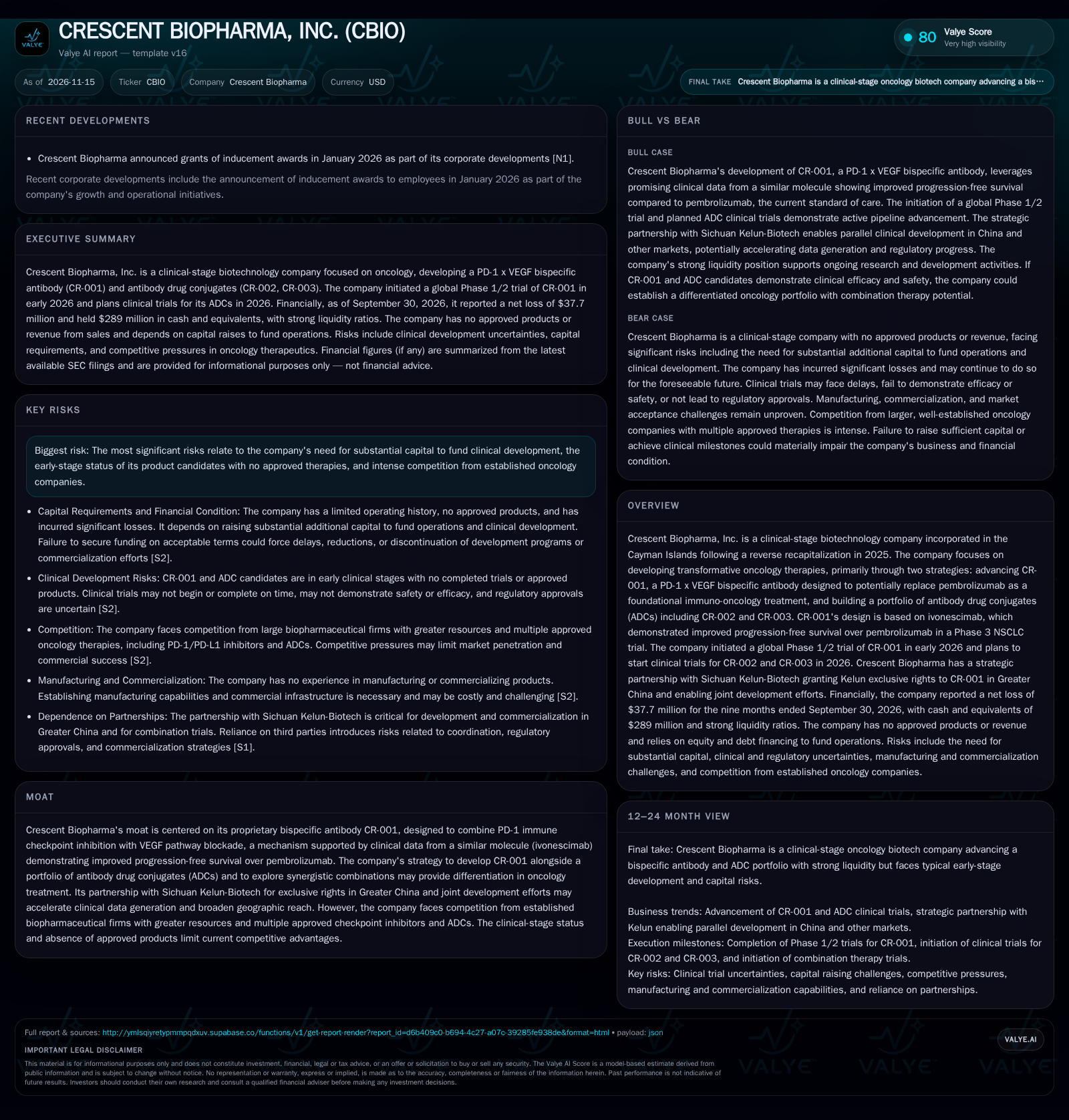
Crescent Biopharma is a clinical-stage biotech developing a PD-1 x VEGF bispecific antibody (CR-001) and two ADCs, with all programs in early-stage or preclinical development. Its lead asset aims to improve on established immuno-oncology backbones, but the company faces significant clinical, financial, and competitive hurdles typical of emerging oncology players. [S1] [S2]
Crescent Biopharma is attempting to leapfrog the current generation of immuno-oncology therapies by developing a bispecific antibody designed to combine PD-1 checkpoint inhibition and VEGF pathway blockade—two proven but historically distinct anti-cancer strategies. With a robust $289 million cash position and multiple first-in-class or best-in-class ambitions, Crescent is positioned to aggressively pursue clinical proof points across multiple tumor types and modalities. However, as with most clinical-stage biotechs, the company’s future hinges on translating promising mechanisms into clear clinical efficacy, navigating the capital demands of multi-asset development, and carving out space in a fiercely competitive oncology landscape.
Pipeline Progress, Financial Position, and Partnership Leverage Define the Near-Term Setup
Crescent Biopharma’s most material current facts center on three axes: clinical pipeline momentum, capital resources, and strategic partnerships. The company initiated a global Phase 1/2 trial (ASCEND) for its lead asset CR-001—a PD-1 x VEGF bispecific antibody—in early 2026, aiming to validate a mechanism that has already shown improved progression-free survival over pembrolizumab in a similar molecule (ivonescimab) in NSCLC. This is complemented by plans to advance two antibody drug conjugates (CR-002 targeting PD-L1 and CR-003 targeting ITGB6) into first-in-human studies in 2026. [S1]
Financially, Crescent reported a net loss of $37.7 million for the nine months ended September 30, 2026, but held $289 million in cash and equivalents with high liquidity ratios (current ratio 12.57, cash ratio 12.32) as of that date. The company reported cash and liquidity metrics for the period; these figures do not by themselves establish operating runway, investment capacity, financial flexibility, or financing capacity. [S2]
Strategically, Crescent’s partnership with Sichuan Kelun-Biotech grants exclusive rights to CR-001 in Greater China and enables joint development for its ADCs, potentially accelerating clinical timelines and broadening global reach. [S1]
How Crescent Could Monetize Oncology Innovation: Revenue Pathways and Cost Structures
Crescent Biopharma’s business model is predicated on successful clinical development and eventual commercialization or partnering of its assets. If CR-001 demonstrates meaningful efficacy and safety, it could be positioned as a next-generation immuno-oncology backbone, potentially displacing or combining with existing PD-1/PD-L1 inhibitors. Pricing for such therapies in oncology is typically premium, especially for first-in-class or best-in-class agents, though payer pressure and competitive dynamics can limit ultimate margins.
The company’s ADC pipeline (CR-002 and CR-003) also targets indications with high unmet need, where successful agents have historically commanded substantial prices. However, manufacturing costs for biologics and ADCs are high, and Crescent would need to invest heavily in CMC (chemistry, manufacturing, and controls), scale-up, and potentially commercial infrastructure or partnerships. With no current revenue and high R&D spend, Crescent’s economics are highly fixed in the near term, with operating leverage only realized if products reach late-stage development or approval.
Capital needs are substantial and ongoing.
Where Crescent Fits in the Oncology Arms Race: Differentiation, Imitation, and Incumbents
Crescent is operating in one of the most crowded and competitive sectors of biotech: oncology immunotherapies and ADCs. Its lead program, CR-001, is designed to improve upon the efficacy of pembrolizumab by dual targeting of PD-1 and VEGF. The clinical rationale is bolstered by prior Phase 3 success of ivonescimab in a similar setting, but Crescent faces competition from established players with deep portfolios, extensive commercial infrastructure, and broad KOL (key opinion leader) engagement.
The company’s ADC pipeline targets validated (PD-L1) and emerging (ITGB6) antigens, but the field is rapidly evolving, with multiple competitors advancing similar modalities and new entrants frequently emerging. The partnership with Kelun provides some insulation and development leverage, especially in the Chinese market, but Crescent’s global ambitions mean it must contend with both multinational pharma and aggressive biotechs.
Switching costs in oncology are driven by clinical outcomes, safety, and payer willingness—meaning Crescent must generate robust, differentiated data to earn adoption. Until then, its competitive position remains speculative.
Proof-of-Concept Data Could Catalyze Value: What a Step-Change in Fortunes Might Look Like
The most powerful catalyst for Crescent would be strong early clinical data from the ASCEND trial of CR-001—especially if it demonstrates clear superiority or meaningful benefit over existing PD-1/PD-L1 inhibitors in one or more solid tumor types. This could enable several favorable downstream effects:
Validation of the bispecific approach as a new backbone for immuno-oncology, increasing the probability of late-stage development and regulatory engagement.
Increased interest from potential partners or acquirers—either for global rights or regional commercialization deals, potentially unlocking non-dilutive capital.
Enhanced credibility and momentum for the ADC pipeline, which could then be prioritized for combination studies or fast-follow partnering.
The Most Plausible Outcome: Incremental Progress, Ongoing Spend, and Awaiting Clinical Proof
The most likely scenario is that Crescent advances its pipeline through Phase 1/2 trials over the next 12-24 months, generating safety and preliminary efficacy data but not yet reaching pivotal inflection points. The company continues to spend heavily on R&D and clinical operations, gradually depleting its cash balance while seeking to optimize trial design and expand indications.
Investor sentiment and valuation are likely to track with clinical updates and capital markets conditions. If data are mixed or only modestly positive, the company may remain reliant on external financing and could face dilution or partnership terms less favorable than anticipated.
Confirmation of this scenario would come from regular clinical progress reports, maintenance of cash runway through prudent cost management, and the absence of major licensing or acquisition activity. Falsification would involve either a clinical breakthrough (upside) or major clinical or financing setbacks (downside).
When Promising Science Doesn’t Translate: Clinical Setbacks and Capital Constraints
The primary downside risk is that CR-001 and/or the ADC candidates fail to demonstrate sufficient clinical efficacy or safety, resulting in trial discontinuations, regulatory setbacks, or negative data readouts. This would likely drive a sharp loss of market confidence and restrict Crescent’s access to additional capital, forcing pipeline reprioritization or cost-cutting.
In the absence of compelling data, the company could struggle to attract partners, face increasing dilution in future financings, or be forced to out-license assets on unfavorable terms. Prolonged clinical setbacks could erode the value of the pipeline and jeopardize the company’s ability to remain a going concern.
Confirmation of this scenario would come from negative or inconclusive clinical results, halted or delayed trials, or announcements of significant cost reductions and restructuring in response to funding challenges.
Milestones That Will Define Crescent’s Trajectory in Oncology
Interim and final readouts from the ASCEND Phase 1/2 trial of CR-001, particularly any demonstration of clinical benefit over established PD-1/PD-L1 therapies.
Initiation and enrollment rates for the first-in-human trials of CR-002 and CR-003; a useful metric would be the speed of patient accrual and diversity of indications targeted, if disclosed.
Updates on combination studies involving CR-001 and ADCs, especially any signals of synergy or enhanced efficacy in preclinical or early clinical data.
Cash burn rate and remaining operational runway, as indicated by quarterly filings and management guidance.
Progress on securing new partnerships, licensing deals, or non-dilutive funding sources—either for pipeline assets or regional rights.
Manufacturing and CMC milestones, including IND-enabling studies and scale-up for clinical-stage ADCs, which would help test the company’s ability to advance beyond discovery.
Any regulatory feedback or fast-track designations that could accelerate development timelines or enhance the perceived probability of approval.
Disclaimer: This is research-only, informational analysis and not investment advice. It may include AI-generated interpretation and general industry context. Always verify important details using primary sources.

Comments