
AIM ImmunoTech: Awaiting Ampligen Data as Dilution and Clinical Uncertainty Define the Stakes
With Ampligen’s Phase 2 pancreatic cancer trial fully enrolled and topline results expected in early 2027, AIM ImmunoTech sits at a pivotal juncture.
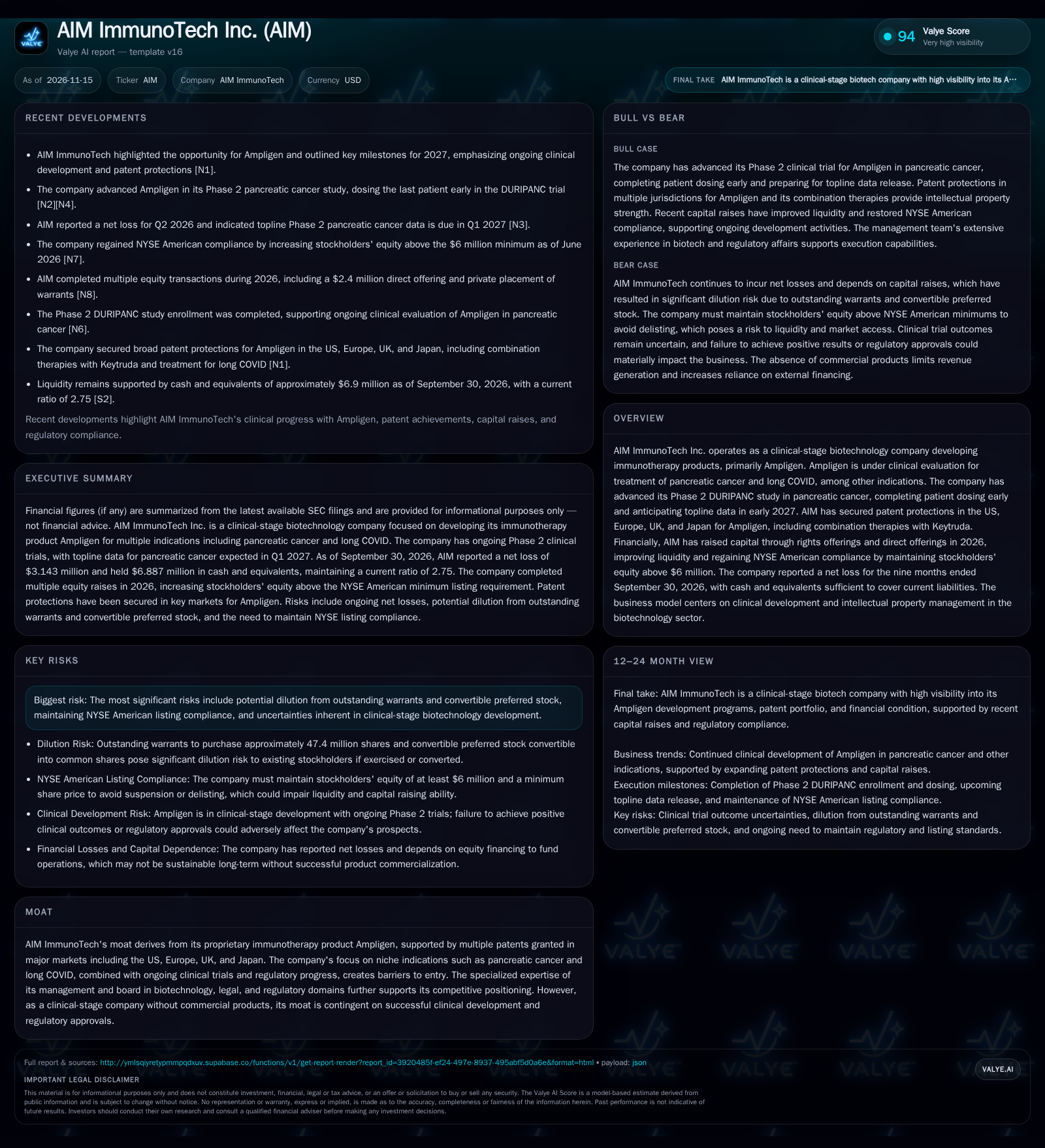
AIM ImmunoTech has completed dosing in its Phase 2 Ampligen pancreatic cancer study, with pivotal data due in Q1 2027. The company regained NYSE compliance through equity raises, but ongoing net losses and large outstanding warrants pose dilution and financing risks. The upcoming data readout will likely determine near-term strategic options and market value. [S2] [N2] [N6] [N7]
AIM ImmunoTech stands at a critical inflection point: the company has finished dosing all patients in its Phase 2 DURIPANC study of Ampligen for pancreatic cancer, setting the stage for a major data readout in early 2027. The next twelve months will likely be defined by Ampligen’s clinical outcomes and AIM’s ability to navigate its capital structure and regulatory hurdles.
Pivotal Trial Completion, Regulatory Compliance, and Dilution Overhang Frame the Near-Term
AIM ImmunoTech has completed enrollment and dosing in its Phase 2 DURIPANC trial for Ampligen in pancreatic cancer, with topline data expected in Q1 2027—a milestone that could significantly impact the company’s future direction and valuation. [N2] [N6] As of September 30, 2026, AIM reported $6.887 million in cash and equivalents, a current ratio of 2.75, and a net loss of $3.143 million for the first nine months of the year. [S2] The company raised approximately $10.4 million through multiple equity transactions in 2026, regaining compliance with NYSE American listing requirements by boosting stockholders’ equity above the $6 million threshold. [N7] However, the balance sheet is shadowed by outstanding warrants to purchase around 47.4 million shares and convertible preferred stock, which could trigger substantial dilution if exercised or converted. [S2]
Clinical-Stage Model: Cash Burn, Capital Cycles, and Binary Value Creation
AIM ImmunoTech’s economics are fundamentally shaped by the high-risk, high-reward profile of clinical-stage biotech. Operating revenues are minimal, and cash outflows are dominated by R&D, clinical trial expenses, and G&A. With no approved commercial products, AIM’s only viable funding sources are equity (including rights offerings and direct placements) and, potentially, non-dilutive capital such as grants or partnerships—none of which are currently disclosed as major contributors. The company’s capital structure is highly levered to future equity issuance, as seen by the recent $10.4 million raised in 2026, and the presence of large outstanding warrants and convertible preferred stock adds further dilution risk. [S2]
If Ampligen’s clinical data is positive, AIM could potentially unlock substantial value through out-licensing, partnerships, or future commercialization. This would likely transform the company’s economics by introducing milestone payments, royalties, or, in the longer term, product sales. However, until such inflection points are reached, AIM’s economics remain defined by negative operating leverage and reliance on external capital, with the risk that further clinical development delays or setbacks could necessitate additional dilutive financing rounds.
Positioning in Oncology and Post-Viral Syndromes: Barriers and Substitution Risks
AIM’s core asset, Ampligen, targets hard-to-treat populations such as pancreatic cancer and long COVID—areas with substantial unmet need but also significant clinical and regulatory hurdles. In oncology, particularly pancreatic cancer, the competitive landscape is crowded with both large pharmaceutical companies and smaller biotechs pursuing immunotherapies, targeted agents, and combination regimens. While Ampligen’s mechanism as an immunomodulator could offer a differentiated approach, the ultimate competitive position will hinge on the magnitude and durability of clinical benefit, safety profile, and the ability to fit into existing treatment paradigms.
Barriers to entry for novel oncology drugs remain high, including regulatory complexity, need for compelling efficacy data, and payer acceptance. However, the absence of commercial traction to date means AIM has not demonstrated switching costs, pricing power, or recurring revenue. Should Ampligen deliver a meaningful survival or quality-of-life benefit in pancreatic cancer, AIM could attract licensing or acquisition interest from larger players. Conversely, negative or equivocal trial results would expose the company to immediate competitive and financial pressures.
Catalyst-Driven Revaluation if Ampligen Delivers Meaningful Clinical Benefit
If topline Phase 2 data for Ampligen in pancreatic cancer demonstrate statistically and clinically significant improvements over standard of care, AIM could experience a step-change in perceived and actual value. Such an outcome may enable the company to negotiate lucrative out-licensing or partnership deals with larger biotech or pharma companies, potentially securing non-dilutive capital, milestone payments, and ongoing royalties. This could also support future funding at less dilutive terms and provide runway for additional indications such as long COVID.
Evidence that would confirm this scenario includes positive survival, progression-free survival, or objective response rate data from the DURIPANC trial, followed by rapid engagement with potential partners or licensing announcements. Conversely, lack of interest from industry peers or tepid market reaction to the data would undermine the upside case.
Clinical Ambiguity and Incremental Progress Sustain a Tenuous Status Quo
The most plausible outcome is that Ampligen’s Phase 2 data are mixed—showing some signs of activity but not enough to trigger immediate licensing or commercial deals. In this scenario, AIM would likely continue to operate as a clinical-stage company, seeking additional funding (possibly at more dilutive terms) to advance Ampligen to Phase 3 or pursue new indications. The company would remain exposed to ongoing cash burn, equity overhang, and the constant need to meet NYSE listing requirements.
Confirmation of this scenario would include ambiguous or modest clinical results, ongoing net losses, further equity raises, and limited external validation. Falsification would require either a clear clinical breakthrough or a definitive negative outcome that forces a strategic pivot or wind-down.
Negative Data, Accelerated Dilution, and Listing Risk Define the Bear Case
Should Ampligen’s Phase 2 trial fail to demonstrate meaningful efficacy or raise significant safety concerns, AIM could face immediate and severe consequences. The absence of positive data would likely preclude near-term partnering or licensing, forcing the company to rely solely on dilutive equity raises to fund operations. With 47.4 million warrants and convertible preferred stock outstanding, any new capital would likely come at increasingly punitive terms, accelerating dilution for existing shareholders. [S2]
Persistent net losses, combined with the inability to raise sufficient capital, could push AIM below NYSE American equity thresholds, risking delisting and further eroding liquidity and market access. Evidence for this scenario would include negative or inconclusive clinical data, steep stock price declines, urgent financing at deep discounts, and formal delisting warnings.
Milestones and Metrics That Will Shape AIM ImmunoTech’s Next Chapter
Topline Phase 2 DURIPANC data for Ampligen in pancreatic cancer, expected in Q1 2027, will be the pivotal inflection point for the company’s near-term prospects.
Announcements of licensing, partnership, or out-licensing deals following clinical data would signal external validation and potential non-dilutive funding.
The pace and terms of any future equity raises, including whether additional warrants or convertibles are issued, will indicate the company’s negotiating leverage and dilution trajectory.
NYSE American listing compliance—specifically, stockholders’ equity and minimum share price—remains a critical threshold for ongoing market access.
Cash burn and net loss trends should be tracked quarterly to assess the urgency of future capital needs and the sustainability of operations.
If disclosed, updates on Ampligen’s progress in other indications (such as long COVID) would provide insight into pipeline diversification and risk mitigation.
A useful metric would be the exercise or conversion rate of outstanding warrants and preferred stock, as this directly affects dilution and per-share value.
Disclaimer: This is research-only, informational analysis and not investment advice. It may include AI-generated interpretation and general industry context. Always verify important details using primary sources.

Comments