
American National Group Refocuses: Annuities-Driven Model Faces Structural Industry Pressures
After exiting property and casualty and halting new life insurance sales, American National Group Inc. is now a pure-play annuities and investment management business, leveraging Brookfield’s scale and expertise. While recent income growth is notable, the company confronts secular headwinds in PRT, regulatory complexity, and limits to organic expansion.
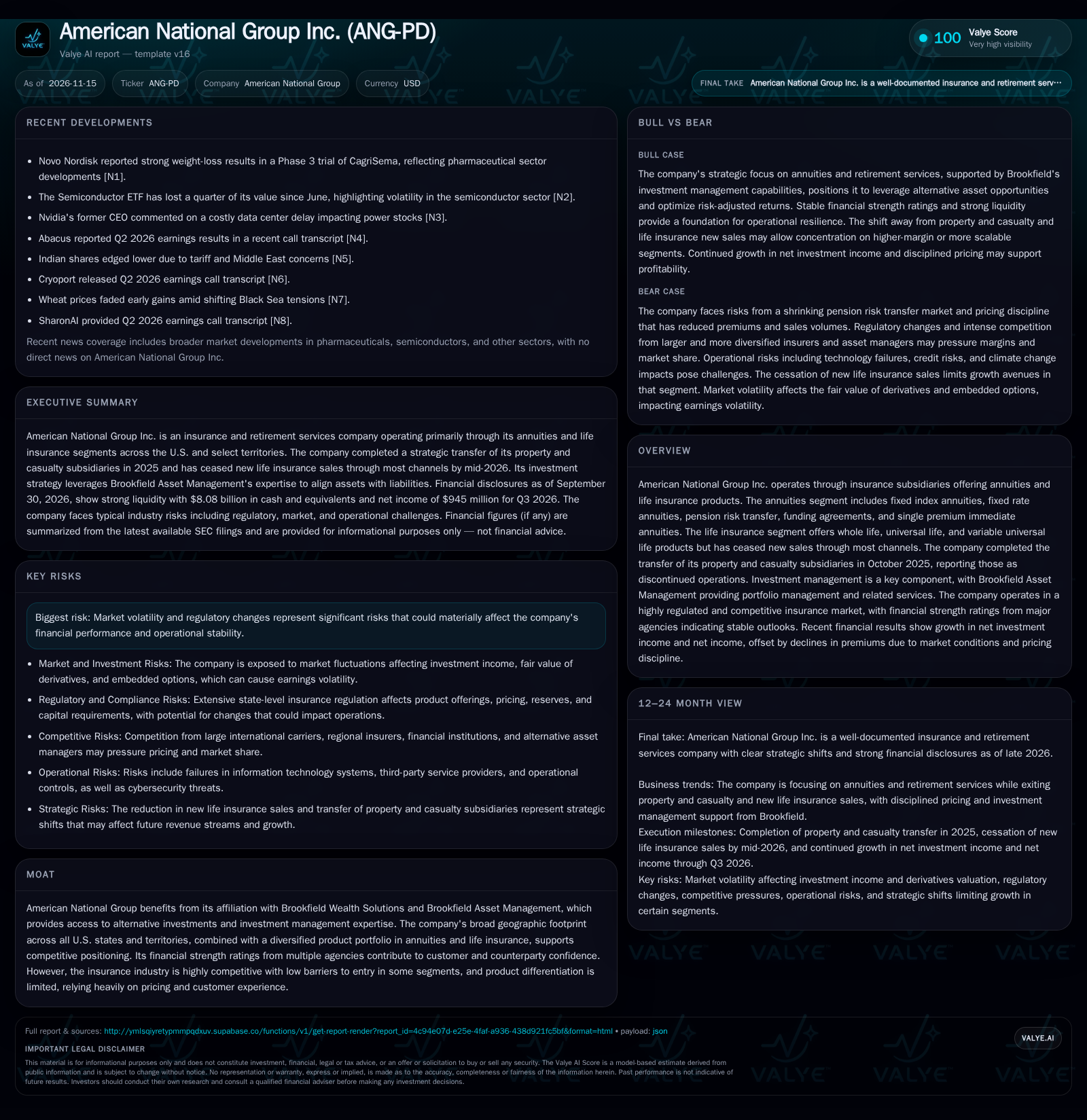
American National Group Inc. (ANGI) has restructured to concentrate on annuities and investment management, with support from Brookfield Asset Management. Strong recent net income reflects investment gains and favorable derivative movements, but premium revenue is down due to a shrinking pension risk transfer market and pricing discipline. The company’s pivot away from property and casualty and new life insurance sales narrows future growth avenues, placing greater emphasis on investment performance and operational efficiency. Regulatory and market risks remain significant.
American National Group Inc. (ANGI) has completed a multi-year transformation, exiting property and casualty insurance and winding down new life insurance sales to become a focused annuities and retirement services provider. The company now leans on Brookfield Asset Management’s investment acumen to generate returns from a growing portfolio, but faces industry-wide headwinds—including a contracting pension risk transfer market and intense competition. Recent gains in net investment income have offset declining premiums, but the sustainability of this model will depend on market conditions, regulatory stability, and ANGI’s ability to maintain pricing discipline and operational efficiency.
Recent Strategic Actions Reshape the Company’s Core
American National Group Inc. has executed a substantial strategic pivot over the past two years. In October 2025, the company transferred all property and casualty subsidiaries to Clearbrook Group Holdings, reporting these as discontinued operations. By mid-2026, it ceased offering new life insurance policies through its remaining distribution channels, effectively ending new business in that segment. The company’s present focus is on annuities—including fixed index annuities, fixed rate annuities, pension risk transfer (PRT), and related products—and on leveraging Brookfield Asset Management’s investment management services. For the nine months ended September 30, 2026, ANGI reported $5.0 billion in total revenues and $1.13 billion in net income attributable to common stockholders, with net investment income up and premium revenue down due to market contraction and pricing discipline. Liquidity is substantial, with $8.08 billion in cash and equivalents at quarter-end [S2].
Annuities and Asset Management: Economics and Leverage
ANGI’s economics are now anchored in the spread between returns on invested assets and the cost of policyholder liabilities—classic for insurers focused on annuities. The withdrawal from property and casualty and new life insurance sales removes premium growth drivers, making net investment income the primary lever. In this model, scale and asset allocation are crucial: higher assets under management (AUM) allow for more efficient matching of liabilities and the potential to capture higher yields, particularly through alternative assets sourced by Brookfield. However, the PRT market has recently contracted, and pricing discipline has led to lower new premium volumes, limiting organic top-line growth.
Operating leverage is mixed: while the business benefits from scale in investment operations, ongoing investments in the operating platform and costs related to plan terminations have increased expenses. If investment yields compress or credit spreads tighten, profitability could be pressured unless offset by further operating efficiencies. The capital intensity of annuities also requires careful asset-liability management to avoid duration mismatches, especially given regulatory capital requirements.
Industry Structure and Competitive Dynamics After the Strategic Pivot
ANGI now competes almost exclusively with other insurers and asset managers targeting the retirement and annuities space. Major competitors include large multi-line insurers, financial institutions with annuity platforms, and alternative asset managers expanding into insurance. The affiliation with Brookfield provides ANGI with access to a broader set of investment opportunities—including alternatives—which may offer a yield or diversification advantage over peers reliant on traditional fixed income.
However, competitive pressure in the annuities and PRT markets is intense. Larger insurers can often underprice risk or absorb lower returns in pursuit of scale. Product differentiation is limited, so customer acquisition often depends on distribution relationships, pricing, and perceived financial strength. ANGI’s stable A. M. Best ratings help, but ceasing new life insurance sales narrows its product suite and may weaken cross-sell potential. Regulatory scrutiny—especially around asset allocation, credit quality, and capital adequacy—remains a persistent counterforce.
Yield Expansion and Operational Efficiency Could Drive Outperformance
A favorable scenario would see ANGI leveraging Brookfield’s asset management capabilities to consistently achieve superior risk-adjusted returns, expanding net investment income even as premium volumes plateau. If alternative asset allocations deliver higher yields without materially increasing risk or regulatory capital charges, the company could maintain or grow profitability despite stagnant new business. Further, if operating platform investments translate into materially lower expense ratios, ANGI could see margin expansion.
Evidence confirming this scenario would include sustained or growing net investment income per dollar of assets, stable or improving credit ratings, and expense ratios trending down. Outperformance relative to peers in investment returns and margins would reinforce the thesis. Falsification would come from asset impairments, adverse regulatory findings on investment allocation, or rising expenses that erode the investment income gains.
Steady-State Annuities Model Anchored by Investment Performance
The most plausible outlook is a stable, lower-growth business defined by disciplined participation in the annuities and PRT markets and modest growth in net investment income. Premiums may remain flat or decline if the PRT market does not recover or if pricing discipline is maintained in the face of aggressive competition. Investment performance, rather than new sales, will be the primary driver of earnings. Expense discipline and platform modernization may provide incremental margin support, but secular headwinds limit the potential for significant top-line expansion.
Confirmation would come from relatively stable revenue, earnings, and expense ratios, with no major swings in credit ratings or regulatory capital. If disclosed, steady AUM growth and consistent net investment income would support this scenario. Falsification would involve a sharp drop in investment returns, regulatory intervention, or a significant deterioration in the PRT or annuities markets.
Market Volatility and Regulatory Shifts Expose Vulnerabilities
A negative outcome could arise if market volatility or regulatory changes disrupt ANGI’s investment strategy or erode the economics of its annuities business. A sharp decline in asset values, widening credit spreads, or impairments on alternative investments could reduce net investment income and compromise capital adequacy. Regulatory tightening on asset allocation or capital requirements could force deleveraging or limit allocations to higher-yielding alternatives, compressing spreads.
Further downside would result if the PRT market continues to shrink, competition intensifies, and ANGI is unable to replace lost life insurance or property and casualty revenue. Rising operating expenses—whether due to technology, compliance, or claims—could further pressure margins. Confirmation would come from declining net income, negative rating actions, or regulatory findings requiring changes to investment or capital practices.
Milestones and Trends That Will Define ANGI’s Long-Term Viability
Sustained growth or resilience in net investment income, particularly relative to AUM and peer benchmarks, would help validate the investment-led model.
Trends in premium revenue and PRT market participation—if disclosed—would indicate whether the company can defend or expand its annuities franchise.
Operating expense ratios and evidence of platform efficiency gains would clarify if cost discipline is offsetting the lack of premium growth.
Any changes to financial strength or credit ratings by major agencies would signal shifts in perceived risk or business quality.
Regulatory developments affecting permissible asset allocation, reserve requirements, or capital standards could materially alter the economics of the business.
Trends in surrender rates or policyholder behavior—if disclosed—would reveal the stability of the existing annuities book.
Material asset impairments or negative fair value adjustments, especially on alternative investments, would test the resilience of the investment strategy.
Evidence of successful integration or further collaboration with Brookfield Asset Management would support the thesis of investment-led value creation.
Disclaimer: This is research-only, informational analysis and not investment advice. It may include AI-generated interpretation and general industry context. Always verify important details using primary sources.

Comments