
Pono Capital Four, Inc.: The Countdown to Business Combination and the Stakes of reported liquidity position
Pono Capital Four, Inc.
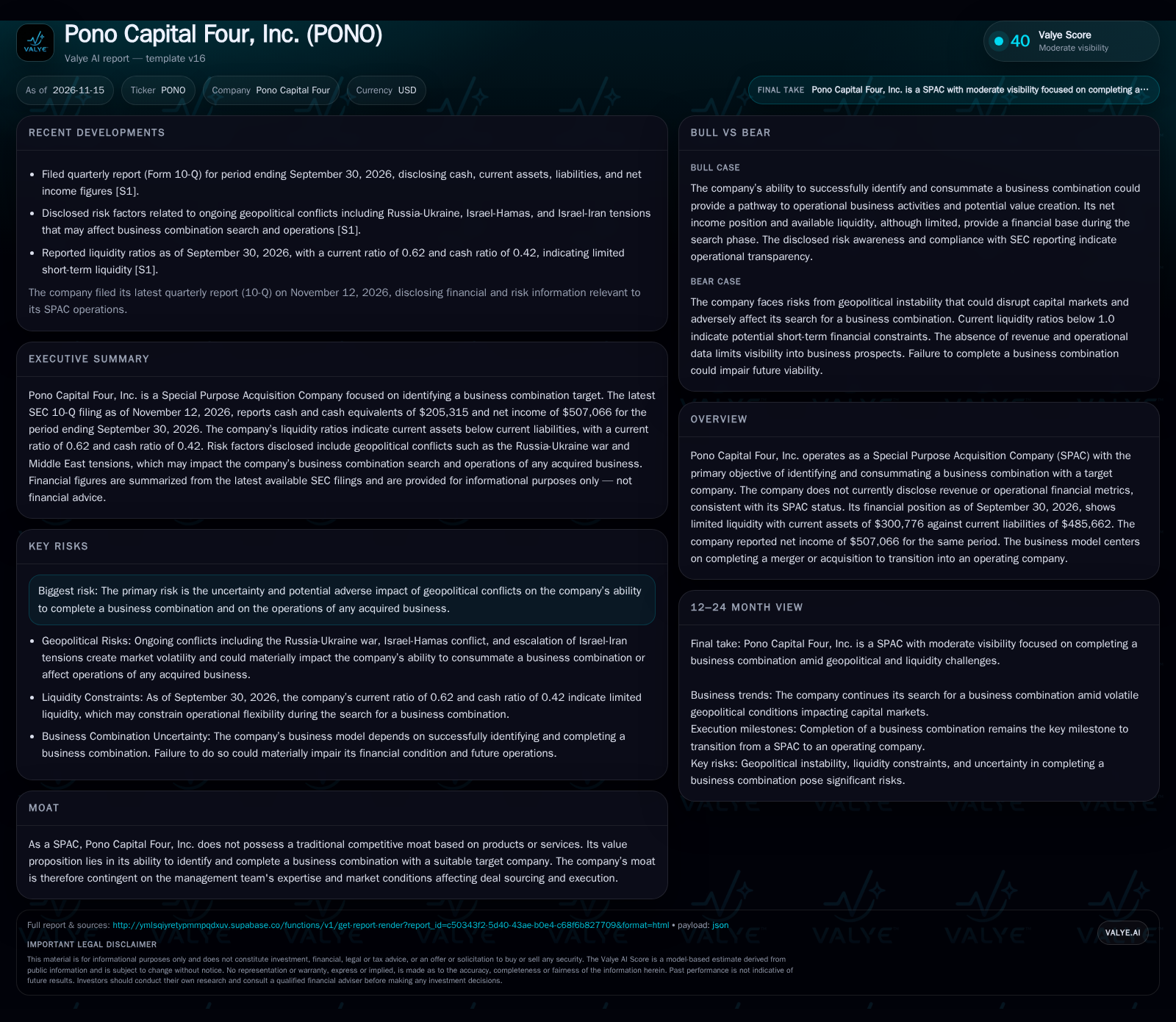
Pono Capital Four, Inc. is a newly formed SPAC with a reported liquidity position cushion (current ratio 0.62) and a mandate to complete a business combination by September 2027. The company’s operations remain in the pre-acquisition search phase, with net income driven by non-operating sources. Its outlook hinges entirely on identifying and executing a viable merger, all while managing geopolitical uncertainties and the risk of forced liquidation if no deal is reached in time. [S1]
Pono Capital Four, Inc. represents the archetypal high-stakes SPAC story: flush with trust capital but operating with minimal liquidity outside its escrowed funds, it sits at a critical juncture. With less than a year remaining to secure an acquisition before mandatory liquidation, the company must navigate a landscape complicated not just by market cycles and sponsor alignment, but also by mounting geopolitical risks that could disrupt both deal sourcing and the viability of any target. The fundamental question is whether Pono’s management can convert its trust capital into a durable operating business—before the clock runs out and with limited room for error. [S1]
Liquidity Pinch and the Business Combination Deadline Define the Moment
Pono Capital Four, Inc. is a Special Purpose Acquisition Company formed in January 2026 with the sole mission of effecting a merger or similar business combination. As of September 30, 2026, it reported $205,315 in cash outside its trust account, with current assets totaling $300,776 and current liabilities of $485,662, resulting in a current ratio of 0.62 and a cash ratio of 0.42. These figures indicate that the company does not have enough liquid assets to cover its short-term liabilities, a situation that could become acute if a business combination is not consummated soon. Net income of $507,066 for the period is attributable to non-operating sources, as is typical for SPACs pre-acquisition. Critically, Pono has until September 16, 2027, to complete a business combination or face mandatory liquidation—a deadline that now looms large. [S1]
The company’s latest filings also highlight the material risk posed by ongoing geopolitical conflicts, including the Russia-Ukraine war and tensions in the Middle East, which could disrupt capital markets and complicate both the search for and the operations of any target business. [S1]
How the SPAC Structure Shapes Economics and Funding Needs
Pono’s economics are governed by the classic SPAC model: trust account capital (raised via IPO) is held in escrow and cannot be freely used for operations, while a small pool of cash outside the trust account funds the search for a target. The trust account, as of September 30, 2026, contained approximately $122.3 million, available primarily for the eventual business combination and not for ongoing expenses. [S1]
Operating leverage is minimal in the pre-acquisition phase: costs are limited to due diligence, legal, and travel, with little revenue and no product or service economics. All net income to date is from interest income on trust assets, not from commercial activity. If a deal is consummated, the economics shift dramatically; the merged entity inherits both the capital and the operational risks of the target. Transaction costs, including deferred underwriting fees and other offering expenses, are significant and must be covered from available cash or sponsor loans until the deal closes. [S1]
If the search drags on or deal costs escalate, Pono may require up to $1.5 million in sponsor loans, which are convertible into post-merger equity. This structure creates both an incentive for the sponsor to close a deal and a potential dilution mechanism for public shareholders. Should no combination occur, all trust capital is returned to shareholders, and only the small operating pool is available to wind down operations. [S1]
SPACs in a Crowded Field: Differentiation, Sponsor Reputation, and External Shocks
Pono Capital Four competes in a saturated market of SPACs all chasing a limited pool of attractive targets. With no operating business or proprietary technology, its only differentiators are the reputation of its sponsor, the quality of its deal pipeline, and its ability to execute under pressure. The company’s sponsor, Mehana Ventures LLC, provides some credibility, but the absence of disclosed sector focus or target criteria means Pono must compete with both sector-agnostic and sector-focused SPACs, as well as private equity and direct acquirers.
Geopolitical instability (Russia-Ukraine, Israel-Hamas, Israel-Iran) introduces a further competitive wrinkle: macro shocks can freeze capital markets, disrupt cross-border dealmaking, and raise the bar for risk-adjusted returns on any potential target. In this context, SPACs with sector expertise, strong sponsor networks, or differentiated capital structures may have a relative edge. Pono’s generic structure and reported liquidity position outside the trust account could be a disadvantage if rapid due diligence or bridge financing is needed to secure a deal. [S1]
Ultimately, the ability to source, negotiate, and close a transaction in a volatile environment will determine whether Pono can outmaneuver its peers and avoid liquidation.
Strategic Target Acquisition Unlocks Shareholder Value
The favorable scenario for Pono Capital Four is defined by the successful identification and consummation of a high-quality business combination well before the September 2027 deadline. In this pathway, the company leverages its $122 million trust account to acquire a target with strong fundamentals, growth prospects, and a credible management team, thereby converting trust capital into an operating business with long-term value potential. An efficient due diligence process and disciplined transaction structuring would minimize deal costs and sponsor dilution.
Confirmation of this scenario would come from a definitive agreement announcement, regulatory progress, and positive market reaction to the target’s fundamentals and growth outlook. Additional supporting evidence would include the absence of material redemptions at deal closing, successful PIPE (private investment in public equity) fundraising if needed, and the post-merger entity’s ability to access capital markets for future growth.
Falsification would be indicated by prolonged delays, failure to announce a target, or the selection of a high-risk or poorly vetted business with limited market support.
Deal Execution Under Pressure: Typical SPAC Outcomes and the Role of Market Volatility
The most plausible trajectory is that Pono secures a business combination close to its deadline, after an extended search and negotiation period. The target is likely to be a mid-tier private company or a carve-out, with moderate growth prospects but not a clear market leader. Deal terms may require significant sponsor support, concessions to PIPE investors, or additional bridge financing to close. Shareholder redemptions could be high, reflecting market skepticism or broader SPAC fatigue.
In this scenario, the post-merger entity faces immediate pressure to demonstrate operational traction and capital discipline, particularly if macro conditions remain volatile. Confirmation would come from a timely deal announcement, completion of regulatory filings, and moderate but not overwhelming redemption rates. Falsification would be indicated by deal delays, regulatory setbacks, or the emergence of unforeseen due diligence issues that force deal renegotiation or abandonment.
Failure to Close: Liquidation Risk, Sponsor Losses, and Market Fallout
The adverse scenario is straightforward: Pono fails to identify or close a business combination by September 16, 2027. In this event, the company is forced to liquidate, returning the trust account capital to public shareholders and incurring wind-down costs from its minimal operating pool. Sponsors lose their investment in private placement units and any unrecovered transaction expenses. The cause could be an inability to find a willing target, insurmountable regulatory or geopolitical barriers, or market conditions that make deals unattractive for both targets and investors.
Confirmation of this outcome would include repeated extensions, lack of substantive deal progress, or explicit liquidation announcements. Falsification requires clear evidence of ongoing negotiations with credible targets, regulatory filings for a proposed merger, or sponsor bridge financing to keep the process alive.
Milestones and External Triggers That Could Shift Pono’s Trajectory
Announcement of a definitive business combination agreement, including sector, target profile, and deal terms.
Updates on shareholder redemption rates at deal closing—high redemptions would signal market skepticism and reduce post-merger cash.
Disclosure of any working capital loans from sponsors or affiliates—if disclosed, would indicate growing liquidity pressure.
Evidence of PIPE (private investment in public equity) commitments to supplement trust capital and support deal closing.
Changes in the macroeconomic or geopolitical environment that materially affect capital markets or cross-border dealmaking.
Updates on deferred underwriting fee and transaction cost management, as high costs could erode net proceeds.
Regulatory filings or SEC comments that could delay or complicate the business combination process.
Disclaimer: This is research-only, informational analysis and not investment advice. It may include AI-generated interpretation and general industry context. Always verify important details using primary sources.

Comments