
Prime Medicine’s Prime Editing Ambition: Clinical Progress, Capital Uncertainty, and the Stakes for Platform Biotech
Prime Medicine advances its prime editing technology with positive early clinical data and strategic disease foundation funding, but faces acute going concern risk as cash burn outpaces capital inflows. The company’s future hinges on execution in liver and genetic disease programs, validation of its novel platform, and its ability to secure new financing amid sector headwinds.
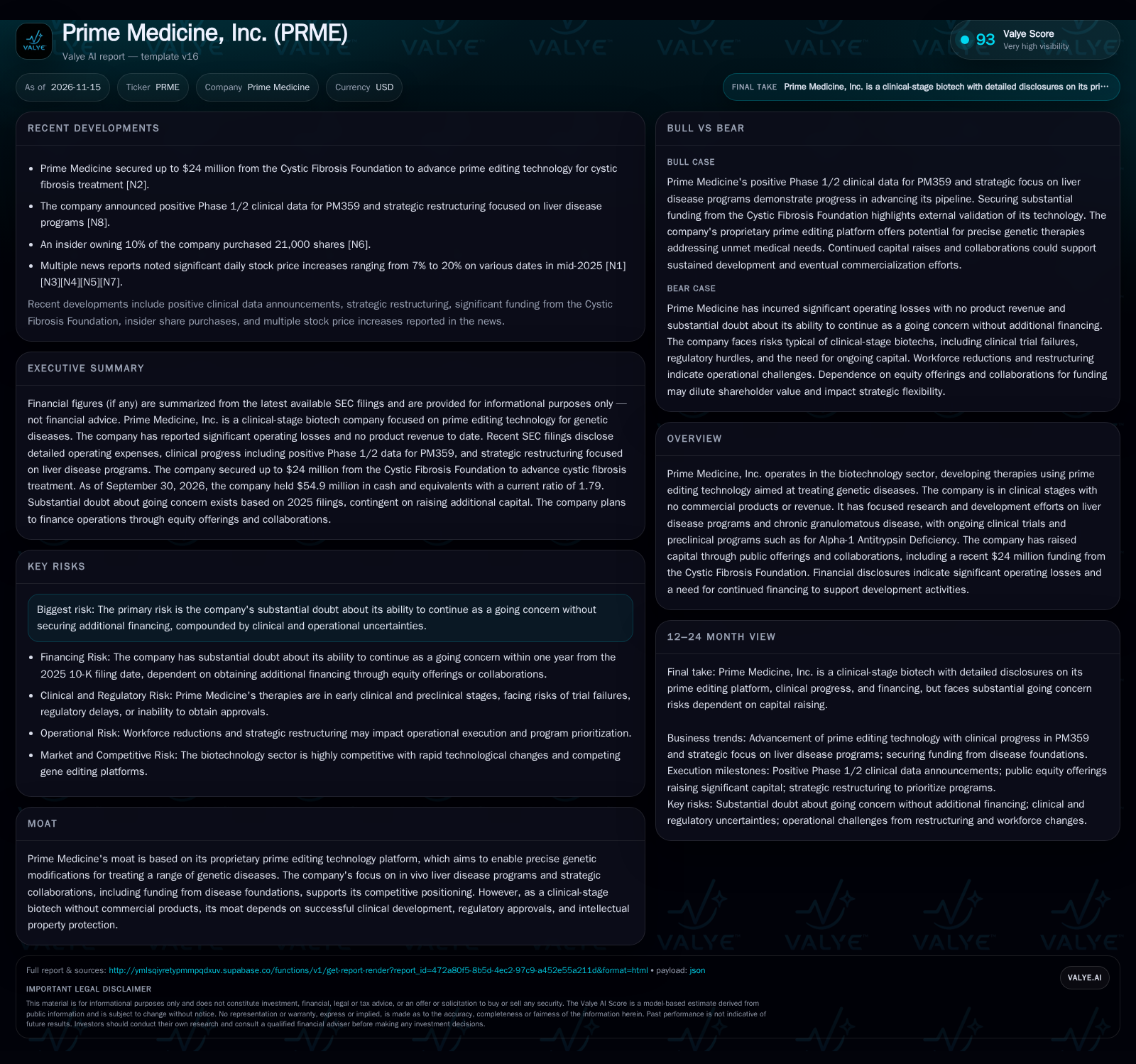
Prime Medicine reported positive Phase 1/2 clinical data for its PM359 candidate, secured up to $24 million in disease foundation funding, and raised $138.4 million in its August 2025 public offering. The core thesis centers on whether Prime Medicine can convert early clinical and platform validation into sustainable financing and eventual commercialization before its capital runs out. [S2] [N2] [N8]
Prime Medicine, Inc. exemplifies the high-stakes dynamics of clinical-stage platform biotechs: scientific ambition, episodic funding, and existential uncertainty. The company’s proprietary prime editing technology has yielded positive early clinical signals—most notably for PM359 in chronic granulomatous disease—and attracted up to $24 million in external funding from the Cystic Fibrosis Foundation. The next year will be pivotal in testing whether the promise of prime editing can outpace the realities of biotech cash burn and sector competition. [S2] [N2] [N8]
Recent Clinical and Financial Milestones Define the Near-Term Outlook
Prime Medicine’s most material recent developments include the announcement of positive Phase 1/2 clinical data for PM359, its lead candidate for chronic granulomatous disease, and a strategic restructuring to prioritize liver disease programs. These steps suggest both scientific progress and a sharper capital allocation focus. The company also secured up to $24 million in targeted funding from the Cystic Fibrosis Foundation, reflecting external validation for its prime editing platform and providing non-dilutive capital to push a key preclinical program forward. Financially, Prime Medicine raised $138.4 million in a public offering in August 2025, but by September 30, 2026, cash and equivalents had declined to $54.9 million amid continued operating losses ($39.0 million net loss in Q3 2026) and no product revenue. The company’s current ratio of 1.79 and cash ratio of 1.54 are descriptive of its operating liquidity, but substantial doubt about going concern status remains, contingent on the ability to raise additional capital within the next year. [S2] [N2] [N8]
Prime Editing Platform Economics: Cost Structure, Funding Dependencies, and Pathways to Value
Prime Medicine’s economic model is emblematic of clinical-stage platform biotechs: intensive up-front R&D investment, high fixed personnel and facility costs, and zero product revenue until regulatory approval. The company’s research and development expenses increased by $5.3 million year-over-year, driven by facility expansion, licensing, and clinical trial activity in Wilson Disease and Alpha-1 Antitrypsin Deficiency (AATD) programs. These investments are necessary to demonstrate the breadth and depth of its prime editing platform, but also accelerate cash burn in the absence of revenue. General and administrative expenses ticked up slightly, largely due to legal and professional fees, while a workforce reduction in 2025 trimmed personnel costs. [S2]
The company’s capital needs are recurring and substantial, with ongoing reliance on equity offerings, grants, and collaborations. The recent $24 million foundation funding is earmarked for cystic fibrosis, limiting fungibility across programs. The August 2025 public offering temporarily bolstered liquidity, but the current cash balance underscores the short runway typical for this stage. Prime Medicine’s economics will only shift meaningfully if a candidate achieves late-stage clinical success and regulatory approval, unlocking commercial revenue and potential operational leverage. Until then, the business remains structurally dependent on episodic financing and external validation.
Assessing Prime Medicine’s Strategic Edge in a Crowded Gene Editing Arena
Prime Medicine’s competitive positioning derives from its proprietary prime editing platform, designed for precise, programmable genetic modifications with potentially fewer off-target effects than first-generation CRISPR systems. This technological promise has attracted foundation funding and enabled pursuit of both rare and prevalent genetic diseases. Nevertheless, the company operates in a highly competitive sector, with multiple gene editing modalities—from base editors to CRISPR/Cas9 variants—pursued by both established biotechs and well-funded startups.
Sustainable advantage will hinge on demonstrating clinical superiority, safety, and scalability across indications. Intellectual property protection and strategic partnerships could reinforce its moat, but these are only durable if clinical proof-of-concept translates into regulatory and commercial traction. Platform biotechs face constant pressure to show that their technology can be applied broadly, achieve regulatory milestones, and attract non-dilutive capital—otherwise, differentiation erodes as scientific and financial capital flows to more validated or capitalized rivals.
Platform Validation and Strategic Partnerships Unlock a Virtuous Cycle
In a favorable scenario, Prime Medicine’s positive Phase 1/2 data for PM359 catalyzes additional clinical milestones—such as further positive readouts in liver disease programs or early signals in cystic fibrosis and AATD. These milestones could attract new strategic partnerships or licensing deals, providing both non-dilutive capital and external validation. If the company is able to secure additional disease foundation grants or pharma collaborations, this could extend its cash runway and reduce dependence on dilutive equity offerings.
The upside would be confirmed by announcements of new funding partnerships, expanded clinical pipelines, and, critically, evidence of durable efficacy and safety across multiple indications. Accelerating enrollment in clinical trials, successful IND filings, and movement of additional candidates into the clinic would signal platform breadth and scalability. Falsification would occur if clinical progress stalls, partnerships fail to materialize, or subsequent data underwhelms, limiting both external interest and financing options.
Incremental Progress Amid Persistent Financing and Execution Risk
In the base scenario, Prime Medicine continues to advance its lead programs, with additional clinical data readouts and preclinical milestones achieved on schedule but without dramatic inflection points. The company may secure modest additional funding through equity offerings or small-scale collaborations, but the pace of capital inflows remains closely matched to cash burn. This scenario is characterized by incremental platform validation—such as continued progress in PM359 and liver disease programs—without a major breakthrough or partnership that would fundamentally alter the company’s financial trajectory.
Operationally, management maintains a disciplined focus on prioritized programs, with further cost containment or restructuring possible if financing remains tight. The company’s ability to avoid value-destructive dilution or forced retrenchment depends on timely execution and continued external interest, but the risk of a funding gap persists. Confirmation of this scenario would come from steady, if unspectacular, clinical progress, periodic financing announcements, and ongoing disclosures of cash and liquidity metrics that reflect a delicate balance between ambition and resource constraints.
Funding Shortfall and Clinical Setbacks Force Strategic Retrenchment
The adverse scenario centers on a combination of clinical setbacks—such as inconclusive or negative trial results—and a tightening capital environment that limits access to both equity and partnership funding. If Prime Medicine is unable to deliver further positive clinical data or attract new collaborators, its cash position could deteriorate rapidly, forcing it to halt or delay programs, initiate further layoffs, or explore strategic alternatives such as asset sales or a distressed merger.
This downside would be confirmed by missed or negative clinical milestones, announcements of additional cost-cutting or program discontinuations, and disclosures of unsuccessful funding attempts. Deteriorating balance sheet metrics, such as a current ratio falling below 1.0 or a sharp sequential drop in cash, would further validate this scenario.
Milestones That Will Determine Whether Prime Editing Delivers on Its Promise
Progression and readout timing for ongoing and planned clinical trials, especially for PM359 and prioritized liver disease programs, will directly test platform efficacy and safety. [N8]
Updates on the cystic fibrosis preclinical program and any movement toward IND-enabling studies or early clinical development would clarify the impact of foundation funding. [N2]
Disclosures regarding new strategic partnerships, collaborations, or non-dilutive grant funding would indicate external confidence and extend cash runway.
Quarterly cash burn rate and detailed cash flow statements, if disclosed, will help assess runway and the urgency of additional financing needs. [S2]
Announcements of further equity offerings, shelf registration draws, or at-the-market sales will reveal funding strategy and potential dilution risk.
Any additional insider buying or selling activity could signal management or major shareholder views on near-term prospects. [N6]
Updates on workforce size, restructuring progress, or further operational retrenchment would indicate management’s confidence in execution capacity and capital allocation.
Patent filings, licensing developments, or new IP disputes related to prime editing technology would impact the durability of Prime Medicine’s competitive position.
Disclaimer: This is research-only, informational analysis and not investment advice. It may include AI-generated interpretation and general industry context. Always verify important details using primary sources.

Comments