
System1’s Revenue Collapse and NYSE Delisting: Assessing the Viability of an AI-Powered Digital Ad Platform Reset
System1, Inc. confronts a dramatic revenue contraction and deep operating losses in 2026 amid the loss of key monetization agreements, asset impairments, and an imminent NYSE delisting. The company’s AI-powered platform and owned web utilities offer potential, but structural changes and execution risk now dominate the investment thesis.
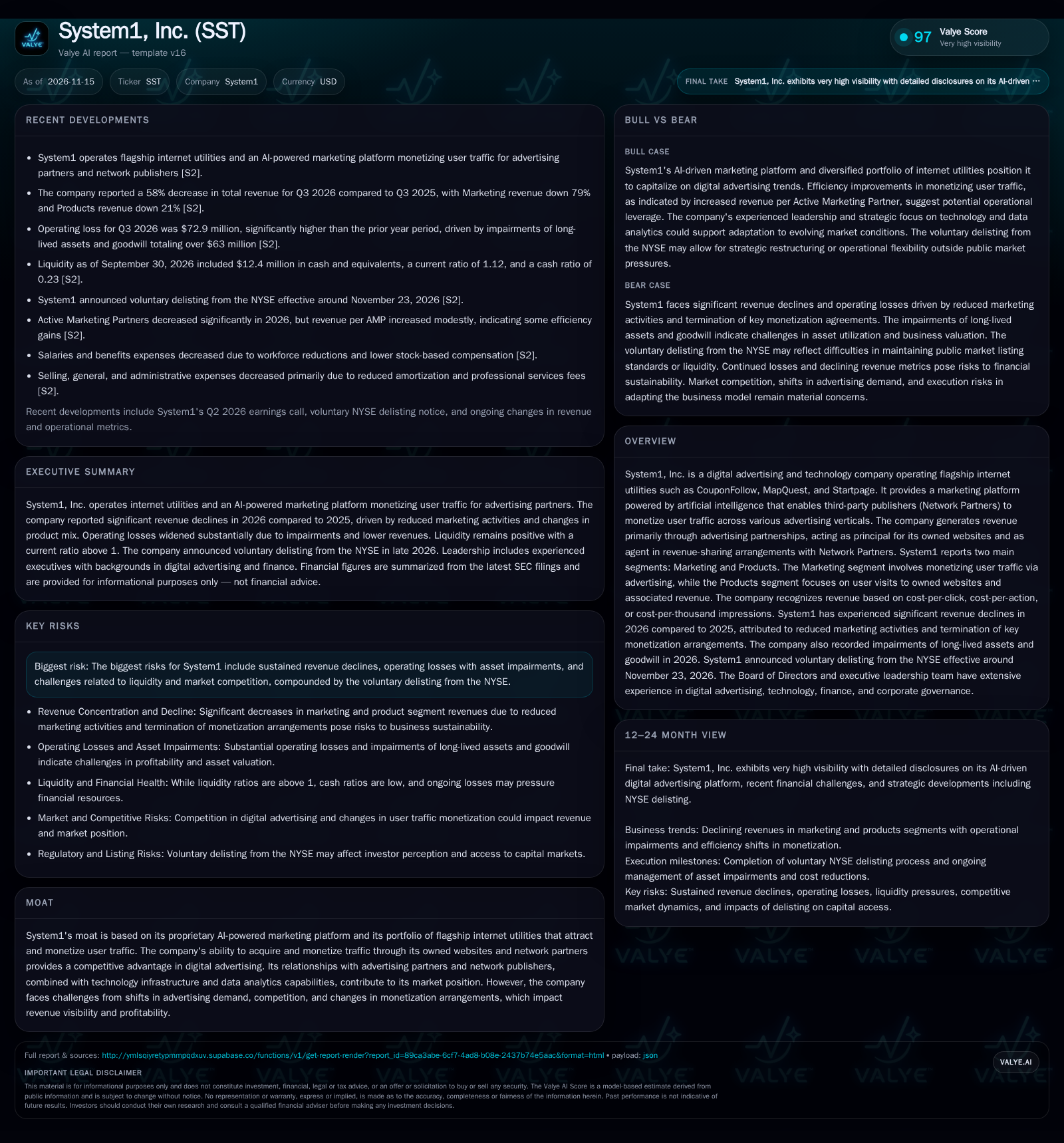
System1, Inc. saw a 58% year-over-year revenue decline in Q3 2026, driven by the end of critical monetization partnerships and a weaker product mix, leading to a $72.9 million quarterly operating loss and over $63 million in impairments. The company is voluntarily delisting from the NYSE and is operating with reported liquidity position. While its AI-driven marketing platform and efficiency gains per partner offer some operational hope, sustaining the business will require successful adaptation to a changed digital advertising landscape and a new capital markets reality. [S2]
System1, Inc. enters a period of existential uncertainty after a devastating drop in revenue and profitability in 2026, culminating in a voluntary NYSE delisting. The company’s AI-powered ad tech platform and portfolio of web utilities were not enough to offset the loss of major monetization arrangements and an unfavorable shift in product mix. With significant asset impairments and cash resources under pressure, System1’s path forward hinges on its ability to extract more value from remaining assets and adapt to a digital advertising market in flux.
2026 Marked by Steep Revenue Losses, Asset Write-Downs, and Stock Exchange Departure
System1 reported a 58% year-over-year revenue drop in Q3 2026, with total revenue falling to $25.95 million from $61.56 million in the prior-year period. The Marketing segment was hit especially hard, down 79%, primarily due to reduced marketing activity and the termination of its AdSense for Domains arrangement with Google. The Products segment also declined, as higher-revenue sessions were replaced by lower-revenue-per-session activity, even as total sessions increased. [S2]
Operating losses soared to $72.9 million for the quarter, up from $15.6 million a year earlier, largely due to $63.6 million in impairments of long-lived assets and goodwill. [S2] Liquidity is constrained: cash and equivalents totaled $12.4 million, with a current ratio of 1.12 and a cash ratio of just 0.23 as of September 30, 2026. [S2]
System1’s Board announced a voluntary delisting from the NYSE, expected to take effect around November 23, 2026. This move removes the company from public market visibility and potentially signals a strategic pivot or necessity-driven restructuring. [S2]
System1’s Revenue Model Under Strain Amid Digital Advertising Shifts
System1’s core economics are shaped by its dual role as principal (for its owned-and-operated sites) and agent (for network partners), recognizing revenue on a gross or net basis depending on its role. Revenue is primarily generated via cost-per-click, cost-per-action, and cost-per-thousand-impression models, which directly tie topline performance to user engagement and advertiser demand. [S2]
In principle, the business model offers operating leverage: incremental traffic or improvements in monetization efficiency can flow through to margins if fixed costs are contained. However, 2026 exposed a vulnerability: the loss of a major Google monetization arrangement and a shift to lower-yield sessions in Products decimated gross revenue. The result was negative operating leverage—falling revenue amplified losses, while fixed costs and asset impairments swamped any cost savings from workforce reductions or lower stock-based compensation. [S2]
System1’s cost structure includes significant traffic acquisition costs, technology investment to maintain its AI-powered platform, and personnel expenses. While some efficiency was gained—revenue per Active Marketing Partner rose modestly even as the partner count fell—the company’s ability to scale back costs in line with revenue proved limited. The need to maintain technology infrastructure and data capabilities to remain competitive in digital advertising creates a floor for fixed costs, raising the stakes for restoring revenue growth or fundamentally restructuring operations.
Monetization Partnerships Under Pressure in a Competitive Market
System1’s competitive position depends on its proprietary AI-driven marketing platform and its portfolio of established web utilities like MapQuest and Startpage. These assets can attract user traffic and provide first-party data, which are valuable in a digital advertising market increasingly constrained by privacy regulations and the decline of third-party cookies.
However, the company’s reliance on key monetization partners—such as Google’s AdSense for Domains—creates structural risk. The 2026 revenue collapse demonstrates the fragility of these relationships: a single terminated deal can erase a large portion of revenue. In the broader digital advertising ecosystem, System1 competes against both large-scale ad tech platforms and specialized traffic brokers, many of which have deeper integrations with advertisers, more robust proprietary data, or greater scale.
Switching costs for advertisers and network partners are low; if System1 cannot demonstrate superior monetization or unique traffic, partners can shift their business elsewhere. The modest increase in revenue per Active Marketing Partner suggests some efficiency improvement, but this may not be enough to offset partner attrition or the competitive pull of better-capitalized rivals. As digital advertising budgets become more performance-driven, platforms with more granular targeting, higher conversion rates, or deeper integrations are likely to win share unless System1 can carve out a distinct value proposition.
Turnaround Potential Hinges on AI Integration and Monetization Revival
The bull case for System1 hinges on its ability to stabilize and grow revenue by rebuilding its monetization engine—either by signing new high-yield advertising partnerships, optimizing its AI-driven platform to extract more value from existing traffic, or expanding its owned-and-operated product portfolio. If the company can leverage its technology to improve targeting, increase session value, or attract new advertisers, operating leverage could return, with incremental revenue translating into improved margins.
Evidence that would confirm this scenario includes a reversal or stabilization in Products segment revenue, increases in revenue per session, successful launch of new monetization partnerships, or a return to positive adjusted EBITDA. Further, if management can demonstrate that cost reductions are sustainable without eroding core capabilities, System1 could emerge as a more focused, profitable company—potentially able to relist or attract strategic investment.
Falsification would come from continued revenue declines, further partner loss, or evidence that technology investments are failing to yield improved monetization or competitive differentiation.
Ongoing Restructuring and Search for a Viable Business Model
The most plausible near-term outcome is a period of further contraction and operational restructuring. With key monetization partnerships gone and the NYSE delisting imminent, System1 is likely to focus on cost containment, asset rationalization, and exploring alternative revenue channels. The company may look to streamline its portfolio, divest underperforming assets, and prioritize core properties that still generate positive cash flow.
If disclosed, ongoing modest improvements in revenue per session or per partner could provide a floor for the business, allowing management to stabilize losses while seeking new growth opportunities. However, with liquidity limited and public market access curtailed, external capital or a strategic transaction may be necessary to fund any significant pivot. Confirmation of the base scenario would be ongoing cost reductions, flat-to-declining revenue, and a stable or slightly improving cash position—absent a dramatic turnaround or collapse.
Falsification would be signaled by a sudden return to growth, a major new monetization deal, or evidence of insolvency and forced asset sales.
Risks of Continued Revenue Decline and Financial Distress Leading to Restructuring or Liquidation
In a negative scenario, System1 continues to lose key partners or fails to halt the decline in session value, leading to ongoing revenue contraction. If cost reductions cannot keep pace with revenue loss, or if impairments recur, System1 may be forced into a distressed sale, asset liquidation, or even bankruptcy.
Confirmation of this scenario would include ongoing double-digit revenue declines, further asset impairments, missed payments to creditors or employees, or disclosure of going-concern risk in future filings. The voluntary delisting may also limit access to new capital, making external rescue less likely.
Falsification would require evidence of revenue stabilization, new monetization partnerships, or an unexpected capital infusion that meaningfully extends the company’s runway.
Key Milestones Influencing System1’s Ability to Adapt and Persist
Sustained or improving Products segment revenue—especially revenue per session or per user, if disclosed—would indicate successful adaptation of the monetization model.
Trends in Active Marketing Partner count and revenue per partner: ongoing declines would signal further platform weakness, while stabilization or growth could support a turnaround.
Disclosure of new or renewed strategic monetization partnerships, particularly with large advertising networks or platforms.
Cash flow from operations and changes in net working capital—if positive, these would suggest improving financial resilience.
Updates on workforce size and further cost-reduction initiatives to assess whether expenses are being managed in line with revenue realities.
Any indication of asset sales, divestitures, or restructuring charges, which would clarify whether management is taking decisive action to right-size the business.
Board or management changes, especially those indicating a shift in strategic direction or willingness to consider external capital or M&A.
If disclosed, any guidance or commentary on the company’s post-delisting capital strategy and access to funding sources.
Disclaimer: This is research-only, informational analysis and not investment advice. It may include AI-generated interpretation and general industry context. Always verify important details using primary sources.

Comments