
Nakamoto Inc.: Bitcoin Ecosystem Ambition Meets Structural and Financial Crossroads
The company’s bet on Bitcoin holdings, media/events, and investment management faces the dual tests of market volatility and internal financial discipline.
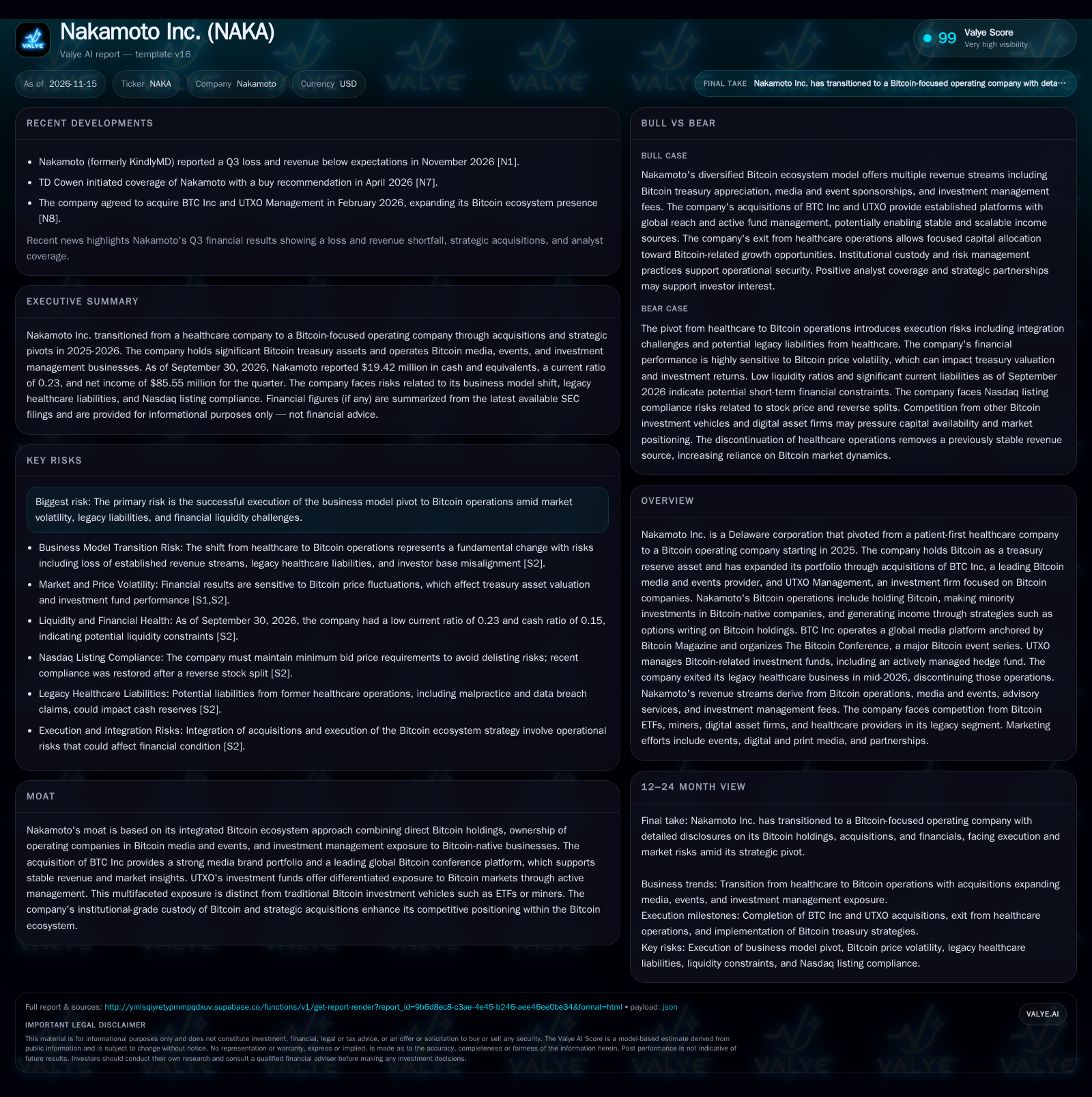
Nakamoto Inc. has exited healthcare to become a Bitcoin-focused operator, holding over 5,300 Bitcoin, acquiring BTC Inc (media/events) and UTXO Management (investment funds). Despite strong net income in Q3 2026, the company reports negative revenue, low liquidity ratios, and high current liabilities. The strategy hinges on Bitcoin price appreciation, operational leverage from events/media, and fee-based asset management, but faces risks from market volatility, legacy liabilities, and short-term financial constraints. Execution and integration across diverse business lines will determine whether Nakamoto’s ecosystem thesis can be realized or falters under structural pressures. [S1] [S2] [N1]
Nakamoto Inc. has engineered one of the most radical strategic pivots in recent small-cap history, abandoning its legacy healthcare operations in favor of a bold, multi-pronged Bitcoin ecosystem strategy. The company now holds substantial Bitcoin reserves, operates marquee industry media and events, and manages investment funds targeting Bitcoin-native businesses. The coming quarters will reveal whether Nakamoto’s hybrid model can deliver sustainable value or whether structural and financial headwinds will undermine its ambitions.
Recent Pivot and Financial Results Define Nakamoto’s New Reality
Nakamoto Inc. completed a decisive transition in 2026, selling off its legacy healthcare business and acquiring BTC Inc (operator of Bitcoin Magazine and The Bitcoin Conference) and UTXO Management (Bitcoin-focused investment funds). As of September 30, 2026, Nakamoto reported holding 5,342 Bitcoin, valued at $467.5 million as of December 2025. Despite this large crypto asset base, the company’s Q3 2026 financials revealed negative revenue of $1.93 million but net income of $85.55 million, suggesting that mark-to-market gains on Bitcoin holdings drove profitability rather than recurring operational earnings. Cash and equivalents stood at $19.42 million against current liabilities of $127.43 million, yielding a current ratio of just 0.23 and a cash ratio of 0.15. The company faces both opportunities from its new Bitcoin ecosystem approach and significant risks from its financial structure and operational integration challenges. [S1] [S2] [N1]
How Nakamoto’s Bitcoin-Centric Model Could Generate Profits—And Where It Might Break
Nakamoto’s business model is now a blend of asset appreciation, fee-based income, and event-driven revenue. Its core economics rest on three pillars: (1) Bitcoin treasury gains (mark-to-market and realized), (2) media/events income from BTC Inc, and (3) management/advisory fees from UTXO’s Bitcoin investment funds. The Bitcoin treasury strategy can deliver outsized reported earnings in bull markets, but exposes the company to sharp swings in net income and equity value during downturns. Media/events businesses like The Bitcoin Conference typically enjoy high operating leverage—fixed costs (venue, staff, content) can be spread over growing attendee/sponsorship volumes, but are vulnerable to crypto market cycles and event execution risk. Asset management and advisory fees from UTXO depend on assets under management (AUM) and performance, creating a levered exposure to both Bitcoin returns and Nakamoto’s ability to attract/retain capital. The company’s low current and cash ratios indicate potential liquidity stress—large Bitcoin holdings are illiquid and may not be easily or quickly converted to pay liabilities without market risk. If event attendance or fund inflows falter, or if Bitcoin prices fall, Nakamoto’s model could quickly swing from lucrative to loss-making, especially given its thin short-term liquidity buffer. [S1] [S2]
Integrated Bitcoin Ecosystem: Differentiation or Distraction?
Nakamoto’s competitive strategy is to be more than just a Bitcoin holding company or fund manager: by controlling media, events, and investment management, it aims to create feedback loops—brand authority, community engagement, and deal flow—that reinforce its position in the Bitcoin ecosystem. This multifaceted approach sets Nakamoto apart from pure-play miners, ETF sponsors, or single-channel asset managers. BTC Inc’s global media footprint and conference franchise provide unique access to Bitcoin thought leaders, developers, and investors, potentially driving both sponsorship revenue and proprietary investment opportunities for UTXO. However, this scope also increases managerial complexity and integration risk. The company faces competition from specialist Bitcoin ETFs (offering lower fees and greater liquidity), established digital asset managers with more diversified client bases, and event/media firms with deeper sector experience. Nakamoto’s edge will depend on its ability to cross-leverage its assets (e.g., converting conference attendees to fund investors or media subscribers) and to maintain relevance as the Bitcoin landscape evolves. A key question is whether the company’s integrated model becomes a self-reinforcing moat or a source of operational distraction and resource drain. [S1]
If Bitcoin Rallies and Nakamoto Orchestrates Its Ecosystem, Outperformance Is Plausible
In a favorable scenario, Bitcoin enters a sustained bull market, driving mark-to-market gains on Nakamoto’s treasury holdings and boosting both event/media activity and investor appetite for Bitcoin funds. BTC Inc’s media brand and conferences could see increased sponsorship and attendance, with the 2025 conference drawing 67,000 attendees as a reference point. UTXO’s funds may benefit from both asset appreciation and new inflows, increasing management fee revenue and potentially delivering performance fees. Cross-promotion across media, events, and funds could reinforce Nakamoto’s brand, deepening its moat and enabling greater pricing power for sponsorships and services. Confirmation of this scenario would include: robust sequential growth in event attendance and sponsorship revenue, rising AUM and fee income at UTXO, and positive cash flow from operations (not just Bitcoin appreciation). Successful integration of acquired businesses—with clear cost synergies and cross-business initiatives—would further validate the ecosystem thesis. [S1]
Navigating Volatility: Nakamoto’s Most Likely Course Is Mixed Results and Ongoing Execution Risk
The most plausible outcome is a period of operational volatility and uneven financial results as Nakamoto integrates its new assets and contends with Bitcoin’s inherent price swings. Bitcoin may trade in a broad range, producing lumpy reported income and considerable mark-to-market swings. Event and media revenue could stabilize, but may not immediately scale to offset the loss of healthcare revenue or support full overhead absorption. UTXO’s fund business may face competition from lower-cost ETFs and established asset managers, limiting AUM growth or compressing fees. The company’s reported current ratio and negative revenue for Q3 2026 suggest that, absent a strong Bitcoin rally or rapid operational scaling, the company may have to carefully manage liquidity and capital allocation. Confirmation would come from continued reliance on Bitcoin price movements for net income, slow or modest growth in core operating revenue, and incremental progress on integration and expense control. Falsification would be evident if Nakamoto demonstrates consistent positive operating cash flow and growing, diversified revenue streams independent of Bitcoin price movements. [S2] [N1]
What Happens If Bitcoin Slumps or Integration Falters?
In a bearish scenario, Bitcoin prices decline or stagnate, eroding the value of Nakamoto’s treasury and depressing both event/media demand and fund inflows. Negative revenue trends could persist or deepen if sponsorships, conference attendance, or AUM fall short. Operational distractions from integrating BTC Inc and UTXO, coupled with potential legacy liabilities from the discontinued healthcare business, could drain cash reserves and force asset sales at unattractive prices. Confirmation of this scenario would include: sequential declines in event attendance, negative operating cash flow, further deterioration in current ratio, and disclosures of material liabilities from legacy healthcare operations. [S2] [N1]
What Will Prove Whether Nakamoto’s Bitcoin Ecosystem Thesis Holds Up?
Quarterly growth and composition of consolidated operating revenue—especially the breakdown between Bitcoin-related operating income, media/events, and investment management fees—if disclosed.
Cash flow from operations and free cash flow, to test whether the business can self-fund or remains dependent on Bitcoin asset sales.
Attendance, sponsorship revenue, and profitability of The Bitcoin Conference and other BTC Inc events—if disclosed.
Assets under management (AUM), net inflows, and fee rates for UTXO’s investment funds—if disclosed.
Incidence and magnitude of any claims or settlements tied to legacy healthcare liabilities.
Progress on cross-business integration, such as realized synergies, shared customer pipelines, or joint product launches.
Compliance status with Nasdaq listing requirements, including minimum bid price and reverse split effectiveness.
Disclaimer: This is research-only, informational analysis and not investment advice. It may include AI-generated interpretation and general industry context. Always verify important details using primary sources.

Comments