
Rekor Systems’ Financial Pressures, Contract Wins, and the Stakes of Nasdaq Compliance
While its $16.8 million contract demonstrates commercial traction, persistent losses and refinancing uncertainty threaten its ability to remain a going concern.
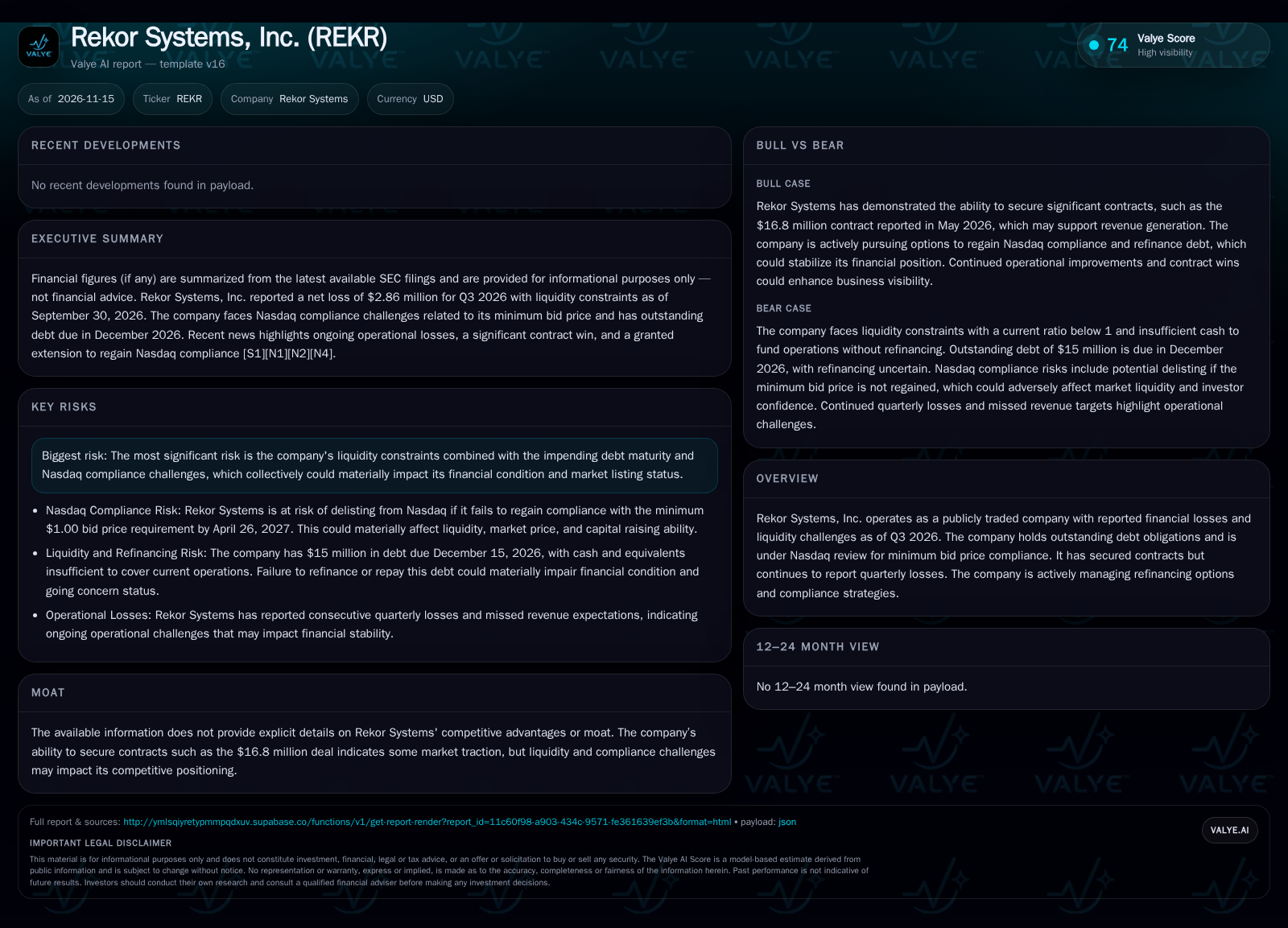
The next few quarters will be decisive as Rekor seeks refinancing, operational improvements, and regulatory compliance [S1] [N1] [N2] [N4].
The coming months will test Rekor’s ability to stabilize its finances, regain compliance, and preserve its position in the public markets.
Liquidity Crunch, Debt Maturity, and Nasdaq Compliance: Rekor’s Immediate Challenges
As of September 30, 2026, Rekor Systems reported just $5.1 million in cash and cash equivalents, with current liabilities of $26.5 million, resulting in a current ratio of 0.61 and a cash ratio of 0.68—well below the threshold generally considered healthy for ongoing operations [S1].
Compounding the pressure, Rekor faces a $15 million principal payment on its Series A Prime Revenue Sharing Notes due December 15, 2026. The company is exploring refinancing alternatives, but the outcome remains uncertain [S1].
On the regulatory front, Rekor received a Nasdaq notice for non-compliance with the $1.00 minimum bid price requirement in April 2026. While it obtained a 180-day extension to regain compliance by April 26, 2027, a failure to do so could result in delisting, which would further restrict capital access and damage investor confidence [N4].
Despite these headwinds, the company secured a $16.8 million contract in May 2026, providing a potential revenue boost and evidence of commercial traction, though not enough to reverse ongoing losses [S1].
Revenue Potential, Cost Structure, and the Tension Between Scale and Solvency
Rekor Systems’ business economics are currently defined by high operating costs relative to revenue generation, as evidenced by consecutive quarterly losses and missed revenue targets [S1] [N2]. The company’s ability to secure significant contracts, such as the recent $16.8 million deal, suggests potential for meaningful top-line growth if it can convert pipeline opportunities into recognized revenue.
However, the company’s cost structure appears to be heavily front-loaded or fixed, as recurring losses have persisted despite contract wins. This dynamic indicates that Rekor may require substantial volume or a step-change in contract flow to achieve break-even or positive operating leverage. If the company’s platform or services involve a mix of hardware deployments, software licensing, and managed services—as is typical in traffic management, AI-driven infrastructure, or public safety verticals—the margin profile could vary widely depending on contract type and delivery model.
The need to refinance or restructure $15 million in debt introduces additional capital costs or potential dilution if new equity is issued. Rekor’s near-term economics are thus tightly linked to its ability to stabilize cash flows, secure bridge financing, and compress its operating loss run rate.
Market Traction Versus Structural Handicaps in a Crowded Data-Driven Sector
While the $16.8 million contract win demonstrates that Rekor can compete for sizable deals, its financial constraints may limit its ability to scale or invest in product and business development at the pace of better-capitalized rivals. The company operates in a sector likely characterized by established incumbents and emerging tech-driven challengers, all vying for public sector or enterprise contracts in traffic management, AI surveillance, or data analytics.
Without a clear capital buffer, Rekor may be forced to turn down large, resource-intensive opportunities or face higher costs of capital versus peers. Competitors with stronger balance sheets can absorb longer sales cycles, invest in R&D, and withstand pricing pressure, which could erode Rekor’s relative position.
Switching costs in this sector can be meaningful if Rekor's solutions are deeply integrated into customer workflows or infrastructure. However, the company’s ongoing financial distress could itself become a risk factor for customers considering long-term commitments, unless Rekor can convincingly resolve its refinancing and compliance overhangs.
How a Turnaround Could Unfold: Contract Execution, Successful Refinancing, and Compliance Restoration
A favorable scenario for Rekor would involve the timely execution and revenue recognition of its $16.8 million contract, possibly accompanied by additional wins that build backlog and demonstrate recurring demand. If the company successfully refinances or restructures its $15 million debt—potentially at manageable terms—it could stabilize its liquidity position and extend its operational runway.
Regaining Nasdaq compliance, either through market-driven share price appreciation or a reverse split with stockholder approval, would preserve its public listing and maintain access to capital markets. Evidence of operating leverage—such as narrowing losses in subsequent quarters or a shift to break-even—would further validate the turnaround.
Confirmation of this scenario would include improved cash flow from operations, additional contract announcements, positive guidance on refinancing progress, and a sustained recovery in share price above the $1.00 threshold.
Stalled Progress: Operational Strain and the Search for a Lifeline
The most plausible outcome, given current facts, is that Rekor continues to face operating losses and liquidity stress while working to close refinancing or restructuring arrangements. The company may execute on existing contracts and seek new business, but the pace of improvement is likely to lag the urgency of its debt and compliance deadlines.
Nasdaq extension buys time, but if the share price remains below $1.00, the company may be forced to pursue a reverse split, which can sometimes further erode investor sentiment. If refinancing terms are unfavorable or delayed, Rekor could be forced into asset sales, workforce reductions, or other cost-cutting measures to preserve cash.
This scenario would be confirmed by continued negative operating cash flow, additional disclosures of cost containment or restructuring, and a lack of significant upward movement in the share price or contract pipeline.
Failure to Refinance or Regain Compliance: Paths to Delisting and Distress
If Rekor fails to refinance its $15 million debt and is unable to generate sufficient cash from operations or new investment, it could face insolvency or be forced into a distressed sale of assets. Delisting from Nasdaq, if compliance is not restored by April 2027, would likely exacerbate these pressures by reducing liquidity, impairing the company’s ability to raise capital, and triggering default or acceleration provisions in debt agreements.
In this scenario, customers and partners may view Rekor as a higher-risk counterparty, leading to lost business or renegotiated terms. The company’s negotiating leverage in any future capital raise would be minimal, resulting in punitive dilution or loss of control if an investor of last resort steps in.
Evidence for this scenario would include missed or defaulted debt payments, delisting notifications, asset impairments, steep share price declines, or disclosures of going concern doubts.
Milestones That Will Determine Rekor’s Future Viability
Progress and terms on refinancing or restructuring the $15 million Series A Prime Revenue Sharing Notes due December 2026.
Operating cash flow trends; a shift toward break-even or positive cash flow would signal improved economic viability.
Execution and revenue recognition from the $16.8 million contract, including associated margin and backlog conversion, if disclosed.
Updates on Nasdaq minimum bid price compliance, including share price movements and any shareholder votes on a reverse split.
Announcements of new contract wins or expansions that materially expand the revenue base and improve visibility.
Disclosure of cost containment or restructuring initiatives that could extend the company’s operating runway.
Any signals of customer or partner attrition in response to Rekor’s financial health or market uncertainty.
If disclosed, backlog levels and renewal rates would be useful indicators of customer confidence and revenue durability.
Disclaimer: This is research-only, informational analysis and not investment advice. It may include AI-generated interpretation and general industry context. Always verify important details using primary sources.

Comments