
Azitra’s Engineered Microbiome Ambition: Clinical Progress, Capital Constraints, and the Stakes for Precision Dermatology
Azitra, Inc. is leveraging its proprietary microbial library and AI-augmented platform to develop genetically engineered live biotherapeutics for challenging dermatologic diseases. As early clinical trials progress for its lead programs, the company confronts the realities of limited capital, pipeline execution risks, and the unproven economics of commercializing live bacterial therapies in dermatology.
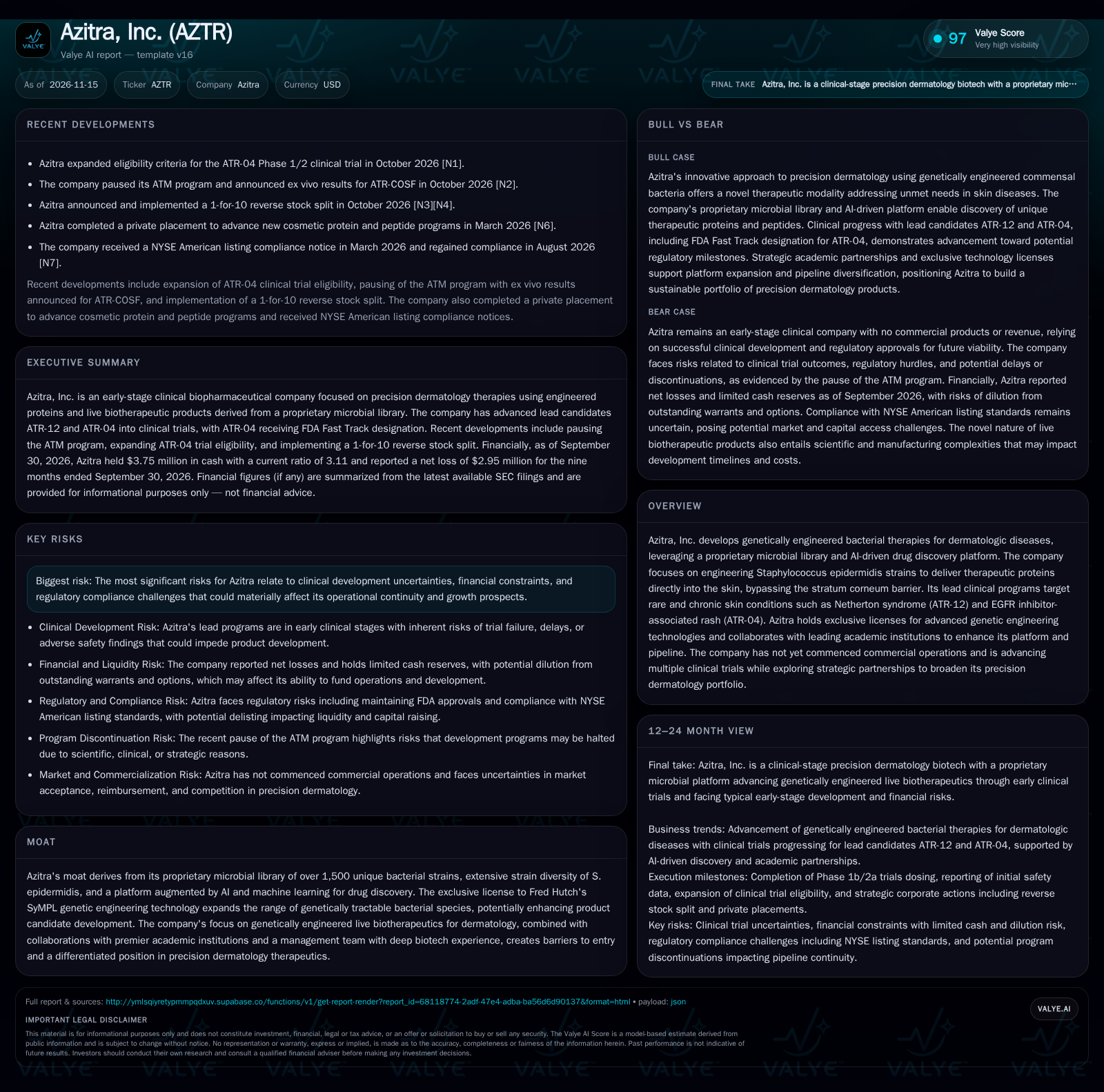
Azitra is advancing a precision dermatology pipeline based on engineered commensal bacteria, with ATR-12 and ATR-04 in early clinical trials and ATR-04 receiving FDA Fast Track status. Recent actions—including a reverse stock split, pausing its ATM program, and expanding trial eligibility—reflect both operational milestones and financial constraints. [S1] [S2] [N1] [N2] [N3] [N4] [N8]
Azitra, Inc. is betting on the convergence of synthetic biology, AI-powered drug discovery, and the therapeutic promise of live biotherapeutic products to carve out a differentiated niche in precision dermatology. Recent operational decisions, including a reverse stock split and a pause in at-the-market (ATM) financing, highlight both the company’s strategic recalibration and the financial fragility typical of early-stage biotechs. The question is whether Azitra’s innovative platform and clinical progress can translate into a viable, defensible business before capital constraints or clinical setbacks force a shift in strategy.
Recent Clinical and Corporate Moves Define Azitra’s Near-Term Trajectory
Azitra’s most material recent developments revolve around its lead clinical programs and urgent financial management. The company’s ATR-04 candidate, designed to treat EGFR inhibitor-associated rash, received FDA Fast Track status in September 2024, began Phase 1/2 dosing in Q3 2025, and expanded its trial eligibility in October 2026—suggesting active efforts to accelerate enrollment and regulatory momentum. Meanwhile, ATR-12, targeting Netherton syndrome, is in an ongoing Phase 1b/2a trial, with initial safety data expected in 2025. On the financial front, Azitra paused its ATM program and implemented a 1-for-10 reverse stock split in October 2026, reflecting a response to both low share price and limited fundraising options. As of September 30, 2026, Azitra held $3.75 million in cash, with no reported commercial revenue and a net loss of $2.95 million for the year to date. These facts highlight the company’s dual imperatives: clinical execution to drive value and urgent capital stewardship to extend runway. [S1] [S2] [N1] [N2] [N3] [N4] [N8]
Microbial Therapeutics and the Unproven Economics of Live Biologics in Dermatology
Azitra’s business model is predicated on developing and ultimately commercializing live biotherapeutic products—specifically, genetically engineered strains of Staphylococcus epidermidis—capable of delivering therapeutic proteins directly into the skin. The economics of such products remain largely theoretical: if successful, live biotherapeutics could command premium pricing in rare or high-burden dermatologic indications, especially where current treatments are inadequate or cause significant side effects. However, manufacturing live bacterial products at scale presents challenges around consistency, stability, and regulatory compliance, likely resulting in higher fixed costs and potentially lower gross margins than traditional small molecules or biologics.
The company’s AI-driven platform, proprietary microbial library, and exclusive genetic engineering licenses may offer cost efficiencies in discovery, but the capital intensity of clinical development and the need for specialized manufacturing infrastructure suggest significant ongoing funding requirements. With no revenue to date and a net loss pattern, Azitra’s near-term business economics are dominated by R&D expense, clinical trial costs, and the necessity to raise external capital, likely through equity or structured partnerships. The company’s ability to achieve operating leverage will depend on successful clinical readouts, regulatory approvals, and the scalability of its manufacturing processes—none of which are yet proven.
Defensive Moats and Vulnerabilities in a Crowded Precision Dermatology Landscape
Azitra’s core competitive advantages derive from its proprietary microbial library of 1,500 strains, exclusive access to Fred Hutchinson’s SyMPL genetic engineering technology, and its integration of AI/ML for candidate selection and optimization. These assets create scientific barriers to entry and may accelerate pipeline innovation, particularly for indications where engineered commensals can address unmet needs. Academic partnerships with institutions like Carnegie Mellon, Yale, and Duke further bolster credibility and technical capacity.
However, the field of precision dermatology is highly competitive, with established pharmaceutical and biotech players exploring topical biologics, gene therapies, and alternative microbiome interventions. The live biotherapeutics segment itself remains nascent, with regulatory, manufacturing, and adoption hurdles yet to be fully resolved. Azitra’s lack of commercial products and modest financial resources place it at a disadvantage relative to well-capitalized incumbents and even some peer-stage innovators. The risk is that scientific differentiation may not translate into durable commercial advantage if execution falters or if competitors can fast-follow with broader pipelines, superior data, or deeper market access capabilities.
Transformational Value if Early Clinical Data Validate Platform and Unlock Partnerships
The most favorable scenario for Azitra involves strong safety and efficacy signals from ongoing Phase 1b/2a (ATR-12) and Phase 1/2 (ATR-04) trials, enabling rapid advancement to later-stage studies or even expedited regulatory pathways for rare dermatologic indications. Positive data could catalyze strategic partnerships with larger biopharma companies, providing non-dilutive capital, development expertise, and commercial infrastructure. If the AI-driven platform continues to deliver differentiated candidates and the company demonstrates scalable, compliant manufacturing processes, Azitra could establish itself as a first-mover in engineered live biotherapeutics for skin diseases.
Evidence that would confirm this scenario includes: robust clinical readouts demonstrating clear therapeutic benefit and safety; new partnership or licensing deals with upfront payments; successful manufacturing scale-up; and early signs of regulatory flexibility or orphan drug incentives. Conversely, lackluster efficacy, safety concerns, or continued inability to attract external partners would falsify the bull thesis.
Incremental Progress Amid Persistent Funding and Execution Risks
The most plausible near-term path is one of measured clinical progress offset by recurring financial and operational constraints. Azitra advances its lead programs through Phase 1/2, generates preliminary safety and exploratory efficacy data, and continues to leverage academic partnerships for platform expansion. Dilution from outstanding warrants and options remains a concern, and commercial timelines are likely to slip unless external validation accelerates the story.
Key evidence confirming this scenario would include steady but not breakthrough clinical updates, continued reliance on equity or hybrid financing, and incremental progress on manufacturing and regulatory fronts. Failure to achieve meaningful clinical differentiation or to secure strategic capital would push the company closer to the downside.
Clinical Setbacks or Capital Shortfall Force Pipeline Retrenchment or Strategic Alternatives
In an adverse scenario, one or both lead programs encounter safety issues, insufficient efficacy, or regulatory setbacks—undermining confidence in the platform and limiting prospects for follow-on funding. In this event, Azitra may be forced to halt or divest pipeline assets, pursue a distressed strategic transaction, or even face delisting from the NYSE American if stockholder equity fails to meet minimum thresholds.
Confirmation of this scenario would include negative or inconclusive clinical data, further pausing or discontinuation of development programs, inability to raise capital on acceptable terms, or public signals of restructuring or sale. A positive inflection in trial results or a new partnership could, however, reverse this trajectory.
Milestones and External Factors That Will Shape Azitra’s Platform Viability
Initial safety and exploratory efficacy data from ATR-12 and ATR-04 clinical trials—particularly any indication of disease-modifying benefit or superior tolerability (when disclosed).
Announcements of new strategic partnerships, out-licensing deals, or non-dilutive funding to offset capital constraints.
Updates on manufacturing scalability, quality, and regulatory compliance for live biotherapeutic products—a useful metric would be cost per dose or batch consistency (if disclosed).
Frequency and terms of future capital raises, including dilution impact from warrants and options exercised.
NYSE American listing status, especially any further compliance notices or actions tied to stockholders’ equity metrics.
Expansion of pipeline beyond current lead programs, including progress on cosmetic protein and peptide candidates and ex vivo results for ATR-COSF.
Changes to clinical trial design, eligibility, or endpoints that could impact probability of success or regulatory timelines.
Management commentary or actions regarding business development, capital strategy, or risk-mitigation plans in response to operational setbacks.
Disclaimer: This is research-only, informational analysis and not investment advice. It may include AI-generated interpretation and general industry context. Always verify important details using primary sources.

Comments