
Parabilis Medicines: Zolucatetide’s Clinical Momentum and the Capital-Intensive Road to Rare Disease Impact
Parabilis Medicines stands out for its lead candidate zolucatetide’s promising early results in rare oncology and genetic disease, backed by a substantial cash position. Yet, the company’s future will hinge on successfully navigating pivotal trial execution, regulatory hurdles, and the economics of commercializing first-in-class therapies in narrow indications.
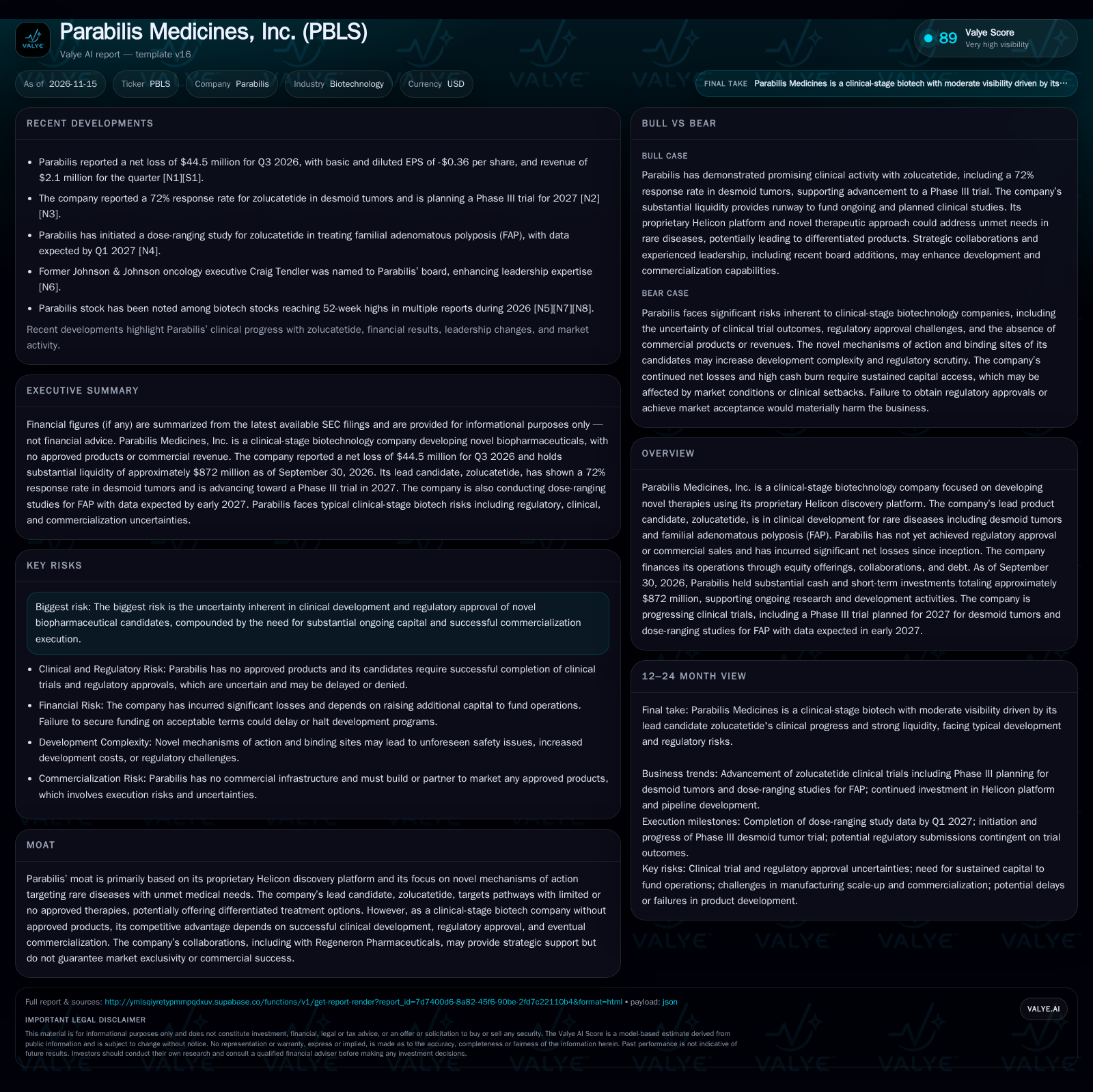
Parabilis Medicines, a clinical-stage biotech, is advancing zolucatetide in desmoid tumors and FAP with a 72% response rate reported in desmoid trials and a Phase III on the horizon. The company’s $872 million in liquid assets provides runway but not certainty: path-defining risks include clinical and regulatory outcomes, capital intensity, and the challenge of translating scientific differentiation into commercial success in rare diseases. Board additions and platform potential add optionality, but thesis confirmation depends on late-stage trial execution and pathway clarity to approval and adoption. [S1] [N2] [N3] [N4] [N6]
However, Parabilis remains firmly in the pre-commercial phase, facing the perennial biotech gauntlet: translating clinical promise and scientific novelty into regulatory approvals and, ultimately, sustainable business economics. The stakes are high, not only for its pipeline but for the very viability of its platform-centric approach.
Recent Clinical Results and Financial Position Define the Inflection Point
Parabilis Medicines’ most material recent development is the reported 72% response rate for zolucatetide in desmoid tumor patients, a rare oncology indication with limited effective therapies. This result underpins the company’s decision to plan a Phase III trial in 2027, a critical milestone that could define the drug’s regulatory and commercial prospects if replicated at scale. Concurrently, the company has initiated a dose-ranging study for zolucatetide in familial adenomatous polyposis (FAP), with data expected by Q1 2027, potentially unlocking a second rare-disease indication. The company posted a net loss of $44.5 million in Q3 2026 and continues to operate at a significant deficit, typical for its stage. These facts frame a company at a critical transition: clinical promise with material funding, but no commercial revenues or regulatory certainty. [S1] [N1] [N2] [N3] [N4]
The Economics of Rare Disease Biotech: High Stakes, High Burn, and the Search for Leverage
Parabilis’ business model follows the archetype of high-risk, high-reward clinical-stage biotech. The company invests heavily upfront in research, clinical trials, and regulatory processes, with the goal of achieving breakthrough status and premium pricing in rare disease markets. The economics are characterized by high fixed costs related to R&D, trial execution, and regulatory filings, while variable costs remain relatively low until and unless commercialization begins. If zolucatetide or future candidates are approved, pricing power could be substantial given the severe unmet need in desmoid tumors and FAP. However, commercial success would depend on the ability to secure reimbursement, demonstrate clear clinical benefit, and potentially navigate small patient pools—factors that can limit overall market size and revenue scalability.
With no approved products, Parabilis currently generates only nominal revenue—likely from collaborations or grants—and is reliant on external capital. The company’s accumulated deficit of $683.8 million and ongoing quarterly net losses illustrate the capital intensity and long payback periods inherent to the sector. The company’s $872 million in liquid assets provides flexibility to fund at least mid-term development, but does not guarantee the ability to reach cash flow break-even, particularly if additional setbacks or expanded trials arise. Operating leverage could materialize if a drug is approved and achieves rapid uptake, but the transition from clinical to commercial economics remains a major risk and inflection point.
Platform Differentiation and the Challenge of Clinical and Commercial Moats
Parabilis’ potential competitive advantage rests on its proprietary Helicon discovery platform, which enables the targeting of novel mechanisms and binding sites in diseases with few or no approved therapies. In rare diseases like desmoid tumors and FAP, first-mover status and strong clinical data can create a potentially leading moat through regulatory exclusivity, orphan drug incentives, and high barriers to entry for direct competitors. The company’s 72% response rate in desmoid tumors, if confirmed in late-stage trials, could differentiate zolucatetide from competing agents and improve its standing with regulators and payors.
However, the moat is not assured. Other clinical-stage biotechs, large pharmaceutical companies, and academic centers are also pursuing therapies for rare tumors and genetic conditions, sometimes leveraging alternative modalities (e.g., gene therapies, small molecules, or biologics). Should a competing agent demonstrate superior efficacy, safety, or ease of administration, Parabilis’ lead could be eroded before meaningful commercial traction is achieved. Moreover, the company will have to build or partner for commercialization, which could impact margins and control over market strategy. The recent appointment of a seasoned oncology executive to the board may help bridge the gap between clinical development and market execution, but the platform’s true defensibility will only be tested post-approval.
Breakthrough Data and Regulatory Success Could Unlock Accelerated Adoption
The most favorable outcome for Parabilis would materialize if zolucatetide’s Phase III trial in desmoid tumors confirms or exceeds the 72% response rate seen in earlier studies, with a safety profile that satisfies regulators. This could enable rapid regulatory approval—possibly with orphan or breakthrough designation—leading to early market entry and premium reimbursement in a space with limited competition. Simultaneous positive data from FAP studies could strengthen the company’s rare-disease portfolio and justify further pipeline investment.
Confirmation of this scenario would include robust, statistically significant Phase III data, clear regulatory guidance or expedited review pathways, and early signals from payors indicating willingness to reimburse at high price points. Additional evidence could come from partnership announcements with larger pharmaceutical companies, reflecting external validation and potential for commercial scale-up. A sharp reduction in cash burn relative to revenue (if disclosed) would further support thesis confirmation.
Clinical Progress with Delays and Iterative De-Risking Likely Defines the Next 18–24 Months
The most plausible trajectory is that Parabilis continues to advance zolucatetide through the planned Phase III desmoid tumor trial and completes the FAP dose-ranging study, but encounters the typical delays, protocol amendments, or mixed data points common in late-stage drug development. Regulatory feedback may require additional data, longer follow-up, or comparative studies, potentially stretching timelines and increasing costs. Pipeline expansion or new indications may be explored, but will remain early-stage until lead programs are de-risked.
Evidence supporting this scenario would include ongoing trial enrollment updates, interim analyses showing safety or efficacy trends (if disclosed), and continued high R&D expense with only incremental revenue. Falsification would come from a material clinical setback, major regulatory rejection, or a strategic pivot away from the current lead indications.
Clinical or Regulatory Setbacks Could Force Strategic Retrenchment and Capital Raises
The primary risk is that zolucatetide fails to demonstrate sufficient efficacy or safety in Phase III desmoid tumor trials, or that regulatory agencies require more extensive data, delaying approval and eroding investor confidence. Negative or inconclusive data from the FAP study could further weaken the pipeline’s perceived value. In this scenario, Parabilis would face continued high cash burn with no clear path to revenue, potentially triggering the need for dilutive capital raises or restructuring.
Confirmation of this downside would include trial discontinuations, public disclosures of adverse safety findings, withdrawal or shelving of lead programs, or announcements of new financing at unfavorable terms. A significant drop in liquid assets without corresponding clinical progress, or the exit of key executives or partners, would further validate a bearish thesis.
Milestones That Will Define Parabilis’ Ability to Transition from Platform to Product
Progress and outcomes from the planned Phase III trial of zolucatetide in desmoid tumors, including enrollment rates, interim data (if disclosed), and regulatory communications.
Readout of the FAP dose-ranging study by Q1 2027 and any subsequent indication expansion decisions.
Cash burn trajectory relative to clinical milestones achieved; a useful metric would be quarterly cash utilization versus trial progress.
Updates on potential partnership, out-licensing, or collaboration agreements, especially with larger biopharma firms.
Regulatory feedback from FDA and EMA, especially regarding trial design, endpoints, and accelerated approval pathways.
Board and executive team changes, particularly additions with commercial or late-stage development expertise.
If disclosed, payor engagement and preliminary pricing or reimbursement discussions for zolucatetide.
Disclaimer: This is research-only, informational analysis and not investment advice. It may include AI-generated interpretation and general industry context. Always verify important details using primary sources.

Comments