
Planet 13’s Multi-State Cannabis Platform: Integration Ambitions, Merger Stakes, and the Economics of Scale
Planet 13 Holdings pursues a multi-state, vertically integrated cannabis strategy anchored by flagship superstores and proprietary brands. As the company faces persistent net losses, a pending merger with Vireo Health International could reshape its operational scope and financial profile—but exposes the business to new integration, regulatory, and competitive risks.
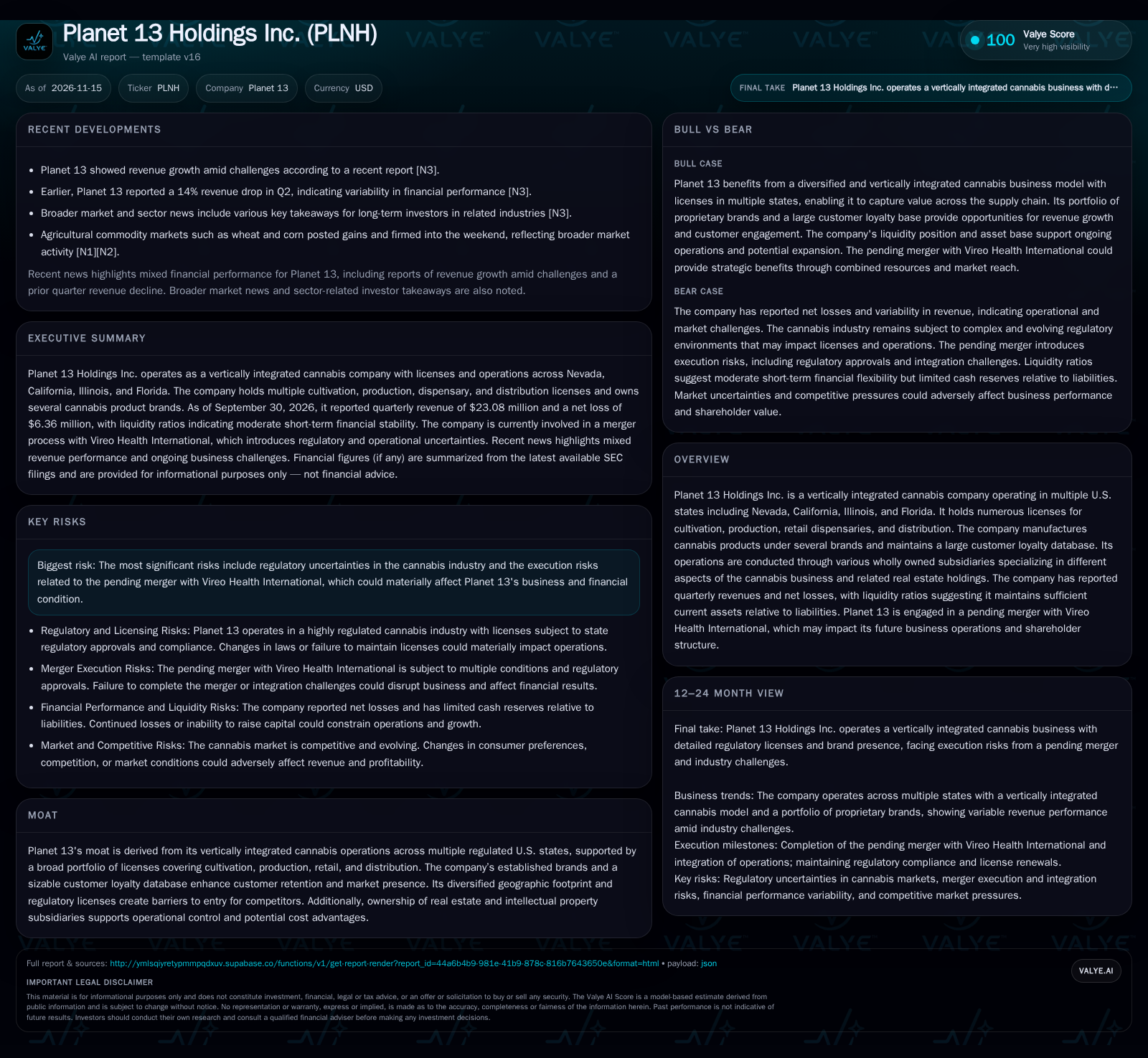
Planet 13 operates a vertically integrated cannabis business across Nevada, Florida, and Illinois, with a focus on experiential retail and proprietary brands. The company reported $23.08 million in quarterly revenue and a net loss of $6.36 million as of September 2026. A merger with Vireo Health International is pending, introducing both strategic potential and execution risk. Near-term performance hinges on regulatory approvals, integration execution, and the ability to leverage operational scale.
Planet 13 Holdings is emblematic of the U.S. cannabis industry’s push for scale and integration, operating cultivation, manufacturing, and retail assets across several regulated states. With its signature Las Vegas superstore and a portfolio of proprietary brands, Planet 13 has sought to differentiate through experiential retail and broad market presence. The company’s pending merger with Vireo Health International could create a larger, more diversified platform—but also raises the stakes for regulatory navigation, integration, and sustained execution.
Recent Developments: Multi-State Operations, Financial Results, and Merger Uncertainties
Planet 13 Holdings operates as a vertically integrated cannabis company with licensed assets and operations in Nevada, Florida, and Illinois, and completed its exit from California during 2026 [S1]. The company’s business model encompasses cultivation, manufacturing, and retail—anchored by large-format dispensaries and several in-house brands. For the quarter ending September 30, 2026, Planet 13 reported $23.08 million in revenue and a net loss of $6.36 million, reflecting ongoing profitability challenges [S2]. The most material near-term development is a pending merger with Vireo Health International, which could fundamentally alter Planet 13’s market reach, operational structure, and risk profile; this transaction remains subject to regulatory and shareholder approvals [S2].
Revenue Streams and the Structural Economics of Vertically Integrated Cannabis
Planet 13’s revenue model is built around capturing value at multiple points in the cannabis supply chain: cultivation, manufacturing (including branded products), and retail. In theory, vertical integration can improve gross margins by reducing reliance on third-party suppliers and maximizing control over product quality, pricing, and branding. The company’s flagship superstores—particularly its Las Vegas location—are designed to drive higher traffic and potentially could support premium pricing and customer loyalty through experiential features.
However, the fixed costs associated with large-format retail, cultivation facilities, and regulatory compliance are substantial. Operating leverage can amplify both gains and losses: while higher sales volumes could drive margin expansion, underutilized capacity or flat sales can exacerbate losses, as seen in the persistent net loss reported for the recent quarter [S2]. State-by-state regulatory fragmentation complicates scale economies, as each market requires separate facilities, licenses, and compliance systems. Capital requirements remain elevated, especially if expansion or facility upgrades are needed. The pending merger with Vireo could increase potential for cost synergies and broader market access, but would also add integration costs and complexity.
Defensible Advantages and the Challenge of Differentiation in Cannabis Retail
Planet 13’s most notable competitive differentiator is its superstore retail format, which emphasizes immersive, experiential shopping—a model that may attract both local consumers and cannabis tourism in Las Vegas. The company’s proprietary brands and a customer loyalty database exceeding 485,000 customers also provide a foundation for repeat business and targeted marketing [S1]. Vertically integrated operations and real estate ownership can, in theory, create cost advantages and supply chain reliability.
However, these advantages are subject to erosion. The cannabis retail market is increasingly crowded, with local and regional players expanding, and larger multi-state operators (MSOs) vying for share. Regulatory barriers, while significant, are not absolute; as more licenses are issued or regulatory regimes evolve, new entrants could pressure pricing and margins. The exit from California underscores the difficulties of competing in mature or oversupplied markets. Product commoditization and shifting consumer preferences could further challenge brand differentiation unless Planet 13 sustains marketing innovation and product development. The pending Vireo merger may unlock greater geographic reach and operational scale, but only if integration is executed effectively and regulatory risks are managed.
Strategic Integration and Regulatory Tailwinds Could Unlock Operating Leverage
A favorable scenario would see Planet 13 successfully completing the merger with Vireo Health International, rapidly integrating operations, and leveraging the combined platform to expand market share in core states. If regulatory approvals are secured without onerous conditions, the merged entity could achieve cost synergies in procurement, distribution, and back-office functions. The ability to cross-sell proprietary brands across a broader retail footprint may drive higher sales volumes and support margin expansion.
Upside would be confirmed by a return to sequential revenue growth post-merger, visible improvement in gross and operating margins, and evidence of successful new store openings or market entries leveraging the combined license portfolio. In this scenario, sustained investment in experiential retail and brand marketing could continue to differentiate Planet 13 from commodity competitors, while a larger scale could improve negotiating power with suppliers and regulators.
Incremental Progress Amid Persistent Regulatory and Margin Pressures
The most likely near-term outcome is a slow, uneven integration process if the Vireo merger closes, with Planet 13 continuing to face regulatory, competitive, and profitability headwinds. Revenue may grow modestly through incremental store additions or market recovery in core states, but persistent fixed costs, state-level regulatory complexity, and market competition would continue to weigh on margins. Cost synergies from the merger could materialize only gradually, offset by integration expenses and potential disruption.
Confirmation of this scenario would come from continued single-digit revenue growth, limited margin improvement, and periodic net losses as operating leverage remains constrained. Regulatory delays, integration hiccups, or underwhelming performance from new markets could reinforce the base case. If the company is unable to materially grow its customer database or drive higher engagement, upside would be further limited.
Execution Failures and Regulatory Setbacks Could Accelerate Financial Strain
A more adverse outcome would involve significant delays or failure in closing the merger with Vireo—whether due to regulatory hurdles, shareholder opposition, or unforeseen legal challenges. In this case, Planet 13 would remain a standalone operator with limited scale, facing ongoing net losses and constrained liquidity. Should market conditions deteriorate further—such as increased price competition, slower demand growth, or additional regulatory burdens—the company’s ability to cover fixed costs and invest in growth could be compromised.
Downside confirmation would include material revenue declines, shrinking gross margins, further cash burn, and warnings about going-concern risk. Any loss of key state licenses, legal or regulatory setbacks, or negative developments in the ability to renew or secure new licenses would exacerbate these pressures. Should the company be forced to curtail operations, sell assets, or resort to dilutive financing, shareholder value would be at heightened risk.
Milestones and Data Points That Will Shape Planet 13’s Strategic Outcome
Progress and timeline for regulatory and shareholder approvals of the Vireo merger; any announced delays or material changes to transaction terms would be highly consequential.
Quarterly revenue growth and gross margin trends post-merger (if completed), as evidence of integration success and operational leverage.
Cash flow from operations and changes in cash reserves—especially if the company continues to report net losses.
Store-level performance metrics, including customer traffic and loyalty program engagement (if disclosed), to test the effectiveness of the experiential retail model.
Licensing updates: renewals, new approvals, or regulatory actions in Nevada, Florida, or Illinois, as these determine market access and growth potential.
Synergy realization and integration expense disclosures following the Vireo transaction, to assess whether expected cost savings are materializing.
Market share trends in core states, particularly in Nevada and Florida, relative to other MSOs and local competitors (if disclosed).
Any major shifts in state or federal cannabis regulation, which could reshape the competitive landscape or open new growth avenues.
Disclaimer: This is research-only, informational analysis and not investment advice. It may include AI-generated interpretation and general industry context. Always verify important details using primary sources.

Comments