
Obsidian Therapeutics: Clinical Momentum, Reported Liquidity Position, and the Stakes for Cell Therapy Advancement
With over $214 million in liquid assets and promising clinical signals from its lead cell therapy candidate, Obsidian Therapeutics faces a critical window to translate R&D progress into regulatory and commercial outcomes—while navigating industry-standard risks around capital, competition, and execution.
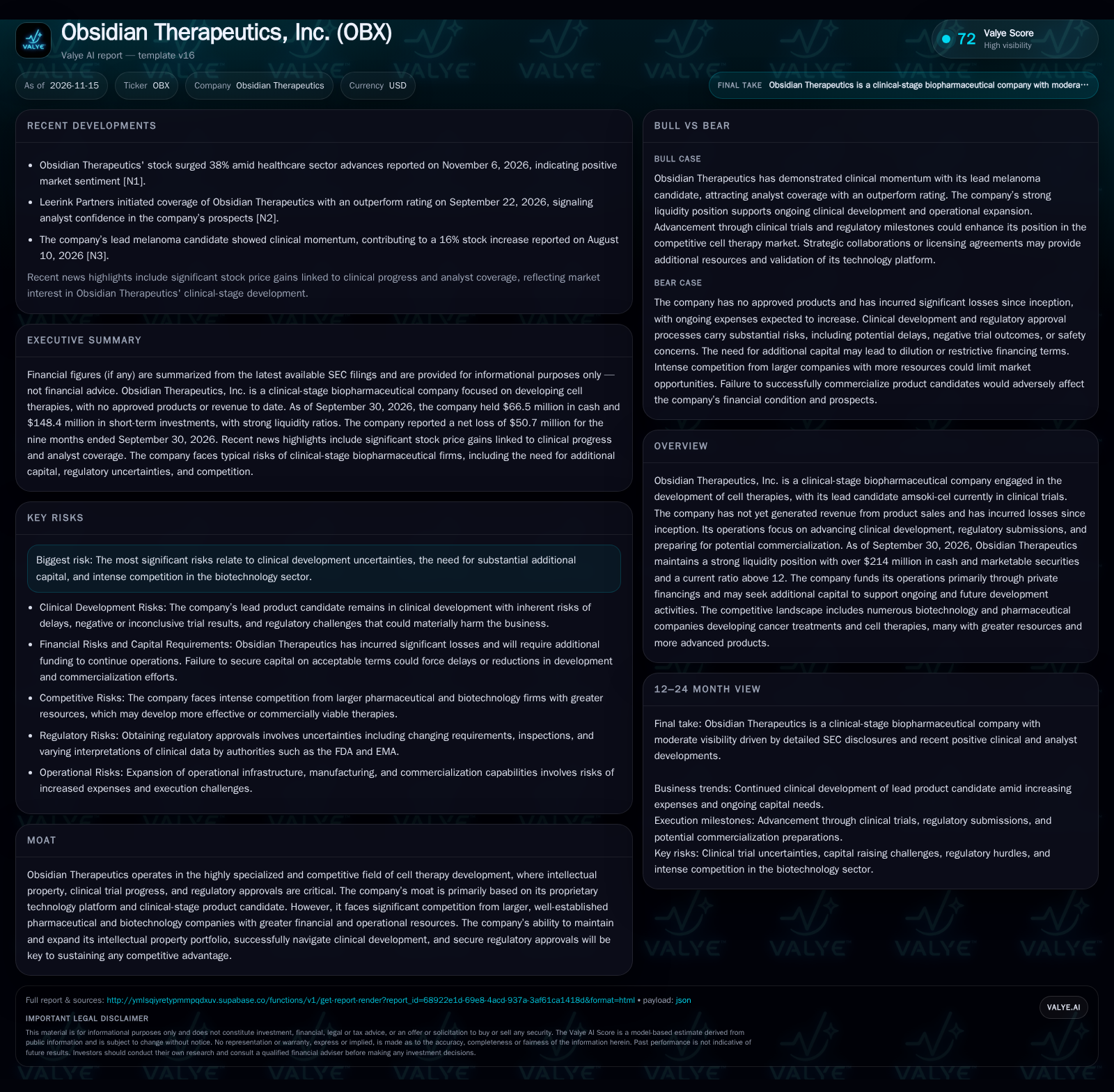
Obsidian Therapeutics is a clinical-stage biotech with no revenue, a net loss of $50.7 million YTD, and areported liquidity position into late 2028. Its lead cell therapy, amsoki-cel, has shown clinical momentum, spurring a 38% stock surge and positive analyst coverage. The company’s challenge is to convert this progress into regulatory approvals and eventual commercialization before further capital is required.
Obsidian Therapeutics, a clinical-stage biotech focused on cell therapies for cancer, sits at a pivotal inflection point. With over $214 million in liquid assets and recent momentum for its lead candidate amsoki-cel, the company has financial runway and growing external attention. Yet, the road ahead is defined by clinical, regulatory, and capital-raising hurdles—common to all pre-commercial biotechs. Investors and stakeholders must weigh the promise of cutting-edge cell therapy science against the realities of unproven revenue models and a fiercely competitive oncology market.
Recent Clinical Progress and Financial Position Define the Opportunity Window
Obsidian Therapeutics’ most recent developments center on its lead candidate amsoki-cel, which has shown clinical momentum in melanoma, contributing to a 16% stock increase in August 2026 and a further 38% surge in November 2026 amid broader healthcare sector advances [N1] [N3]. Analyst coverage from Leerink Partners, initiated with an outperform rating in September 2026, signals increasing institutional interest and confidence in the company’s prospects [N2]. Financially, Obsidian reported $66.5 million in cash and $148.4 million in short-term investments as of September 30, 2026, for a total liquidity position of $214.9 million. This supports operating expenses and capital requirements into the second half of 2028 based on current plans [S1]. The company remains pre-revenue, with a net loss of $50.7 million for the first nine months of 2026, and continues to face the typical risks of clinical-stage biotechs: uncertainty in trial outcomes, regulatory hurdles, and the eventual need for additional capital.
Cell Therapy Economics: High Costs, Unproven Revenue, and the Leverage of Success
Obsidian’s business model is currently characterized by high fixed costs—driven by R&D, clinical trial expenses, and early commercialization preparations—without offsetting product revenue. The company’s capital requirements are front-loaded, as it must fund multi-phase clinical trials, regulatory submissions, and infrastructure expansion before any commercial returns. If amsoki-cel or future candidates achieve approval, the transition to revenue generation would likely follow the typical cell therapy commercialization pathway: high per-patient pricing reflecting complex manufacturing and personalized treatment, but initially limited volumes due to narrow indications and the need for specialist centers.
Operating leverage could be substantial if clinical success leads to market entry, as initial fixed investments in manufacturing and regulatory infrastructure may support multiple indications or pipeline assets. However, variable costs remain high in cell therapy, especially if in-house manufacturing is required. The need for additional capital is ongoing and will be determined by the pace of clinical progress, regulatory demands, and the scale of commercial buildout. Strategic partnerships or licensing deals could defray some of these costs but might also dilute future economics.
A critical factor influencing Obsidian’s economic outlook is the scalability of its manufacturing process. Cell therapies often face bottlenecks due to complex, patient-specific production requirements, which can limit throughput and increase per-unit costs. Should Obsidian develop or adopt more automated, modular manufacturing technologies, it could reduce variable costs and improve margins, enhancing the overall business model. Conversely, reliance on manual or outsourced manufacturing could constrain capacity and delay market penetration, necessitating higher upfront investment or partnerships to scale effectively.
Another dimension to consider is reimbursement dynamics in cell therapy markets. High-cost therapies must demonstrate clear clinical benefit and cost-effectiveness to secure favorable payer coverage, especially in oncology where multiple treatment options exist. Obsidian’s pricing strategy will need to balance recouping R&D and manufacturing investments with payer willingness to reimburse. Early engagement with payers and health technology assessment bodies could be critical to shaping trial design and market access strategies, thereby reducing commercialization risk and supporting sustainable revenue generation.
Navigating a Crowded Oncology and Cell Therapy Arena
Obsidian competes in a highly dynamic and intensely competitive field. The cell therapy and oncology markets are populated by both early-stage biotechs and major pharmaceutical companies, many of which have greater resources, deeper clinical pipelines, and established commercial infrastructures. Large incumbents may have the advantage of broader portfolios, faster trial enrollment, and more robust distribution channels.
Obsidian’s potential edge lies in proprietary technology platforms and the ability to demonstrate differentiated clinical outcomes, such as improved efficacy, safety, or patient access. However, barriers to entry are not insurmountable—intellectual property is critical, but the fast-evolving nature of cell therapy means that new entrants or technological advances could quickly erode any first-mover advantage. Success in this space often depends on the speed of clinical execution, compelling data, and the ability to secure strategic partnerships or licensing agreements that validate the platform and provide commercial leverage.
The competitive landscape also demands attention to intellectual property (IP) strategy and freedom to operate. While proprietary platforms can provide differentiation, overlapping patents or emerging technologies may challenge exclusivity. Obsidian’s ability to defend its IP portfolio and navigate potential infringement risks will influence its attractiveness to partners and investors. Moreover, rapid innovation cycles in cell therapy mean that competitors may introduce next-generation products with improved efficacy or safety profiles, necessitating continuous innovation and pipeline diversification to maintain a competitive edge.
Market dynamics further complicate competitive positioning, as reimbursement frameworks and regulatory expectations evolve alongside scientific advances. Obsidian must anticipate shifts such as value-based pricing models or expedited regulatory pathways that could alter commercial viability. Additionally, strategic collaborations with established pharma companies may provide access to broader commercial infrastructure and accelerate market entry, but also require careful negotiation to preserve long-term economic value. The interplay of these factors underscores the importance of agility and strategic foresight in navigating the cell therapy ecosystem.
If Clinical Success Spurs Regulatory Progress and Strategic Partnerships
The most favorable scenario for Obsidian involves amsoki-cel delivering strong clinical data in ongoing trials—demonstrating superior efficacy and a favorable safety profile in melanoma or other indications. Positive trial results could accelerate regulatory submissions and attract interest from large pharma partners or acquirers, providing non-dilutive capital or co-development resources.
Confirmation of this scenario would come from successful completion of pivotal trials, clear regulatory guidance, and the announcement of strategic collaborations or licensing agreements. Additional analyst upgrades and further stock appreciation would likely follow as milestones are met. The thesis would be challenged by trial delays, inconclusive data, or lack of external validation through partnerships.
Incremental Clinical Progress Amid Ongoing Losses and Capital Needs
The most plausible trajectory for Obsidian is continued advancement of amsoki-cel through clinical development, with incremental data releases and steady progress toward regulatory milestones. Expenses are likely to rise as trials expand and operational infrastructure is built out, with no product revenue until at least late-stage approval. The company’s current liquidity could support these activities into the second half of 2028, but any delays or trial expansions could accelerate the need for additional capital.
Evidence supporting this scenario would include modest but positive clinical updates, continued analyst coverage, and a stable or gradually appreciating stock price. A shift in this trajectory—such as negative clinical data, regulatory setbacks, or an inability to raise additional capital on favorable terms—would challenge the base case.
Adverse Trial Outcomes or Financing Constraints Derail the Pipeline
The primary risk to Obsidian’s outlook is a negative or inconclusive clinical trial result for amsoki-cel, which could delay or halt development and erode investor confidence. Regulatory rejections or new safety concerns would have a similar effect, potentially forcing the company to reprioritize the pipeline or cut costs aggressively. Should capital markets become less receptive, Obsidian may face unfavorable financing terms or dilution, limiting its operational flexibility.
This downside scenario would be confirmed by trial discontinuations, major layoffs, unexpected cash conservation measures, or public disclosures of failed clinical endpoints. A significant decline in share price, withdrawal of analyst coverage, or loss of key personnel could also signal mounting distress.
Milestones That Could Shift the Obsidian Therapeutics Thesis
Updates on the clinical progress of amsoki-cel, including interim results, safety signals, and advancement to later-stage trials.
Regulatory feedback or guidance regarding amsoki-cel’s approval pathway and requirements for pivotal studies.
Announcements of new strategic partnerships, co-development deals, or licensing agreements that bring in non-dilutive capital or validate the technology platform.
Changes in the company’s liquidity position, burn rate, or capital-raising plans, especially if disclosed in future SEC filings.
Progress in expanding the pipeline beyond amsoki-cel, such as the initiation of new clinical programs or IND filings.
Competitive developments, such as the approval or clinical success of rival cell therapies in the same indication.
Turnover in key management or clinical leadership roles, or changes to the board, especially if tied to strategic pivots.
Disclaimer: This is research-only, informational analysis and not investment advice. It may include AI-generated interpretation and general industry context. Always verify important details using primary sources.

Comments