
INFLECTION POINT ACQUISITION CORP. IV: Merlin Labs’ Autonomous Flight Ambition, Military Contracts, and Commercialization Barriers
After acquiring Merlin Labs, INFLECTION POINT ACQUISITION CORP. IV gained a foothold in the autonomous aviation sector with the Merlin Pilot system, securing a major U.S. Air Force contract and reporting reported liquidity position and Q3 profitability. The company’s future hinges on scaling military deployments, overcoming integration and regulatory hurdles, and translating defense credibility into broader commercial adoption.
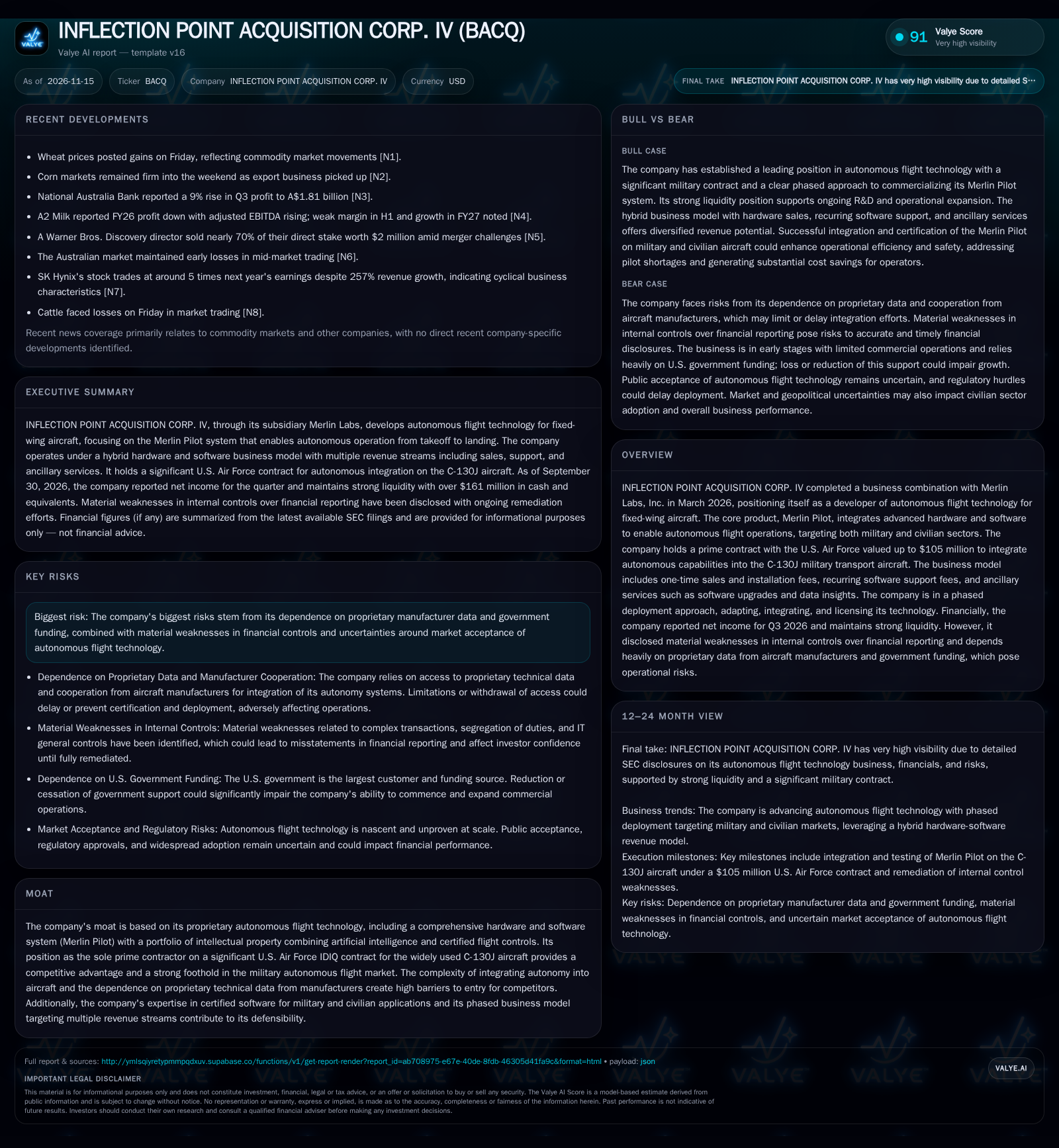
INFLECTION POINT ACQUISITION CORP. IV, now parent to Merlin Labs, is targeting both military and civilian markets with its Merlin Pilot autonomous flight system. The company reported net income in Q3 2026 and has significant liquidity, anchored by a $105 million Air Force contract. Key challenges include reliance on government funding, integration complexity, internal control weaknesses, and the uncertain timeline for regulatory and market acceptance.
INFLECTION POINT ACQUISITION CORP. IV’s absorption of Merlin Labs positions the company at the vanguard of autonomous flight, targeting high-stakes military and eventually civilian aviation markets. The company’s Merlin Pilot system—integrating advanced hardware and software for pilotless or pilot-reduced flights—anchors a business model that combines upfront sales with recurring support and service revenue. With a substantial U.S.
Military Contracts and Cash Drive the Near-Term Outlook
The most material recent developments for INFLECTION POINT ACQUISITION CORP. IV are its completion of the Merlin Labs acquisition, the securing of a prime $105 million IDIQ contract with the U.S. Air Force for C-130J aircraft integration, and the recognition of $73.8 million in net income for Q3 2026. The company reported cash and liquidity metrics for the period; these figures do not by themselves establish operating runway, investment capacity, financial flexibility, or financing capacity. [S2] The company also disclosed material weaknesses in internal controls over financial reporting, especially regarding complex transactions and IT controls [S2].
How Merlin Pilot Could Monetize Autonomy: Multi-Stream Model and the Phasing Challenge
The economic foundation of INFLECTION POINT’s strategy relies on a hybrid model: one-time hardware and installation fees for the Merlin Pilot system, recurring software support contracts, and ancillary services such as training, upgrades, and data insights [S2]. This structure, if executed at scale, could generate a mix of upfront cash and steady downstream revenue, especially as the installed base grows. Hardware sales and installations are likely capital-intensive, with gross margins dependent on integration complexity and manufacturing costs. Recurring software and service fees, if priced effectively, could drive operating leverage as the customer base expands and software development amortizes over more units.
The phased implementation—adapting Merlin Pilot to new platforms, integrating onto customer aircraft, and ultimately licensing autonomy as a service—introduces both ramp-up costs and revenue timing uncertainty. Early deployments (especially in military settings) may require bespoke engineering, limiting initial margins and slowing the transition to more standardized, higher-margin software revenue. The capital needs for certification, regulatory compliance, and ongoing R&D are significant, suggesting that the company’s liquidity must be actively managed to avoid shortfalls before commercial scale is reached.
Beyond the fundamental revenue streams, the company’s ability to optimize cost structure will be pivotal. Hardware production involves complex supply chains and precision manufacturing, which can be susceptible to component shortages or price volatility. If the company can streamline manufacturing processes or secure long-term supplier agreements, it may improve gross margins over time. Additionally, the recurring software and service segment benefits from network effects and data accumulation; as more aircraft are equipped with Merlin Pilot, the system can potentially leverage aggregated operational data to enhance performance, predictive maintenance, and customization, thereby increasing customer stickiness and justifying premium pricing. However, this requires robust data governance and cybersecurity frameworks to mitigate risks associated with sensitive flight data.
The phased rollout strategy introduces timing and scaling risks that hinge on regulatory bodies’ responsiveness and the company’s internal execution capabilities. Early-stage deployments may face prolonged certification cycles, especially when adapting to diverse aircraft models with varying avionics architectures. This heterogeneity limits economies of scale and necessitates tailored engineering efforts. Conversely, successful standardization of integration protocols and modular software architectures could accelerate deployment across multiple platforms, reducing marginal costs and enabling faster revenue growth. The company’s capital allocation decisions—balancing investment in R&D, certification, and market development—will thus critically influence the pace at which it transitions from bespoke military contracts to scalable commercial offerings.
Barriers and Counterforces: Proprietary Tech, Defense Beachhead, and the Integration Bottleneck
INFLECTION POINT’s competitive moat rests on its proprietary Merlin Pilot technology, integration know-how, and early anchoring in the defense sector through the C-130J contract [S2]. The complexity of certifying and integrating autonomous systems into existing aircraft creates high technical and regulatory barriers to entry, especially for military applications where reliability and compliance are paramount.
However, several counterforces threaten this position. The company is dependent on access to proprietary technical data and cooperation from aircraft OEMs, which may be limited or withdrawn [S2]. This reliance could slow or halt integration on key platforms, especially if OEMs develop competing solutions or restrict third-party modification. In the civilian sector, emerging competitors in aviation autonomy—ranging from established avionics suppliers to AI startups—may leverage broader portfolios, deeper integration with OEMs, or faster regulatory pathways. The U.S. government’s outsized role as customer and funder also creates concentration risk, exposing the business to policy changes or budget constraints.
From Defense Validation to Commercial Takeoff: The Bullish Chain Reaction
A favorable trajectory for INFLECTION POINT would see successful and timely integration of Merlin Pilot on the C-130J fleet, resulting in operational deployments and positive performance data. This would establish technical credibility and regulatory precedent, making it easier to win follow-on military contracts (for other platforms or allied forces) and to market the system to civilian operators facing pilot shortages or cost pressures.
If recurring software and service revenues begin to scale—especially through multi-year support contracts—operating leverage could accelerate profitability as fixed R&D and integration costs are spread over a larger base. Evidence confirming this scenario would include public announcements of additional military or commercial contracts, disclosed recurring revenue growth, successful regulatory certifications, and customer testimonials regarding operational benefits and safety improvements.
Incremental Progress Anchored by Defense, with Civilian Expansion Lagging
The most plausible near-term scenario is that INFLECTION POINT continues to execute on its Air Force contract, achieving milestone-based progress but encountering delays and cost overruns typical of complex aerospace integrations. Revenue growth is led by milestone and installation payments, while recurring software and service revenue remains modest until the installed base expands.
Civilian adoption likely progresses slowly, hampered by regulatory uncertainty, public skepticism of autonomous flight, and the need for additional certifications. Confirmation would come from steady contract milestone disclosures, slow but positive recurring revenue growth, and gradual improvement in internal control audit findings.
Integration Stalls, OEM Barriers, and Funding Concentration Erode Momentum
A negative scenario would unfold if technical or regulatory setbacks delay or derail the C-130J integration, leading to missed milestones, contract amendments, or funding clawbacks. If proprietary data access is restricted by OEMs—whether through competitive moves or tightened data licensing—INFLECTION POINT could be unable to adapt Merlin Pilot for new platforms, freezing its addressable market.
Loss or reduction of U.S. government support, whether due to shifting defense priorities or budgetary pressures, would directly threaten the company’s revenue base and ability to fund operations. Worsening internal control weaknesses could result in restated financials or regulatory scrutiny, further damaging credibility. Evidence for this scenario would be contract delays, loss of government funding, public disputes with OEMs, or adverse audit findings.
Milestones and External Factors That Could Reshape the Merlin Labs Thesis
Progress on C-130J integration and achievement of contractual milestones; delays or technical setbacks would directly affect revenue and credibility.
Disclosures of new contracts—especially multi-year, recurring software/service agreements—would indicate traction beyond pilot projects.
Updates on remediation of internal control weaknesses; improvement would support investor confidence, while persistent deficiencies could signal broader execution risks.
Evidence of successful regulatory certifications for Merlin Pilot on additional aircraft types, particularly in civilian markets.
Disclosures, if any, on recurring revenue mix and customer retention rates—critical for validating the shift to a software-driven model.
Announcements regarding expanded access to OEM technical data or new OEM partnerships, which would strengthen integration prospects.
Material changes to U.S. government funding or contract scope; reductions would be a clear red flag for business continuity.
Market developments in public acceptance and regulatory frameworks for autonomous flight, including any major incidents or positive endorsements.
Disclaimer: This is research-only, informational analysis and not investment advice. It may include AI-generated interpretation and general industry context. Always verify important details using primary sources.

Comments