
GrabAGun Digital: Tech-Driven Firearms eCommerce Confronts Profitability Hurdles and Regulatory Complexity
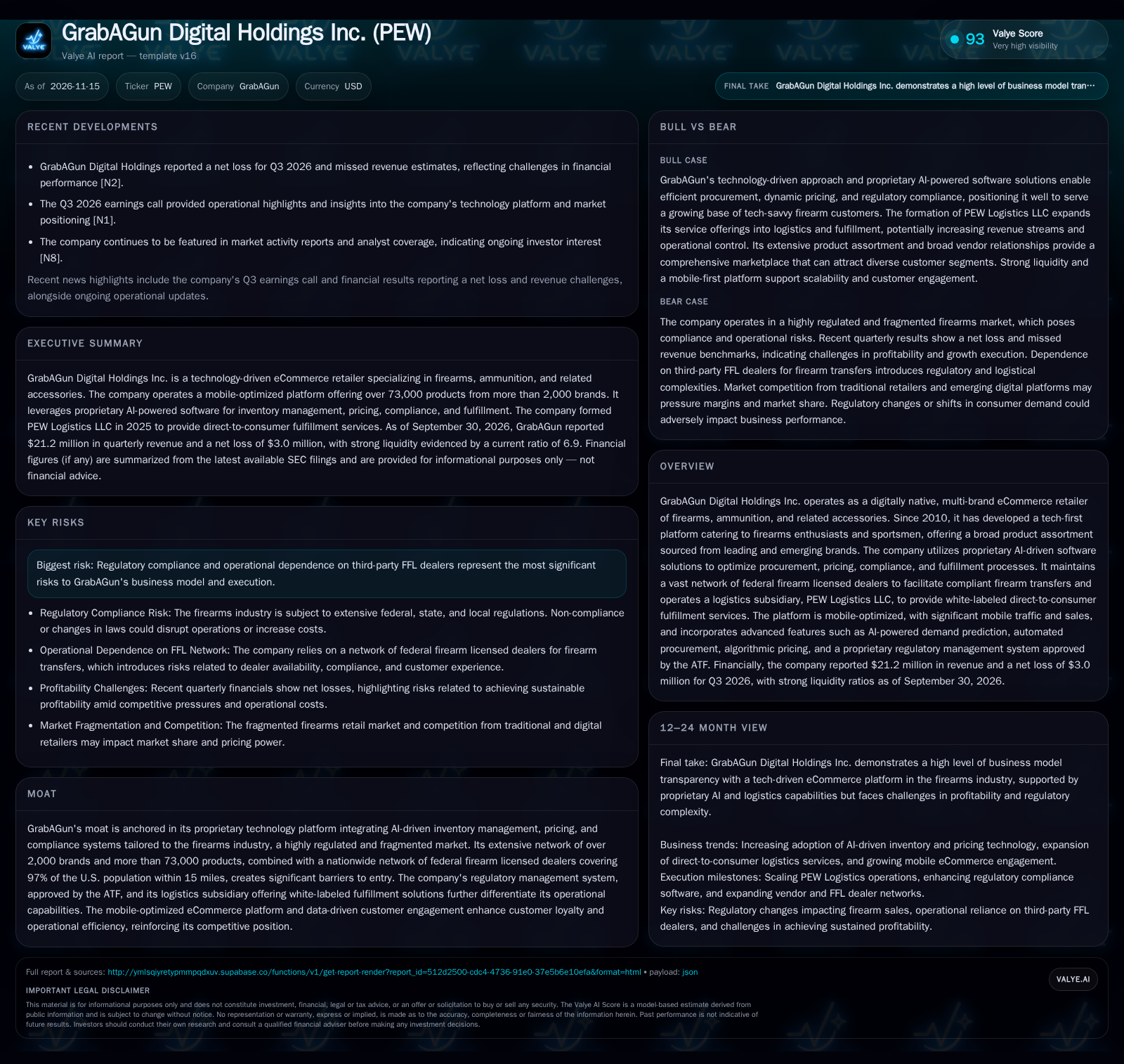
GrabAGun Digital Holdings Inc. has built a mobile-first, AI-enhanced eCommerce platform in the highly regulated firearms and ammunition market, boasting a vast product catalog and a newly launched logistics arm. Despite operational sophistication and reported liquidity position, recent net losses and revenue misses highlight the stakes of scaling this business amid compliance demands, market fragmentation, and persistent margin pressures.
GrabAGun Digital leverages proprietary AI and a deep FFL dealer network to run one of the largest online firearms marketplaces in the U.S., now expanding into logistics services. The company’s tech and logistics assets position it for growth, but execution on both cost control and regulatory navigation will be critical.
GrabAGun Digital Holdings Inc. has emerged as one of the most technologically advanced eCommerce retailers in the U.S. firearms and ammunition sector, combining a broad product selection with proprietary AI-driven tools to optimize inventory, pricing, and regulatory compliance. The company's ambitious expansion into logistics services reflects a push for operational leverage and new revenue streams. Yet, despite a reported liquidity position and a mobile-first engagement strategy, GrabAGun’s recent net losses and missed revenue targets underscore the business model’s vulnerability to margin compression, regulatory headwinds, and the operational complexity of scaling in a fragmented, compliance-heavy market.
Recent Financial Results Reveal Operational Strain Amid Platform Expansion
GrabAGun Digital Holdings reported Q3 2026 revenue of $21.2 million and a net loss of $3.0 million, missing analyst revenue estimates and reflecting ongoing challenges in scaling profitability [S2] [N2]. The company reported cash and liquidity metrics for the period; these figures do not by themselves establish operating runway, investment capacity, financial flexibility, or financing capacity. Notably, GrabAGun’s mobile-first strategy continues to drive engagement, with mobile accounting for 72% of page views and 67% of sales in 2025 [S1]. The October 2025 launch of PEW Logistics LLC marks a significant strategic move to diversify revenue by offering direct-to-consumer fulfillment and logistics services to third-party firearm and outdoor brands [S1]. These facts spotlight a business with advanced digital infrastructure and significant financial resources, but confronting the realities of thin margins and the need for scale in a complex regulatory environment.
How GrabAGun’s Model Attempts to Monetize Scale and Technology
GrabAGun’s core economics hinge on transaction-driven revenue from product sales and, increasingly, service fees from logistics operations. As a non-exclusive online retailer, it offers over 73,000 SKUs from more than 2,000 brands, aggregating demand and leveraging proprietary AI to optimize dynamic pricing and procurement [S1]. This breadth enables competitive pricing but also constrains gross margins, as price transparency and online comparison shopping limit markups—a common reality across digitally native retail verticals.
Variable costs scale directly with fulfillment, shipping, and regulatory compliance, while fixed costs accrue from software development, regulatory systems, and the maintenance of a vast FFL dealer network. The company’s proprietary regulatory management system and AI-driven inventory tools are intended to deliver operating leverage as transaction volume grows, but their fixed costs require sufficient scale to amortize. The formation of PEW Logistics LLC introduces a potentially higher-margin, fee-based service business, as logistics and fulfillment for third parties can command premium pricing in a compliance-heavy industry.
Capital intensity is moderate by traditional retail standards, as GrabAGun does not operate a large physical store base, but working capital demands are significant given the need to maintain broad inventory and ensure rapid fulfillment. The company’s current loss position suggests that either customer acquisition costs, operational overhead, or discounting outpace the contribution margin from each transaction, an issue that may be partially addressed if logistics services reach scale.
Tech-Forward Approach vs. Traditional Retail and Digital Upstarts
GrabAGun competes in a fragmented U.S. firearms and ammunition retail market, where traditional brick-and-mortar stores, regional chains, and a growing cohort of digital-first platforms vie for share. Its competitive edge comes from a proprietary technology stack—AI-driven dynamic pricing, real-time inventory updates, and ATF-approved compliance automation—that allows for rapid product assortment changes and regulatory adherence at scale [S1]. The company’s network effect is reinforced by its integration with over 2,000 brands and a nationwide FFL dealer network covering 97% of the U.S. population within 15 miles [S1], reducing friction in the legally mandated transfer process.
However, these advantages are not insurmountable. Competing digital platforms can license or develop similar software, while large, established retailers may leverage their buying power and logistics infrastructure to undercut on price or delivery speed. The regulatory environment, while creating barriers for less sophisticated entrants, also exposes GrabAGun to risk if compliance systems fail or if laws change abruptly. The recent entry into third-party logistics via PEW Logistics LLC could deepen customer lock-in if successful, but also exposes the company to new operational risks and direct competition with logistics specialists.
Scaling Logistics and AI-Driven Commerce Could Unlock Margin Expansion
If GrabAGun succeeds in scaling its logistics subsidiary and growing its third-party fulfillment client base, it could transition from a low-margin, transactional retailer to a platform extracting higher-margin service fees. The proprietary compliance management system and AI-powered inventory tools may deliver operating leverage, as incremental transaction volume requires little additional fixed cost. This scenario is especially plausible if regulatory complexity increases, making GrabAGun’s turnkey compliance infrastructure more valuable to brands and manufacturers seeking to reach consumers directly.
Confirmation of this upside scenario would come from sustained growth in logistics service revenue, improved gross and operating margins, and evidence of major brands adopting PEW Logistics as a preferred fulfillment partner. A rising transaction conversion rate, increased customer lifetime value, or reductions in per-order fulfillment costs (if disclosed) would further validate the leverage inherent in GrabAGun’s technology stack.
Navigating Margin Pressures While Pursuing Incremental Service Revenue
The most plausible near-term outcome is that GrabAGun continues to grow its core eCommerce business at a moderate pace, leveraging its proprietary technology to maintain competitiveness but facing ongoing gross margin pressure due to price transparency and intense digital competition. The logistics arm, PEW Logistics LLC, gradually onboards clients but does not yet reach the scale required to materially shift consolidated margins or profitability.
In this scenario, net losses persist but narrow as operating efficiency improves and incremental service revenue partially offsets the fixed cost base. Evidence in support of this trajectory would include stable or slightly improving operating margins, steady growth in completed transactions, and incremental disclosures about logistics client wins or fulfillment volumes. Conversely, stagnation in transaction growth, continued revenue misses, or lack of progress in logistics service adoption would challenge the base case.
Regulatory Shocks or Execution Missteps Could Deepen Losses
The primary risk to GrabAGun’s outlook is a combination of regulatory change and execution challenges. A material tightening of federal or state firearms regulations—such as new restrictions on eCommerce sales, background checks, or FFL transfers—could disrupt the core business model or significantly increase compliance costs. At the same time, if PEW Logistics fails to attract major clients or encounters operational bottlenecks, the anticipated operating leverage and higher-margin revenue may not materialize.
This scenario would be confirmed by continued or accelerating net losses, customer attrition, negative regulatory developments, or operational disclosures indicating compliance failures or logistics setbacks. Declining transaction volumes, deteriorating conversion rates, or a contraction in the FFL dealer network would further support a downside thesis.
Signals That Will Clarify GrabAGun’s Margin Trajectory and Platform Advantage
Quarterly gross and operating margin trends: Improvement would suggest success in cost control, pricing, or logistics leverage; deterioration would indicate rising competitive or compliance costs.
Growth in logistics and fulfillment service revenue: A rise would validate the PEW Logistics expansion thesis; stagnation would signal limited traction.
Completed customer transactions and conversion rate: Acceleration would reflect effective customer acquisition and engagement; declines may indicate market saturation or competitive displacement.
FFL dealer network coverage and retention: Sustained breadth and compliance would reinforce regulatory resilience; contraction or compliance failures could disrupt fulfillment.
Major logistics client announcements or partnerships: Wins would provide early evidence of PEW Logistics’ viability as a service platform.
Regulatory or legislative developments affecting online firearms sales: Material changes could directly impact transaction volumes and compliance costs.
Disclosure of per-order fulfillment costs or customer acquisition costs (if disclosed): Trends would help test the scalability and efficiency of the operating model.
Disclaimer: This is research-only, informational analysis and not investment advice. It may include AI-generated interpretation and general industry context. Always verify important details using primary sources.

Comments