
Liquidmetal Technologies: Proprietary Alloys, Commercialization Hurdles, and the Stakes of Manufacturing Scale-Up
Liquidmetal Technologies’ unique amorphous alloys offer differentiated material properties and licensing revenue from marquee partners, but persistent operating losses, supplier concentration, and slow customer adoption cycles raise the stakes for execution at its new China joint venture facility. The next phase depends on proving scalable, cost-effective production and unlocking volume adoption in demanding end-markets.
Liquidmetal Technologies develops and licenses proprietary amorphous alloys with distinct performance advantages. The company’s business model includes product sales, tooling, and licensing, supported by outsourced manufacturing and a new joint venture in China. The core question: can the company transition from niche and licensing revenues to scalable, profitable manufacturing?
Liquidmetal Technologies stands at a critical inflection point in its two-decade effort to commercialize proprietary amorphous alloys that promise superior performance to conventional metals and plastics. While the company has attracted marquee licensing partners and built a foundation of outsourced manufacturing, its persistent operating losses, supplier concentration, and the slow pace of customer adoption have kept it from realizing the full economic potential of its technology. The recent relocation and expansion of manufacturing capabilities in China, via a new joint venture, is a pivotal test: can Liquidmetal achieve the scale, reliability, and cost structure required for broad adoption in demanding industrial, electronics, and medical markets?
Recent Developments Highlight Manufacturing Realignment and Ongoing Losses
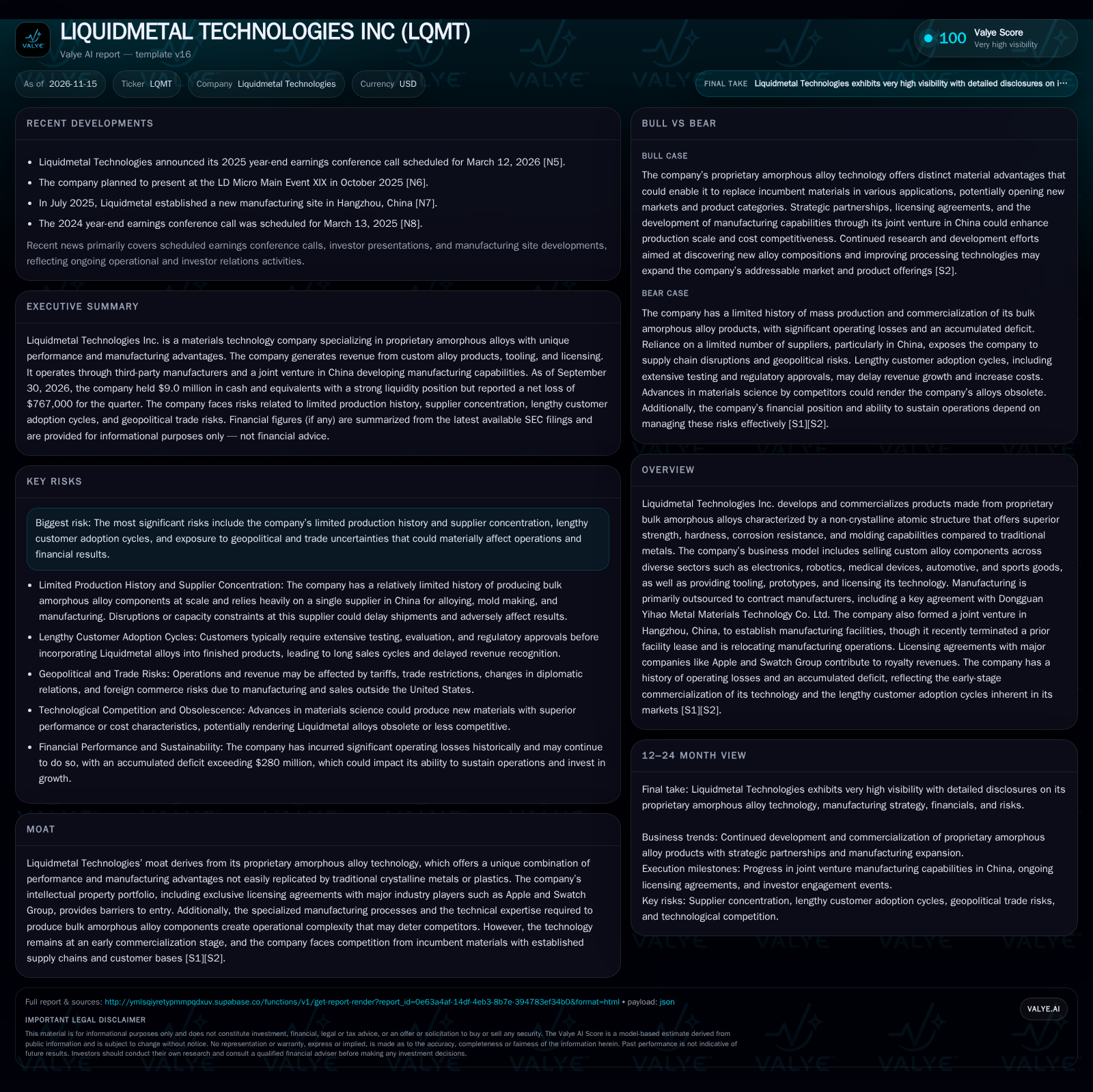
As of September 30, 2026, Liquidmetal Technologies reported $9.0 million in cash and equivalents, with current assets of $15.2 million and current liabilities of $1.6 million, resulting in a current ratio of 9.34 [S2]. The company booked a net loss of $767,000 for the quarter, with an accumulated deficit of $280.6 million as of December 2025 [S1] [S2].
The company recently terminated its lease on a prior manufacturing facility in Hangzhou and is relocating operations to a new site as part of a joint venture—Hangzhou Feifeng Liquidmetal Co. Ltd.—which is 70% owned by its wholly owned subsidiary [S2] [N7]. Manufacturing remains primarily outsourced, anchored by a cost-plus agreement with Dongguan Yihao Metal Materials Technology Co. Ltd. in China [S2].
Licensing agreements with Apple (consumer electronics) and Swatch Group (luxury watches) continue to generate royalty revenue, but these have not meaningfully offset persistent operating losses [S2]. These facts underscore the company’s ongoing challenge: bridging the gap between technological promise and sustainable, scalable economics.
Economics of Amorphous Alloy Commercialization: Fixed Costs, Outsourcing, and Licensing Leverage
Liquidmetal’s business model blends three revenue streams: (1) direct sales of custom amorphous alloy components, (2) tooling and prototyping services, and (3) licensing/royalty income from third parties deploying its technology [S2]. The company outsources its manufacturing, minimizing fixed-asset intensity but creating variable-cost exposure and supplier dependency. Its cost-plus contract with Dongguan Yihao and the strategic joint venture structure in Hangzhou are designed to provide flexible capacity and local market access, but also introduce the risk of operational disruption and margin compression if scale is not achieved.
The core economic challenge is the high upfront investment—time, technical support, and regulatory navigation—required to secure new customer programs. Adoption cycles are long and costly, with volume production often delayed by extensive testing and approvals [S1]. This dynamic leads to lumpy, unpredictable revenue and limits the operating leverage that can be realized from any given product win.
Licensing agreements, such as those with Apple and Swatch, offer high-margin, low-capital-intensity upside, but royalty streams have yet to reach a scale that can cover corporate overhead or drive profitability [S2]. Until manufacturing achieves sustained volume, the company is likely to remain exposed to negative operating leverage, with incremental losses on each marginal dollar of fixed cost.
Barriers and Counterforces: Proprietary Materials, Incumbent Substitutes, and the Challenge of Scale
Liquidmetal’s most defensible asset is its proprietary amorphous alloy technology, protected by a portfolio of intellectual property and exclusive licensing agreements with major industry players [S2]. The alloys offer a unique blend of high strength, hardness, corrosion resistance, and the ability to be precision-molded into complex shapes, potentially outclassing traditional metals like titanium, stainless steel, and aluminum in select applications.
However, the company faces substantial counterforces. Incumbent materials benefit from established supply chains, customer familiarity, and proven regulatory status, which lower the switching incentive for potential adopters. The need for extensive customer validation and regulatory approval further slows displacement of conventional materials.
Competitor categories include advanced materials firms, specialty metals producers, and plastics manufacturers with entrenched customer relationships and global manufacturing footprints. Advances in materials science—whether in alternative amorphous alloys or next-generation composites—could also erode Liquidmetal’s differentiation if the company cannot maintain its innovation lead.
What Success Looks Like: Manufacturing Scale, New Applications, and Licensing Expansion
A favorable trajectory would require Liquidmetal to successfully ramp operations at its new Hangzhou joint venture, achieving consistent production yields and cost efficiencies sufficient to support high-volume orders in target industries. This would demonstrate that the company’s alloys can be manufactured at scale with reliable quality and competitive economics.
If customer adoption accelerates—particularly in sectors like medical devices, robotics, or next-generation electronics—the company could see a flywheel effect: increased production volumes driving down per-unit costs, enabling more aggressive bidding and broader application development. Expansion of licensing agreements, or increased royalty rates from existing partners, would further diversify revenue and improve margins.
Confirming evidence would include signed contracts for large-scale supply, expanded licensing arrangements with new or existing OEMs, and a visible ramp in quarterly revenue tied to core product categories. A shift toward positive operating cash flow and a reduction in quarterly losses would also signal that the business is approaching self-sustainability.
Commercial Progress Remains Uneven as Adoption Barriers Persist
The most plausible near-term scenario is continued incremental progress: modest growth in custom component sales, periodic tooling and prototyping revenue, and steady but limited royalty streams from existing licensing deals. Manufacturing at the new Hangzhou facility may begin to stabilize, but full operational efficiency and cost optimization could take multiple quarters to achieve.
Customer adoption cycles are likely to remain long, with new programs delayed by technical validation and regulatory hurdles. Revenue growth may be lumpy, with periods of relative stagnation punctuated by occasional new wins. Operating losses are likely to persist in the absence of a breakthrough in manufacturing scale or licensing scope.
Evidence confirming this scenario would include stable but slowly growing revenue, continued high current ratios without significant drawdown, and periodic updates on manufacturing progress without transformative contract announcements.
Execution Stalls: Production Delays, Supplier Disruption, and Erosion of Competitive Position
The adverse scenario would be defined by execution missteps in scaling the new joint venture facility—such as persistent yield issues, cost overruns, or regulatory setbacks—leading to delays in fulfilling customer orders or meeting partner expectations. Supplier concentration risk could be realized if the Dongguan Yihao agreement is disrupted, leaving the company unable to deliver against contracts or maintain product quality.
In this scenario, competitors—whether specialty metals producers or advanced plastics firms—could accelerate development of improved substitutes, making it more difficult for Liquidmetal to win new business. Licensing partners may scale back commitments or renegotiate terms if manufacturing reliability or cost competitiveness cannot be demonstrated.
Evidence would include missed production milestones, customer or partner defections, declining royalty revenue, and deterioration in the company’s liquidity position due to ongoing operating losses.
Milestones That Will Define Liquidmetal’s Path to Commercial Viability
Ramp-up pace and yield rates at the new Hangzhou joint venture facility; evidence of stable, cost-competitive production would be pivotal.
Number and size of new commercial contracts or supply agreements for bulk amorphous alloy components, if disclosed.
Trends in licensing and royalty revenue, particularly from Apple and Swatch, and any expansion to new partners or consumer product categories.
Quarterly revenue growth and mix across custom component sales, tooling/prototyping, and licensing; a useful metric would be revenue concentration by end-market.
Gross margin trends, if disclosed, as a signal for manufacturing efficiency and pricing power.
Updates on supplier relationships, especially the Dongguan Yihao agreement, and any moves to further diversify the supply chain.
Disclosure of customer adoption timelines, pilot-to-production conversion rates, or regulatory approval cycles for targeted applications.
Disclaimer: This is research-only, informational analysis and not investment advice. It may include AI-generated interpretation and general industry context. Always verify important details using primary sources.

Comments