
Equillium’s Phase 1 Launch: Capital Strength Meets the Realities of Early-Stage Autoimmune Drug Development
With EQ504 now dosed in its first Australian patient and a $53 million cash position, Equillium enters a pivotal period where scientific proof and capital discipline will determine whether its novel autoimmune pipeline can progress beyond preclinical promise.
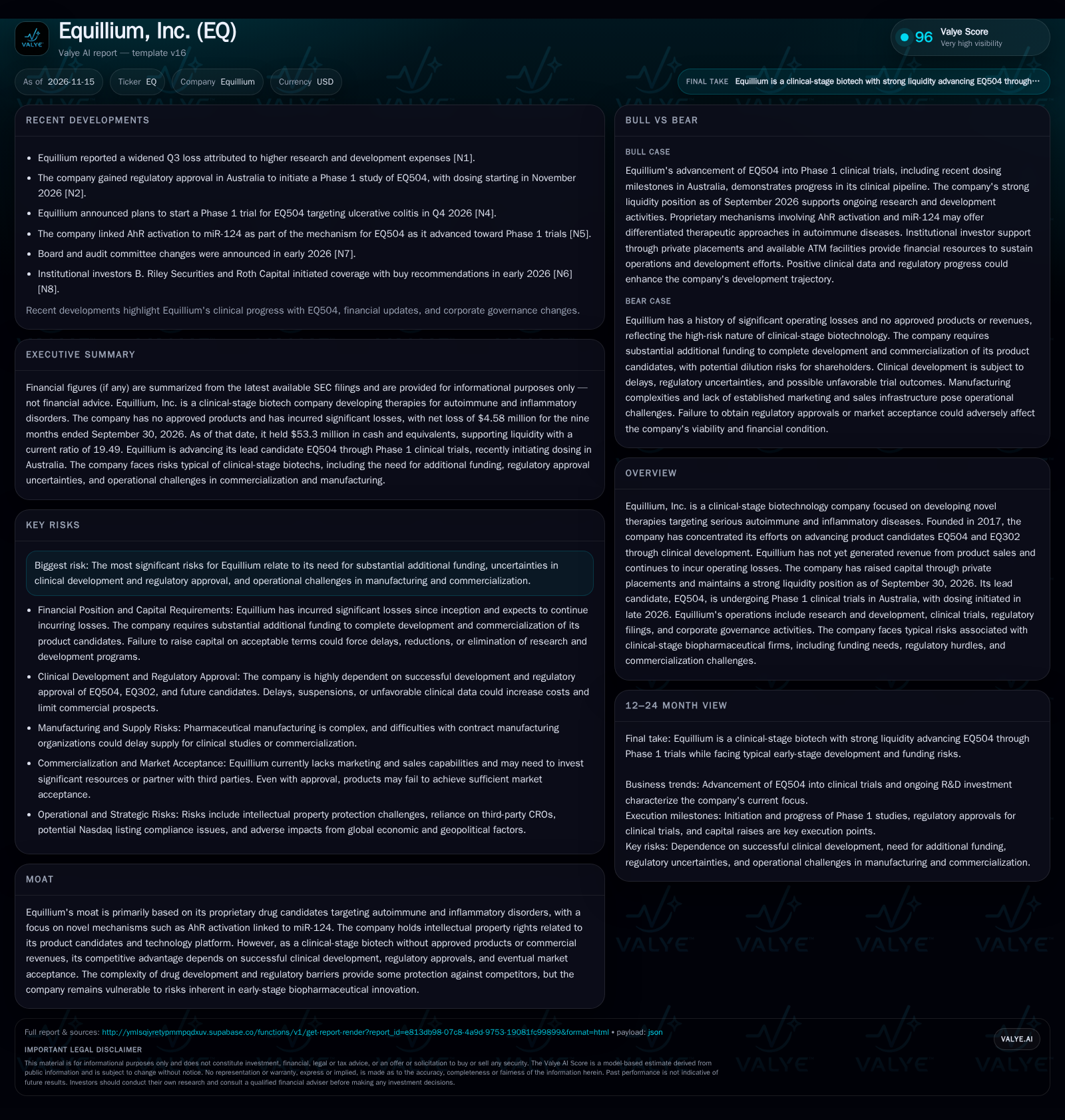
Equillium, Inc. is a clinical-stage biotech focused on autoimmune and inflammatory diseases, most notably through its lead candidate EQ504, which began Phase 1 dosing in Australia in late 2026. The company, founded in 2017, has not generated product revenue and continues to incur losses, but holds $53.3 million in cash following recent private placements. While its proprietary approach—linking AhR activation to miR-124—offers scientific differentiation, Equillium faces the typical challenges of early-stage biotech: high burn, reliance on successful trial outcomes, and eventual needs for commercialization capability or partnerships. The outcome of EQ504’s clinical progress and the company’s ability to secure further funding will be central to its future trajectory. [S2] [N2] [N4] [N5]
Equillium’s transition from preclinical to clinical-stage biotech is now underway, with the first patient dosed in its Phase 1 trial for EQ504 in Australia. Success in the coming year will depend on both clinical progress and the ability to manage capital, as Equillium lacks commercial infrastructure and faces the typical funding and execution risks of pre-revenue biotech. The company’s differentiated scientific approach offers potential upside, but the challenge will be translating mechanistic promise into clinical and commercial outcomes. [S2] [N2] [N4] [N5]
The company reported cash and liquidity metrics for the period; these figures do not by themselves establish operating runway, investment capacity, financial flexibility, or financ
Equillium’s most material recent milestone is the initiation of dosing for EQ504 in a Phase 1 clinical trial in Australia, which took place in November 2026. This marks the company’s transition from preclinical research to first-in-human testing, a critical step for any early-stage biotech seeking to validate its scientific platform and attract future funding or partnership interest. [N2] [N4]
Financially, Equillium reported $53.3 million in cash and equivalents with a current ratio of 19.49 as of September 30, 2026, following $85 million in capital raised through private placements in August 2025 and March 2026. While this provides an operational runway for current development programs, the company remains pre-revenue and continues to report net losses—$4.58 million in the first nine months of 2026. [S2]
Equillium’s scientific positioning is built around a proprietary mechanism involving AhR activation and miR-124 modulation, with the aim of addressing serious autoimmune and inflammatory disorders. The company is targeting indications such as ulcerative colitis with EQ504, but remains at an early proof-of-concept stage. [N5]
The Economics of a Pre-Revenue Biotech: Burn Rate, Capital Needs, and the Long Road to Commercialization
Equillium’s current business economics are defined by high R&D expenditure, a lack of product revenue, and dependence on external financing. The company’s cash reserves, bolstered by recent private placements, are primarily allocated to advancing its clinical pipeline. [S2]
Revenue generation is not expected until—at minimum—late-stage clinical success and regulatory approval, which are several years away under typical biotech timelines. The company’s cost structure is largely fixed in the near term, with R&D expenses dominating operating outflows. Should EQ504 or other candidates advance, incremental costs will accrue from expanded trials, regulatory engagement, and the eventual need to build commercialization or manufacturing capacity (unless Equillium opts for a partnership or out-licensing model).
Operating leverage in biotech is typically realized only after successful product launch, as R&D and overhead costs are spread across meaningful revenue. Until then, the company’s economics are characterized by negative operating margins and the necessity for periodic equity or debt financing—each carrying dilution or risk.
Differentiation in Autoimmune Drug Development: Moats, Substitutes, and the Innovation Arms Race
Equillium’s competitive position is rooted in its proprietary candidates and intellectual property related to AhR activation and miR-124 modulation. This mechanistic approach could offer differentiation if clinical data ultimately support efficacy and safety advantages over existing autoimmune therapies.
However, the autoimmune and inflammatory disease space is highly competitive, with established pharmaceutical and biotech firms pursuing multiple pathways (including biologics, small molecules, and cell therapies). Major competitors may have greater resources, clinical experience, and commercial infrastructure, raising the bar for new entrants. The risk of technological substitution is also material, as alternative mechanisms or next-generation therapies could leapfrog EQ504’s approach if Equillium’s clinical data does not demonstrate clear superiority.
At this stage, Equillium’s moat is theoretical—protected by intellectual property and the complexity of drug development—but will require positive clinical outcomes and regulatory progress to become commercially meaningful. The absence of an existing sales or marketing organization means that, even with approval, Equillium may need to seek commercialization partnerships or invest heavily to compete.
When Scientific Differentiation Meets Clinical Success: The Bullish Chain of Events
A favorable scenario for Equillium would see EQ504 demonstrate strong safety and early efficacy signals in its Phase 1 trial, validating the AhR/miR-124 mechanism as a differentiated approach in autoimmune disease. This could attract partnership interest from larger biopharma players or enable the company to raise further capital on favorable terms, reducing dilution.
If subsequent Phase 2 studies confirm efficacy, Equillium could leverage its proprietary platform to expand into additional autoimmune indications, increasing its addressable market and strategic value. Early licensing deals or co-development partnerships would provide non-dilutive capital and risk-sharing, accelerating development. The ultimate upside would be a successful regulatory approval, followed by commercial uptake—either solo or with a partner—if the therapy meets an unmet need or offers advantages over current standards of care.
Evidence confirming this scenario would include: positive Phase 1 safety/tolerability data, early efficacy biomarkers, partnership announcements, and successful follow-on financings at increasing valuations.
Navigating the Clinical Gauntlet: Probable Outcomes for an Early-Stage Biotech
The most plausible trajectory for Equillium is a measured progression through early clinical development, marked by incremental data releases and ongoing capital needs. EQ504’s Phase 1 trial is likely to focus on safety and pharmacokinetics, with efficacy signals—if any—being exploratory. Should the safety profile prove acceptable, the program would advance to Phase 2, requiring additional funding rounds or a partnership to support expanded trials.
The company may experience moderate dilution as it raises new capital, and could adjust its portfolio or spending based on interim results. Commercialization remains a distant prospect, and Equillium would likely seek to partner or license assets if data is positive but resources remain constrained.
Evidence supporting this scenario would include: sequential but modestly positive clinical updates, additional equity or ATM sales, and no major partnership or acquisition activity until later phases.
Clinical Setbacks and Capital Constraints: How the Thesis Could Break
A negative scenario for Equillium would involve EQ504 encountering safety concerns or a lack of efficacy in Phase 1, undermining confidence in the company’s platform. This could close the door to partnership opportunities, make future financings more dilutive or unavailable, and force Equillium to curtail its pipeline or enter strategic review.
Additional risks include delays in trial enrollment, manufacturing setbacks, or adverse regulatory developments, any of which could increase cash burn and shorten the operational runway. Without validated clinical data, the company’s high R&D expenses and absence of commercial infrastructure would become liabilities, potentially leading to workforce reductions, asset sales, or delisting risk.
Evidence that would confirm this downside scenario includes: negative or inconclusive trial results, delayed trial timelines, large cost-cutting measures, or financing at distressed valuations.
Milestones and Metrics That Will Determine Whether Equillium’s Pipeline Delivers Shareholder Value
Initial safety and tolerability data from the EQ504 Phase 1 trial in Australia—positive or negative outcomes will be pivotal. [N2] [N4]
Any indication of early efficacy signals or biomarker changes in Phase 1, if disclosed, would help validate the mechanistic hypothesis. [N5]
Updates on enrollment rates and trial timelines for EQ504 and EQ302—delays or acceleration will impact the capital runway. [S2]
Announced partnerships, licensing deals, or co-development agreements with larger pharmaceutical firms would materially change the funding outlook.
Details on future capital raises, including terms and dilution, as well as use of the ATM facility, will affect shareholder value and operational flexibility. [S2]
Expansion of the pipeline or entry into new indications, if justified by clinical data, would suggest platform viability.
Progress in building commercialization or manufacturing capabilities, or clarity on the company’s go-to-market strategy, would signal readiness for later-stage development.
Board or management changes, especially in clinical or commercial leadership, could foreshadow strategic pivots or responses to trial outcomes. [N7]
Disclaimer: This is research-only, informational analysis and not investment advice. It may include AI-generated interpretation and general industry context. Always verify important details using primary sources.

Comments