
U.S. Global Investors: Niche ETF Growth, Advisory Renewal, and the Stakes of Scale in Asset Management
With assets under management rising to $1.67 billion and advisory agreements secured through 2027, U.S. Global Investors is pursuing thematic ETF expansion and new investment strategies. The challenge: sustaining asset growth and profitability in a fiercely competitive, regulation-heavy industry where scale and differentiation are decisive.
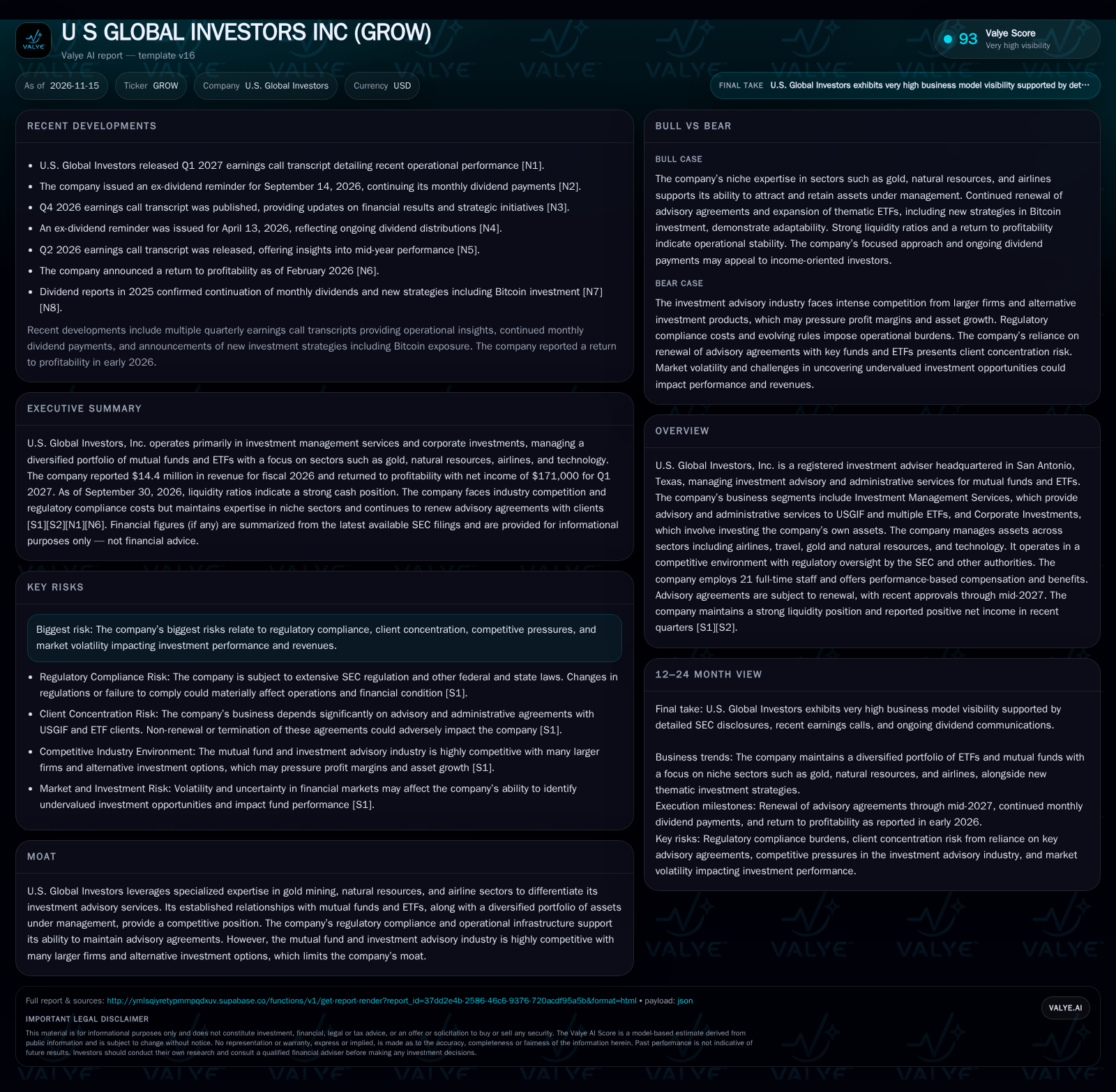
U.S. Global Investors grew AUM to $1.67 billion as of June 2026, reported $14.4 million in annual revenue, and returned to profitability while renewing key advisory agreements into 2027. The company is expanding thematically into areas like Bitcoin, but faces client concentration, regulatory, and competitive threats that could limit scale and margin expansion. The core question is whether niche expertise and product innovation can overcome industry headwinds and drive durable, profitable growth.
U.S. Global Investors has made tangible progress over the past year, growing its assets under management to $1.67 billion and securing renewals for its key advisory agreements well into 2027. The company’s focus on niche sectors—such as gold, natural resources, and airlines—alongside forays into thematic ETFs and digital assets, has supported revenue stabilization and a recent return to profitability. However, the asset management landscape remains highly competitive, and U.S. Global Investors must prove that its specialized approach and new product strategies can deliver sustainable growth and operating leverage amid industry consolidation, fee pressure, and regulatory complexity.
Recent AUM Growth, Profitability Return, and Advisory Stability Define the Current State
U.S. Global Investors reported a substantial rise in assets under management (AUM), reaching $1.67 billion as of June 30, 2026—up from $1.32 billion in 2025. This momentum underscores effective asset gathering in both mutual funds and ETFs, particularly in niche sectors like airlines and gold [S1]. Revenue for fiscal 2026 was $14.4 million, and the company returned to profitability, posting net income of $171,000 for the quarter ended September 2026 [S1] [S2] [N6]. Advisory agreements for its ETFs have been renewed through July 2027, and for the U.S. Global Investors Funds (USGIF) through September 2025, providing near-term revenue visibility [S1]. The company reported $24.3 million in cash and $8.8 million in short-term investments as of September 2026 [S2]. These factors collectively suggest operational stability, but the durability of growth and margins in a consolidating industry remains an open question.
Revenue Model and the Challenge of Operating Leverage in a Low-Fee Era
U.S. Global Investors generates revenue primarily from advisory and administrative fees tied to AUM in its mutual funds and ETFs. Fee rates in the asset management industry have been under persistent pressure, especially for passive and thematic ETFs, which tend to have lower expense ratios than traditional active funds. This dynamic places a premium on scale—larger AUM bases are needed to offset fixed regulatory, compliance, and platform costs. The company’s reported $14.4 million in annual revenue and modest net income reflect this challenge: while recent AUM growth supports top-line expansion, the ability to drive meaningful operating leverage is constrained by the fixed cost base and competitive fee compression [S1] [S2].
The Corporate Investments segment, which invests the company’s own capital, can provide opportunistic returns but also exposes the firm to market volatility and does not offer the recurring, scalable economics of advisory fees. Dividend payments, while attractive to income-oriented shareholders, are a use of cash that could otherwise be reinvested in distribution, technology, or new product development. The company reported cash and liquidity metrics for the period; these figures do not by themselves establish operating runway, investment capacity, financial flexibility, or financing capacity.
Specialization vs. Scale: Competing in a Crowded Asset Management Field
U.S. Global Investors differentiates itself through expertise in gold mining, natural resources, and airlines—sectors where it has longstanding fund products and brand recognition [S1]. This specialization supports client acquisition among investors seeking targeted exposure, particularly during periods of sector outperformance. Thematic ETF launches, such as those focused on travel or Bitcoin, aim to capture incremental flows from retail and tactical allocators interested in niche trends [N8].
However, the mutual fund and ETF industry is dominated by much larger players with vast distribution, lower costs, and broad product lineups. Larger competitors can afford to operate at thinner margins and invest heavily in technology, marketing, and data analytics. Meanwhile, low-cost index providers and direct-to-consumer fintech platforms intensify competition for both assets and attention. U.S. Global Investors’ ability to defend and grow its share will depend on sustained product differentiation, brand loyalty, and the ability to seed and scale new products before larger rivals saturate the space.
If Niche ETFs Win Flows and Advisory Agreements Are Extended, Operating Leverage Could Materialize
The most favorable scenario for U.S. Global Investors is continued strong net inflows into its specialized ETFs and mutual funds, driven by sector tailwinds (e.g., gold or travel outperforming broad markets) and successful marketing of new thematic products like Bitcoin or technology-focused funds. If these funds reach critical mass in AUM, incremental advisory fee revenue could exceed the relatively fixed cost base, unlocking meaningful operating leverage and margin expansion. Further, if advisory agreements with USGIF and ETF clients are renewed beyond their current terms, revenue visibility would be extended, reducing client concentration and contract risk [S1].
Confirmation of this scenario would require persistent AUM growth, especially in newly launched or smaller funds, sustained net inflows outpacing redemptions, expansion of advisory contracts, and evidence of margin improvement in future earnings reports. Accelerated adoption of new themes and successful differentiation from larger competitors would also be strong confirming signals.
Core Outlook: Incremental Growth Amid Fee Pressure and Regulatory Drag
The most plausible near-term trajectory is moderate AUM growth through periodic sector outperformance and new ETF launches, offset by ongoing fee compression and rising compliance costs. The company is likely to maintain profitability, but margins may remain thin given the need to invest in distribution, compliance, and product development. Revenue growth will depend on the ability to attract new assets and retain existing clients despite competitive and regulatory challenges.
This scenario would be confirmed by steady, if modest, net inflows, continued contract renewals, and stable or slightly improving operating margins. Early signs of stagnating AUM, rising redemptions, or an inability to scale new products would suggest downside risk.
What Happens If Asset Flows Stall or Key Advisory Agreements Are Lost?
A credible adverse scenario involves a combination of AUM stagnation or decline—driven by sector underperformance, product commoditization, or the loss of investor interest in niche themes—alongside the non-renewal or termination of critical advisory agreements with USGIF or ETF clients. In this environment, revenue would contract, margin pressure would intensify, and the company could be forced to cut costs or scale back product offerings.
Evidence for this scenario would include negative net flows, shrinking AUM, non-renewal or early termination of advisory contracts, margin deterioration, and a shift from profitability to operating losses. Regulatory fines, client departures, or failed new product launches would also serve as red flags.
Signals That Will Test U.S. Global Investors’ Ability to Scale and Differentiate
Net asset flows by fund and overall AUM growth, particularly in newly launched or thematic ETFs—would help gauge product momentum and market acceptance.
Renewal status and terms of advisory agreements with USGIF and ETF clients, especially as 2025 and 2027 renewal dates approach.
Fee rate trends and expense ratios across the fund lineup; a useful metric would be disclosed changes in average advisory fee rates or margin per dollar of AUM.
Operating margin evolution quarter-over-quarter, as evidence of whether scale is translating into improved profitability.
Redemption rates and client retention, if disclosed, to test the durability of investor relationships and fund stickiness.
Impact of regulatory changes or compliance costs on the company’s cost structure and product economics.
Performance rankings and relative returns of flagship funds versus benchmarks and peer products—would indicate whether sector expertise is translating into investment outperformance.
Dividend payout continuity and size relative to earnings and free cash flow, particularly if profitability faces pressure.
Disclaimer: This is research-only, informational analysis and not investment advice. It may include AI-generated interpretation and general industry context. Always verify important details using primary sources.

Comments