
Vyome Holdings: Merger Integration, Distribution Ambitions, and the Path to Sustainable Device Commercialization
Vyome Holdings, newly merged with ReShape Lifesciences, is navigating product development and early-stage commercialization in the weight loss and diabetes device market.
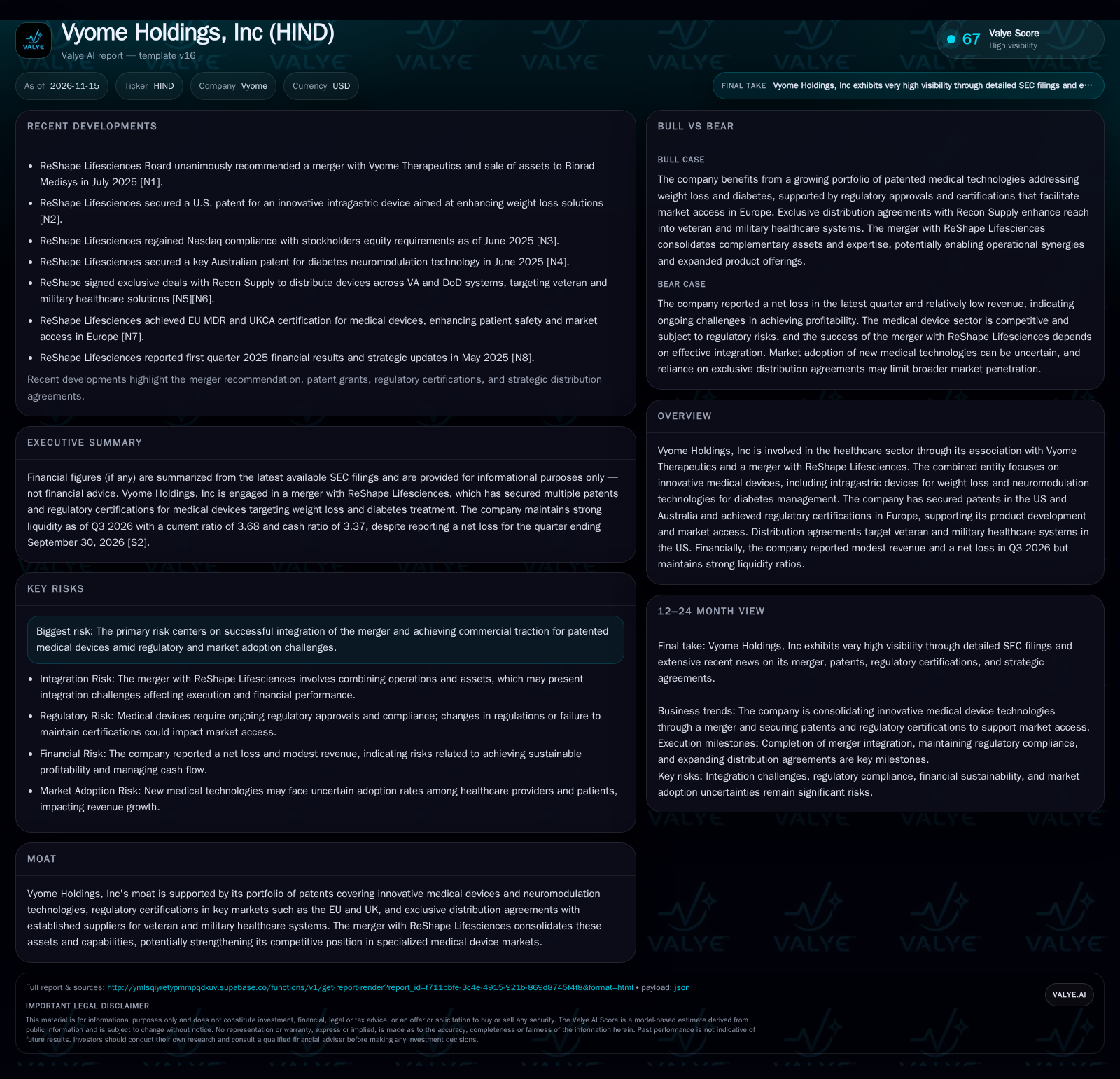
Vyome Holdings, following its merger with ReShape Lifesciences, holds a reported liquidity position but faces ongoing net losses and modest revenue. The company’s strategy focuses on innovative medical devices for weight loss and diabetes, with exclusive distribution targeting veteran and military systems. Success hinges on integration execution, regulatory progress, and market adoption in specialized channels, while persistent losses and uncertain ramp-up remain key threats.[S2] [N1]
Vyome Holdings, Inc., now operating as a combined entity with ReShape Lifesciences, is at a pivotal stage as it seeks to commercialize novel medical devices targeting weight loss and diabetes management. The company’s strategy hinges on leveraging exclusive distribution agreements in veteran and military healthcare systems and realizing operational synergies from its recent merger. Execution on integration, regulatory milestones, and adoption in specialized channels will determine whether Vyome can transition from cash-consuming development to sustainable growth, or remain constrained by the high costs and uncertainties of the medical device sector.[S2] [N1]
Liquidity Buffer and Integration Milestones: Vyome’s Present State
The merger of Vyome Holdings with ReShape Lifesciences in mid-2025 unified two portfolios focused on medical devices for weight loss and diabetes, aiming for operational synergies and expanded product offerings.[N1] As of September 30, 2026, the company reported $6.96 million in cash and equivalents, total current assets of $7.6 million, and current liabilities of $2.07 million, yielding a current ratio of 3.68 and a cash ratio of 3.37.[S2] Quarterly revenue remained modest at $57,998, while the net loss was $885,408, translating to an EPS of -$0.13 per share.[S2] Exclusive distribution agreements are in place targeting the veteran and military healthcare systems, suggesting a focused go-to-market approach. These facts establish Vyome as a well-capitalized development-stage company, but with a business model that has yet to achieve commercial scale or profitability.
Device Commercialization, Cost Structure, and the Challenge of Scale
Vyome’s revenue model is predicated on the commercialization of medical devices for weight loss and diabetes management. In early commercialization phases, revenue tends to be lumpy and modest, as reflected in the most recent quarter.[S2] The company’s cost structure is dominated by R&D and G&A, with future increases expected as clinical programs expand, additional personnel are hired, and regulatory requirements intensify.[S2] Fixed costs are likely high relative to current revenue, creating significant negative operating leverage.
Gross margins in medical devices can be attractive once scale is achieved, but initial volumes are usually low, and manufacturing costs—particularly when relying on third-party production—can compress margins early on. Capital needs are significant: ongoing clinical trials, regulatory submissions, and eventual commercialization efforts (including salesforce buildout or distributor support) require sustained funding. Vyome’s current liquidity provides a buffer, but persistent net losses suggest that without a step-change in top-line growth or cost discipline, additional capital could eventually be needed to fund late-stage development and launch activities.
In addition to the fixed cost challenges, Vyome’s path to scale is further complicated by the capital intensity inherent in medical device commercialization. The need for robust post-market surveillance, quality assurance, and potential iterative product improvements can extend the timeline before profitability is achievable. Moreover, reimbursement dynamics in healthcare significantly influence device adoption; securing favorable coverage terms from payers, including government programs and private insurers, is often a protracted process that directly impacts revenue realization. Therefore, Vyome’s financial sustainability depends not only on managing internal cost structures but also on navigating external reimbursement landscapes effectively.
Specialization, Channel Strategy, and the Realities of Medical Device Competition
Vyome’s competitive strategy emphasizes exclusive distribution agreements for access to veteran and military healthcare systems, a specialized but potentially defensible channel. This approach could reduce direct competition with larger device makers in broader commercial markets and offer a degree of pricing power or preferred access if execution is strong. However, the medical device sector is characterized by established incumbents, rapid innovation cycles, and high regulatory barriers.
The merger with ReShape Lifesciences could allow the combined entity to consolidate R&D, regulatory, and commercial resources, strengthening the platform for innovation and market access. Still, integration risk is non-trivial: harmonizing product pipelines, sales efforts, and compliance protocols is resource-intensive. Substitutes in weight loss (pharmaceuticals, other devices, behavioral programs) and diabetes management (continuous glucose monitoring, insulin delivery tech, digital therapeutics) remain formidable, and switching costs for healthcare providers are often lower than in other industries due to reimbursement and procurement structures.
The choice to focus on veteran and military healthcare channels can be viewed as a strategic hedge against the intense competition prevalent in broader commercial markets. These channels often have unique procurement processes and centralized decision-making, which if successfully navigated, can lead to more predictable purchasing patterns and longer-term contracts. However, this specialization also implies a concentration risk: dependence on a limited number of institutional buyers may constrain revenue diversification and expose the company to policy shifts or budgetary constraints within these systems. Thus, while the channel strategy offers potential competitive insulation, it simultaneously necessitates rigorous stakeholder engagement and adaptability to institutional procurement cycles.
Integration of two distinct corporate cultures and operational systems post-merger introduces additional complexity that can affect innovation velocity and commercial execution. Aligning R&D priorities and harmonizing regulatory strategies require clear governance and effective communication to avoid duplication of efforts or conflicting development pathways. Furthermore, sales and marketing teams must be unified to present a coherent value proposition to specialized customers. The interplay between these integration factors and external competitive pressures will critically influence how quickly and effectively Vyome can capitalize on its combined assets and distribution agreements.
Synergy Realization, Regulatory Wins, and Accelerated Channel Adoption
A favorable outcome would see Vyome successfully integrating ReShape Lifesciences, achieving operational efficiencies, and leveraging exclusive distribution to drive adoption in veteran and military healthcare systems. If clinical data for the combined device portfolio is positive and regulatory approvals are secured without major delays, the company could see a meaningful ramp in revenue and improve gross margins as manufacturing scales. Early traction in specialized channels could provide reference customers and support expansion into adjacent markets or broader healthcare systems.
Evidence that would confirm this scenario includes a sharp increase in product sales through military and VA channels, successful regulatory approvals, positive clinical trial readouts, and a narrowing of net losses or movement toward profitability. Announcements of expanded distribution agreements or new contracts with governmental health systems would further support the upside case.
Incremental Progress Amid Persistent Losses and Measured Adoption
The most plausible near-term trajectory is one of incremental advancement: Vyome continues to invest in R&D and regulatory milestones, with modest but gradually increasing revenue from early commercial sales in specialized channels. Integration with ReShape Lifesciences proceeds, but cost synergies are slow to materialize and operating expenses remain high relative to revenue.
This scenario would be confirmed by continued quarterly net losses, stable or only slightly improving top-line results, and periodic regulatory or clinical progress updates. Expanding the distribution footprint within veteran and military channels would be a positive, but slow adoption or reimbursement hurdles could limit the pace of revenue growth. The key question is whether current liquidity is sufficient to bridge the company to a more sustainable revenue base before further dilution or capital raises become necessary.
Integration Stumbles, Regulatory Setbacks, and Burnout of Liquidity Cushion
Adverse outcomes could stem from failed integration—manifesting as operational disruptions, delayed product launches, or loss of key personnel—or from regulatory setbacks that delay or block commercialization of core devices. If adoption in veteran and military healthcare systems is slower than anticipated, revenue may stagnate while fixed costs remain high, accelerating cash burn.
Confirmation of this scenario would include persistent or widening net losses, declining cash balances without commensurate revenue growth, negative clinical or regulatory news, or the need for emergency capital raises. Failure to expand or renew distribution agreements, or visible delays in clinical trial progress, would further erode confidence in the company’s ability to achieve scale.
Milestones That Will Test Vyome’s Merger Strategy and Commercial Ambitions
Clinical trial progress and regulatory milestones for the combined device portfolio, including FDA submissions, approvals, or major readouts (if disclosed), will be critical in validating the commercial pathway.
Quarterly revenue growth in targeted veteran and military healthcare channels would indicate that exclusive distribution agreements are translating into real market traction.
Updates on integration progress post-merger—such as operational cost savings, R&D pipeline consolidation, or management team stability—would help assess synergy realization.
Gross margin evolution as sales scale up: improvements would suggest growing operating leverage and movement toward profitability (if disclosed).
Expansion or renewal of distribution agreements, especially any new channels beyond the VA/DoD systems, would provide evidence of addressable market growth.
Any announced changes to reimbursement status, procurement wins, or inclusion in government formularies would directly impact adoption potential.
Disclaimer: This is research-only, informational analysis and not investment advice. It may include AI-generated interpretation and general industry context. Always verify important details using primary sources.

Comments