
ARC Group Acquisition I Corp.: SPAC-to-Operator Transition and the Stakes of Malaysian Financial Sector Entry
ARC Group Acquisition I Corp.
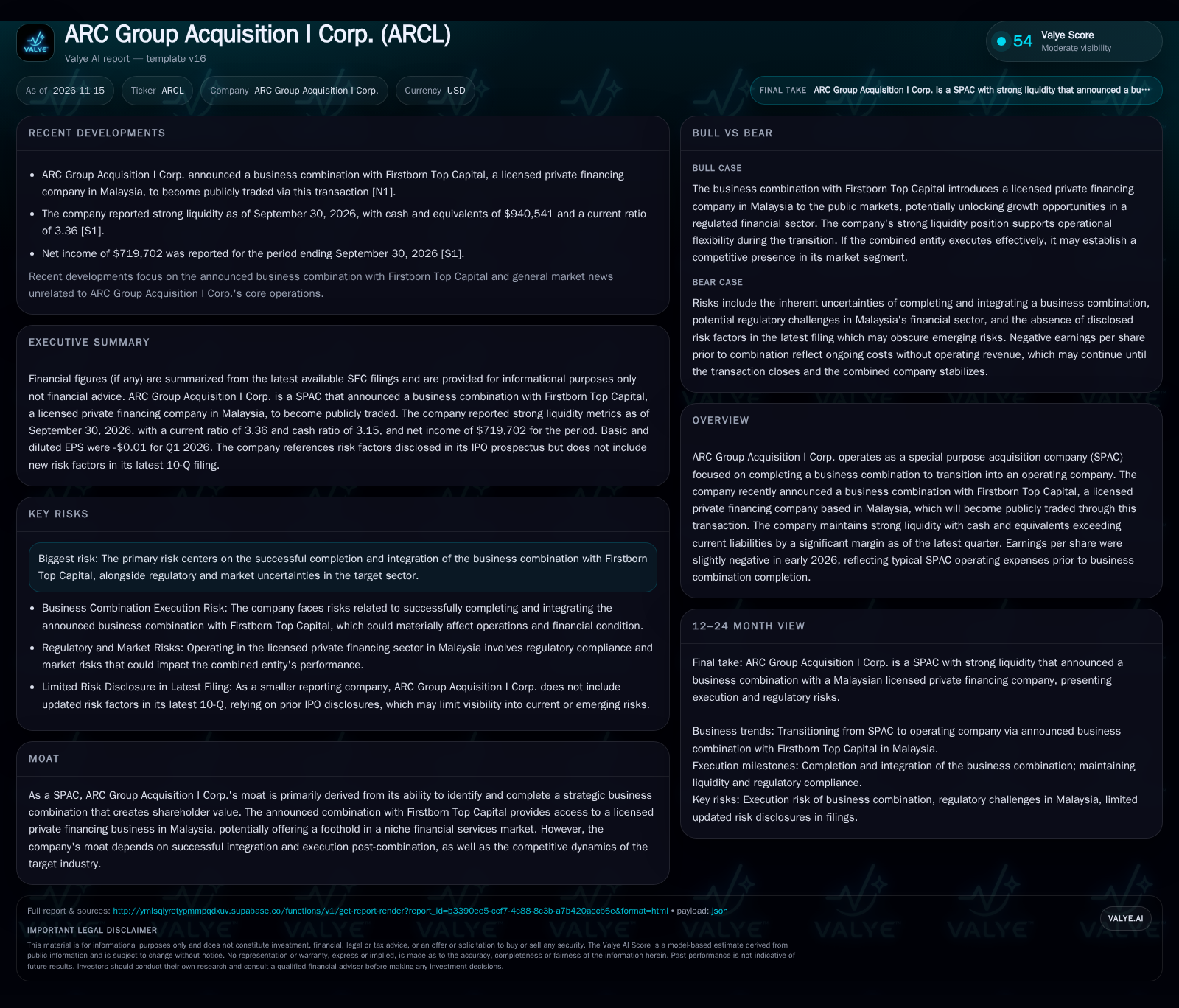
ARC Group Acquisition I Corp. The thesis now rests on successful deal completion and integration, alongside navigating regulatory and market risks specific to Malaysia’s financial sector. Execution, transparency into emerging risks, and evidence of operational revenue post-combination will be critical in testing the deal’s value creation.
ARC Group Acquisition I Corp. stands at a defining inflection point, having announced a business combination with Firstborn Top Capital to facilitate the latter’s public listing. The Malaysian financial sector’s regulatory complexity and competitive landscape introduce significant uncertainties, and the lack of updated risk disclosures in recent filings underscores the importance of ongoing transparency and monitoring. The next phase will test whether ARCL’s transition from SPAC shell to operating entity can deliver sustainable value.
Latest Developments: Combination Announcement and Financial Position Shape the Next Chapter
The most significant present development for ARC Group Acquisition I Corp. is the announced business combination with Firstborn Top Capital, a licensed private financing company in Malaysia, which will become publicly traded through this transaction [N1]. This marks ARCL’s planned transition from a blank-check SPAC to an operating company with exposure to the Southeast Asian financial services sector. As of September 30, 2026, ARCL reported $940,541 in cash and equivalents, current assets of $1,003,614, and current liabilities of $298,310, yielding a current ratio of 3.36 and a cash ratio of 3.15 [S1]. The company also reported net income of $719,702 for the period, though its March 2026 EPS was slightly negative at -$0.01, reflecting typical pre-combination SPAC costs [S1]. The company reported cash and liquidity metrics for the period; these figures do not by themselves establish operating runway, investment capacity, financial flexibility, or financing capacity.
How the Combined Entity Might Make Money: Private Financing Economics and SPAC Capital Structure
ARC Group Acquisition I Corp. itself has not generated operating revenue as of the last report; all activity through September 2026 relates to formation, IPO, and deal sourcing [S1]. Post-combination, the economics shift dramatically. Licensed private financing companies in Malaysia typically earn interest and fee income from lending to SMEs, individuals, or niche sectors underserved by traditional banks. Margins may depend on risk-adjusted lending rates, cost of capital, and credit performance. A successful operator in this space could benefit from recurring interest income and origination fees, but faces exposure to credit losses, regulatory compliance costs, and potentially volatile funding expenses.
From a capital perspective, SPACs like ARCL initially hold cash in trust, earning limited interest income until a business combination closes. After the transaction, the combined entity’s funding needs will likely increase—both to support loan origination and to meet regulatory capital requirements in Malaysia. The trust proceeds, minus any redemptions, may provide initial lending capital, but sustainable growth typically requires access to additional debt or equity funding. Operating leverage could emerge if the combined company scales its loan book faster than fixed costs (e.g., licensing, compliance, overhead), but this is highly dependent on credit quality and market demand.
Assessing Competitive Dynamics: Regulatory Moats, Local Players, and Substitution Threats
The announced target, Firstborn Top Capital, operates in Malaysia’s regulated private financing sector—a market characterized by strict licensing, oversight, and competition from both traditional banks and non-bank financial companies. A regulatory license can act as a partial moat, limiting new entrants and conferring some credibility with borrowers and partners. However, the sector is competitive: local incumbents, fintech startups, and regional financial groups all target similar lending niches.
Key competitive levers include access to low-cost funding, underwriting sophistication, customer acquisition channels, and the ability to manage regulatory compliance efficiently. Technology-driven underwriting and digital distribution could provide an edge, but there is no evidence in the current filings that Firstborn Top Capital possesses such capabilities. Substitution risk is significant, as borrowers may turn to banks, peer-to-peer platforms, or informal lenders if pricing or service distinguishes alternatives. The ultimate competitive position will depend on integration execution, regulatory standing, and the ability to scale responsibly in a crowded market.
Unlocking Value: What Successful Integration and Market Positioning Could Achieve
The favorable scenario sees ARCL and Firstborn Top Capital closing the business combination smoothly, integrating management, systems, and governance without major disruptions. If the combined entity leverages its public status to access lower-cost capital, it could expand its lending book and capture underserved segments in Malaysia’s private credit market. Regulatory compliance would be maintained, and risk management processes would keep credit losses within target ranges.
Upside would be confirmed by early evidence of loan book growth, stable or improving net interest margins, and positive operating cash flow. Additional signals would include successful recruitment of local talent, new product launches, or partnerships with digital platforms to broaden distribution. A further confirming sign would be the avoidance of major loan defaults or regulatory penalties in the first 12-24 months post-combination. If these milestones are met, the entity could establish itself as a credible, scalable player in Southeast Asian private finance.
Transition Realities: Navigating Integration and Early Operating Challenges
The most plausible outcome is a mixed transition: ARCL and Firstborn Top Capital complete the business combination, but the integration process reveals operational and cultural challenges. Initial quarters may show modest loan growth and margin compression as the combined entity invests in compliance, risk management, and digital infrastructure. Funding costs could rise if redemptions from the trust are high, limiting available capital for lending expansion.
Confirmation of this scenario would come from seeing incremental revenue growth, but with elevated non-interest expenses and subdued profitability metrics. Regulatory filings would detail progress on compliance and risk controls rather than breakout performance. Falsification would occur if, instead, the entity immediately demonstrates strong revenue growth, expanding margins, and above-peer returns on equity—signs that integration and market entry are ahead of expectations.
Where the Deal Could Falter: Integration Missteps and Regulatory Setbacks
The adverse scenario unfolds if the business combination is delayed or fails to close, leaving ARCL in SPAC limbo with limited time to secure an alternative deal. Alternatively, if the combination is completed but integration stumbles—due to management turnover, system incompatibility, or misaligned incentives—the combined entity could lose regulatory standing or experience operational disruptions.
A sharp increase in non-performing loans, regulatory penalties, or negative press about governance would signal this downside. Substantial redemptions could also drain trust capital, constraining lending growth and eroding investor confidence. Falsification of the downside would require timely deal closure, early evidence of operational execution, and regulatory approval without major conditions or penalties.
Milestones That Will Define ARC Group Acquisition I’s Post-Combination Value
Closure status and timing of the business combination with Firstborn Top Capital, including any announced conditions or delays.
Level of trust account redemptions at deal close, as this directly affects the lending capital available to the combined entity.
Initial loan book size, growth rate, and composition post-combination—if disclosed—would help test actual market penetration.
Net interest margin trends and credit loss rates, which are core drivers of private financing profitability—would be useful if disclosed.
Regulatory filings or announcements confirming license status, compliance, and any new conditions imposed by Malaysian authorities.
Operating expense trajectory as integration progresses, with a focus on compliance, technology, and talent investment—if disclosed.
Updates to risk factor disclosures in SEC filings, to monitor for new or emerging risks not present in the IPO prospectus.
Management turnover or changes in board composition, which could signal integration friction or governance issues.
Disclaimer: This is research-only, informational analysis and not investment advice. It may include AI-generated interpretation and general industry context. Always verify important details using primary sources.

Comments