
Gaxos.ai: Multi-Sector AI Ambition Meets Execution and Scaling Realities
With an expanding portfolio of AI-driven products across gaming, health, and defense, Gaxos.ai’s diversified approach offers optionality but also exposes the company to execution risk, capital needs, and the challenge of achieving commercial traction in crowded, fast-moving markets.
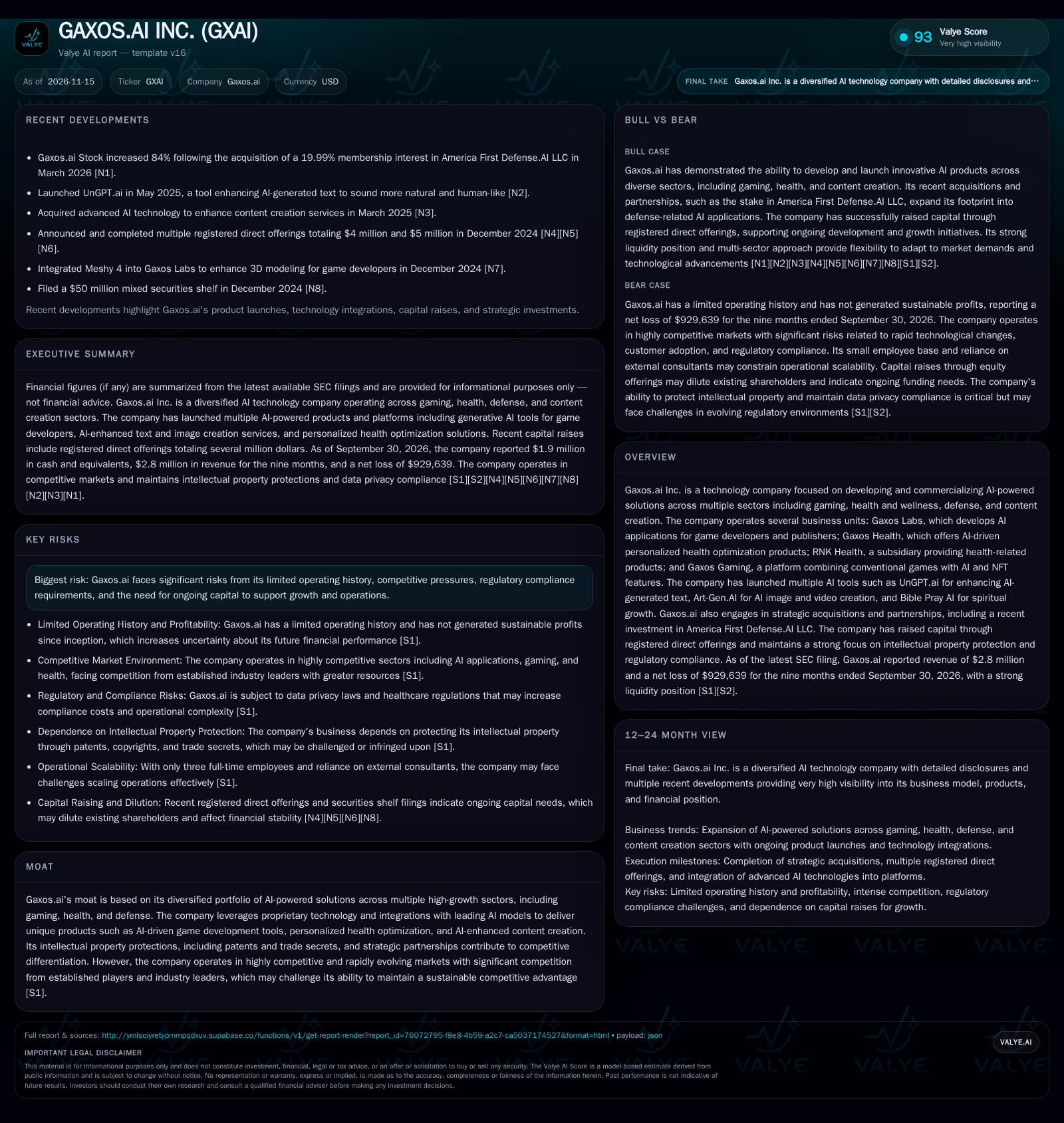
Gaxos.ai has launched a series of AI-powered platforms in gaming, health optimization, and content creation, and has extended its reach into defense technology through a strategic minority investment. While recent product launches and capital raises demonstrate momentum, the company’s limited operating history, small core team, and persistent net losses highlight the importance of converting product breadth into sustained revenue growth and operating leverage. The next phases hinge on customer adoption, scalability, and the ability to defend a differentiated position in highly competitive sectors. [S1] [S2] [N4] [N5] [N6] [N8]
Gaxos.ai’s recent trajectory is marked by aggressive expansion into multiple AI-driven markets, from gaming tools and health optimization to digital spirituality and defense technology. The company’s strategy of rapid product launches and minority investments offers the promise of diversified revenue streams, but also brings the challenge of scaling operations with a minimal in-house team and the ongoing need for external capital. As Gaxos.ai seeks commercial validation for its broad portfolio, the next 12-24 months will test whether its multi-sector bets can translate into sustainable growth and competitive resilience.
Recent Launches, Strategic Investment, and Capital Position Define the Current State
Gaxos.ai has recently rolled out several AI-powered platforms, including UnGPT.ai for naturalistic AI-generated text (May 2025), Art-Gen.AI for image and video creation (August 2025), and Bible Pray AI (December 2025) targeting digital faith markets. The company also launched Gaxos Labs’ generative AI service for game developers and has integrated advanced 3D modeling tools, such as Meshy 4, into its platform. In March 2026, Gaxos.ai purchased a 19.99% interest in America First Defense.AI LLC for $2.9 million, marking a tangible foray into AI-powered defense solutions. Financially, Gaxos.ai reported $2.81 million in revenue and a net loss of $929,639 for the nine months ended September 30, 2026, with $1.9 million in cash and a current ratio of 10.91 at quarter-end. The company has executed multiple capital raises, including a $4 million and a $5 million offering in December 2024, and maintains a $50 million mixed securities shelf. [S1] [S2] [N2] [N4] [N5] [N6] [N8]
These developments matter because they demonstrate both the breadth of Gaxos.ai’s ambitions and the company’s reliance on external capital to fund growth and product launches. The ability to convert these launches and investments into recurring, scalable revenue streams will be critical to validating the business model and supporting future expansion.
How Gaxos.ai’s Multi-Pronged Model Could Generate Value—And Where the Pressure Points Lie
Gaxos.ai’s economics hinge on its ability to monetize proprietary AI products and platforms across several verticals. In gaming, revenues could come from SaaS-style subscriptions or usage-based fees for developer tools, as well as digital asset sales (NFTs) and in-game monetization. Health and wellness products may leverage direct-to-consumer models, recurring subscription fees for personalized optimization, or partnerships with supplement providers. Content creation tools like UnGPT.ai and Art-Gen.AI could be sold via tiered access, API usage, or enterprise licensing. The recent minority stake in a defense AI company suggests potential for future government or B2B contracts, though the economics of such deals often involve lengthy sales cycles and high upfront costs.
Fixed costs remain low due to a reliance on external contractors and a minimal full-time team, which keeps operating leverage limited but provides flexibility. However, this model may constrain scalability and the company’s ability to build durable customer relationships or deliver consistent support—potentially impacting retention and upselling. With $1.9 million in cash and a history of frequent capital raises, Gaxos.ai’s funding model is equity-centric, raising the risk of dilution if commercial traction lags. The challenge will be to drive high-margin recurring revenue in at least one segment, as one-off sales and project revenue tend to be lumpy and less defensible.
Navigating Intense Competition and Fast-Moving Substitutes in AI-Driven Markets
Gaxos.ai faces competition from both large incumbents and nimble startups in every segment it targets. In gaming, established middleware providers, cloud platforms, and specialized AI tool vendors offer deep integrations, brand recognition, and existing customer bases. Health optimization pits Gaxos.ai against a crowded field of digital health apps, supplement companies, and AI-driven wellness platforms—many with years of data, regulatory infrastructure, and established distribution. In content creation, major tech companies and open-source communities are driving rapid advances in generative AI, making it difficult to maintain a durable technical edge.
The recent move into defense AI brings new competitive dynamics, including long procurement cycles, entrenched defense contractors, and regulatory barriers. Gaxos.ai’s competitive advantages may derive from product integration, proprietary enhancements, and intellectual property protections, but these moats are vulnerable if customers can easily switch to competing platforms or if open-source alternatives erode pricing power. The company’s ability to defend a differentiated position will depend on continuous innovation, execution speed, and the development of sticky, high-value use cases.
If Multi-Sector Product Launches Drive Adoption, Gaxos.ai Could Build Recurring Revenue and Margin Expansion
The most favorable scenario for Gaxos.ai is one where its recent product launches—UnGPT.ai, Art-Gen.AI, Bible Pray AI, and the Gaxos Labs developer suite—achieve meaningful adoption in their respective target markets. If one or more platforms establish strong product-market fit and recurring usage, the company could see revenue growth accelerate and gross margins improve, especially if SaaS or subscription models take hold. The minority stake in America First Defense.AI could also yield leverage if the defense business secures material contracts, opening a new, higher-margin revenue stream.
Evidence that would confirm this scenario includes rapid growth in user counts, disclosed recurring or contracted revenues, positive gross margin trends, and indications of customer retention or expansion within any segment. Additional signals would be the announcement of enterprise or government contracts, or publicized partnerships with major distribution channels. Conversely, lackluster revenue growth, high churn, or continued reliance on equity financing would undermine this upside case.
Broad Portfolio Drives Modest Growth, but Scaling and Profitability Remain Elusive
The most plausible path is that Gaxos.ai continues to launch new products and features, attracting some early adopters but facing slow conversion of product breadth into sustainable, high-margin revenue streams. Revenue may grow gradually, driven by incremental adoption in niches but offset by competitive churn, pricing pressure, and the need to invest in support and integration. The company may continue to operate at a net loss, requiring periodic capital raises to fund ongoing development and marketing.
This scenario would be supported by continued, but modest, revenue growth, stable or rising operating expenses, and further dilution events. Confirmation would come from disclosed customer wins that are small or pilot-scale, lack of large recurring contracts, and continued emphasis on product launches over customer retention or expansion metrics. The absence of major cost structure changes or a shift toward recurring revenue would also support this base case.
If Commercial Traction Falters, Capital Constraints and Dilution Risks Intensify
The risk scenario is one where Gaxos.ai’s new platforms fail to achieve significant customer adoption or retention. In this case, revenue stagnates or declines, gross margins compress due to competitive pricing or customer acquisition costs, and the company is forced to rely increasingly on external capital to fund operations. With limited internal resources and a minimal employee base, execution risk mounts, and the ability to deliver support, iterate products, or respond to competitive moves is constrained.
Confirmation of this scenario would include declining or flat revenues, shrinking gross margins (if disclosed), persistent net losses, and additional equity offerings at depressed valuations. Other red flags would be the discontinuation of products, loss of key partnerships, or regulatory setbacks in health or defense. If capital markets tighten or dilution becomes excessive, the ability to sustain operations and invest in innovation could be jeopardized.
Milestones and Data Points That Will Determine Whether Gaxos.ai’s Multi-Sector Bet Pays Off
Pace and magnitude of revenue growth in each core business segment (Gaming, Health, Content Creation, Defense)—especially if broken out by product or platform.
Disclosure of recurring versus transactional revenue, and any contracts or customer relationships that provide multi-year visibility or renewal potential.
Gross margin trends and cost structure evolution—would help clarify the path to profitability and operating leverage, if disclosed.
Updates on customer adoption, churn, and retention metrics for flagship platforms such as UnGPT.ai, Art-Gen.AI, and Gaxos Labs (if disclosed).
Announcements of material enterprise, government, or distribution partnerships, especially in defense and health verticals.
Further capital raises, shelf drawdowns, or changes in capital structure—frequency, terms, and impact on dilution.
Expansion of internal capabilities—any increase in full-time headcount or shift away from outsourced operations as a sign of scaling intent.
Intellectual property litigation, regulatory changes, or compliance issues that could impact core business lines or product launches.
Disclaimer: This is research-only, informational analysis and not investment advice. It may include AI-generated interpretation and general industry context. Always verify important details using primary sources.

Comments