
Allbirds’ Radical Reinvention: From Sustainable Footwear to High-Stakes AI Ambitions
Allbirds’ abrupt exit from footwear and pivot to AI under the NewBird AI brand marks a striking departure from its roots as a sustainability-driven lifestyle company.
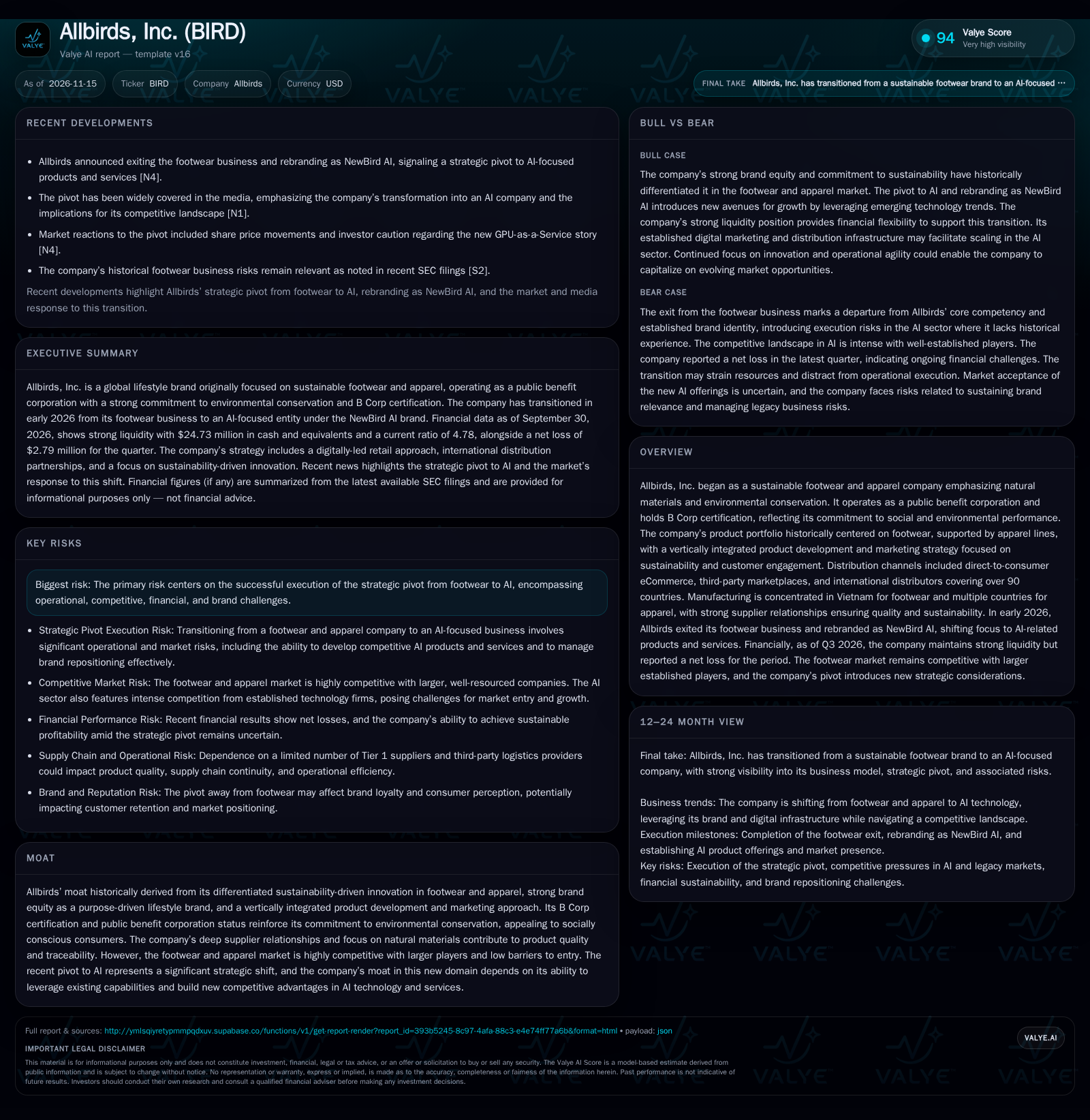
Allbirds, Inc. has ceased its footwear business and rebranded as NewBird AI, shifting focus to AI products and services. As of Q3 2026, it retains $24.73 million in cash and a current ratio of 4.78, but reported a net loss of $2.79 million. The company’s transition introduces significant execution and competitive risks, as it moves from a well-defined sustainability niche into the crowded AI sector, with financial and brand repositioning challenges ahead. [S2] [N4] [N1]
Allbirds, Inc., once a poster child for sustainable footwear and lifestyle branding, has undertaken one of the most radical pivots in recent public-market history. In early 2026, the company announced its exit from the footwear business and rebranded as NewBird AI, shifting its core focus to artificial intelligence products and services. This overhaul leaves Allbirds with reported liquidity position but a legacy of recent net losses, thrusting the company into an unfamiliar and highly competitive technology arena. The central question is whether Allbirds can parlay any of its past brand equity, operational agility, or digital infrastructure into durable advantages as an AI company—or whether this is a high-risk reinvention born of necessity.
A Sudden Strategic Overhaul: Allbirds Emerges as NewBird AI
The most consequential development for Allbirds is its early 2026 decision to exit the footwear business entirely and rebrand as NewBird AI, with a stated focus on artificial intelligence products and services. This pivot was widely covered in the media, emphasizing the abruptness of the change and the market’s cautious response. As of September 30, 2026, the company reported $24.73 million in cash and equivalents, a current ratio of 4.78, and a net loss of $2.79 million for the quarter [S2] [N4] [N1]. The company has closed its physical retail stores, now relying on e-commerce and wholesale partnerships to manage any remaining legacy operations. The legacy apparel and footwear business—previously built around sustainability and natural materials—has been fully exited, and the company’s future now hinges on the successful execution of its AI strategy.
Uncharted Economics: Revenue Models and Capital Needs in the New AI Focus
Allbirds’ historical business model relied on a vertically integrated approach to sustainable footwear and apparel, with revenue driven by direct-to-consumer sales, international distribution, and a premium brand position. Gross margins in footwear and apparel can vary widely, but the company’s focus on natural materials and ethical sourcing likely compressed margins relative to mass-market competitors. The shift to AI fundamentally alters the company’s economics: instead of physical goods, revenue will likely depend on software licensing, AI-as-a-service offerings, or platform subscription models—each with distinct pricing, volume, and margin profiles.
AI businesses, especially those in early-stage transition, typically face high upfront investment in research, talent acquisition, and infrastructure (such as cloud computing or proprietary hardware). While software margins are often attractive at scale, the fixed costs of entering the AI sector are substantial, and customer acquisition in a crowded field can be expensive. Operating leverage may be high if the company can deliver scalable AI products, but initial dilution and negative cash flow are likely until product-market fit and repeatable sales are established. The company reported cash and liquidity metrics for the period; these figures do not by themselves establish operating runway, investment capacity, financial flexibility, or financing capacity. [S2]
From Sustainability Niche to the AI Arena: Facing Entrenched Giants and Fast-Moving Startups
Historically, Allbirds’ competitive advantage stemmed from sustainability-driven product innovation, a clear brand identity, and a vertically integrated digital retail approach. These factors enabled it to carve out a niche in a crowded yet fragmented footwear market. In contrast, the AI sector is characterized by rapid technological change, high capital intensity, and the dominance of established technology giants alongside a vibrant field of deep-tech startups.
Allbirds, now NewBird AI, enters this market with no clear AI pedigree, limited proprietary technology, and an untested brand in the technology sphere. Barriers to entry include not only technical complexity and the need for top-tier talent, but also trust and credibility with enterprise buyers or consumers seeking AI solutions. While the company’s prior digital marketing and e-commerce experience could aid customer acquisition, the absence of a legacy customer base relevant to AI means it will compete from scratch against incumbents with scale, data, and established ecosystems. The company’s former brand equity in sustainability may be difficult to translate into the AI sector unless it can position its offerings as uniquely ethical, transparent, or socially responsible in a field where such concerns are gaining traction.
What Success Looks Like: Rapid AI Product-Market Fit and Brand Relevance
The favorable scenario hinges on Allbirds’ ability to rapidly define and deliver differentiated AI solutions that resonate with a target customer segment—possibly leveraging its historical strengths in design, storytelling, and community-building. If the company can attract top AI talent, form strategic partnerships, and ship a compelling product with early customer validation, it may be able to establish itself as a credible contender in an AI niche (such as sustainability-focused AI tools, ethical AI governance platforms, or consumer-facing applications aligned with its prior brand values).
Confirmation of this scenario would come from disclosed commercial wins, rapid revenue growth in AI lines, and evidence of sticky, recurring customer relationships. Additional validating signals would include external partnerships, intellectual property filings, and positive media coverage positioning the company as an innovator rather than a late entrant. Falsification would be indicated by ongoing cash burn without customer traction, an inability to recruit or retain AI talent, or market indifference to its initial offerings.
A Probable Middle Ground: Slow Traction, Brand Dilution, and Ongoing Losses
The most plausible outcome is that Allbirds—now NewBird AI—faces a protracted and costly ramp-up as it attempts to build credibility and product-market fit in the AI space. The company may be able to leverage some of its prior digital infrastructure for go-to-market activities, but will likely encounter steep learning curves in technology development, talent acquisition, and customer trust-building.
In this scenario, initial AI product launches may see tepid uptake, with limited differentiation in a crowded market. Ongoing net losses would persist as operating expenses remain high relative to nascent AI revenue streams. Evidence for this middle path would include slow but positive progress on AI product milestones, modest customer adoption, and measured announcements of pilot projects or collaborations, balanced against continued financial headwinds and muted investor enthusiasm.
Failure to Launch: Cash Burn and Strategic Drift in the Face of AI Market Realities
The adverse scenario is that NewBird AI fails to achieve meaningful traction in the AI sector, with its legacy brand and organization unable to overcome steep technical and commercial barriers. Without a clear technological advantage, the company could see its cash reserves depleted by ongoing development costs and unsuccessful go-to-market efforts, leading to further net losses and eroding investor confidence.
Falsifying signals would include persistent negative cash flow, lack of disclosed customer wins or partnerships, high turnover among key technical staff, and a reversion to seeking alternative pivots or asset sales. This scenario could culminate in a distressed sale, delisting, or significant dilution if rescue financing becomes necessary. The risk is amplified by the absence of a fallback business line, as the company has fully exited its historical core.
Milestones That Will Determine Whether Allbirds’ AI Pivot Succeeds or Stalls
Disclosure of initial AI product launches, including target use cases and customer segments, would help clarify the company’s intended market position.
Evidence of commercial traction—such as customer wins, recurring revenue contracts, or meaningful pilot deployments—would provide early validation of the AI strategy.
Updates on the company’s cash burn rate and runway, especially in relation to development spend and revenue generation from new AI activities, would be critical to assess sustainability.
Recruitment and retention of experienced AI talent (if disclosed), as well as any advisory board or partnership announcements with established technology firms.
Intellectual property filings, patents, or proprietary technology disclosures that could signal defensible differentiation in the AI sector.
Progress reports on brand repositioning efforts and whether the NewBird AI identity gains recognition or trust in its target markets.
Resolution of any legacy liabilities or risks associated with the discontinued footwear business, especially if they impact capital allocation or reputation.
Investor communications outlining the milestones, timelines, and KPIs the company is using to track the success of its pivot would help test management’s execution discipline.
Disclaimer: This is research-only, informational analysis and not investment advice. It may include AI-generated interpretation and general industry context. Always verify important details using primary sources.

Comments