
Aardvark Therapeutics: Regulatory Re-entry and the Stakes of Rare Disease Innovation
Aardvark Therapeutics faces a pivotal window following the FDA’s recent lifting of a clinical hold on its lead candidate for Prader-Willi Syndrome.
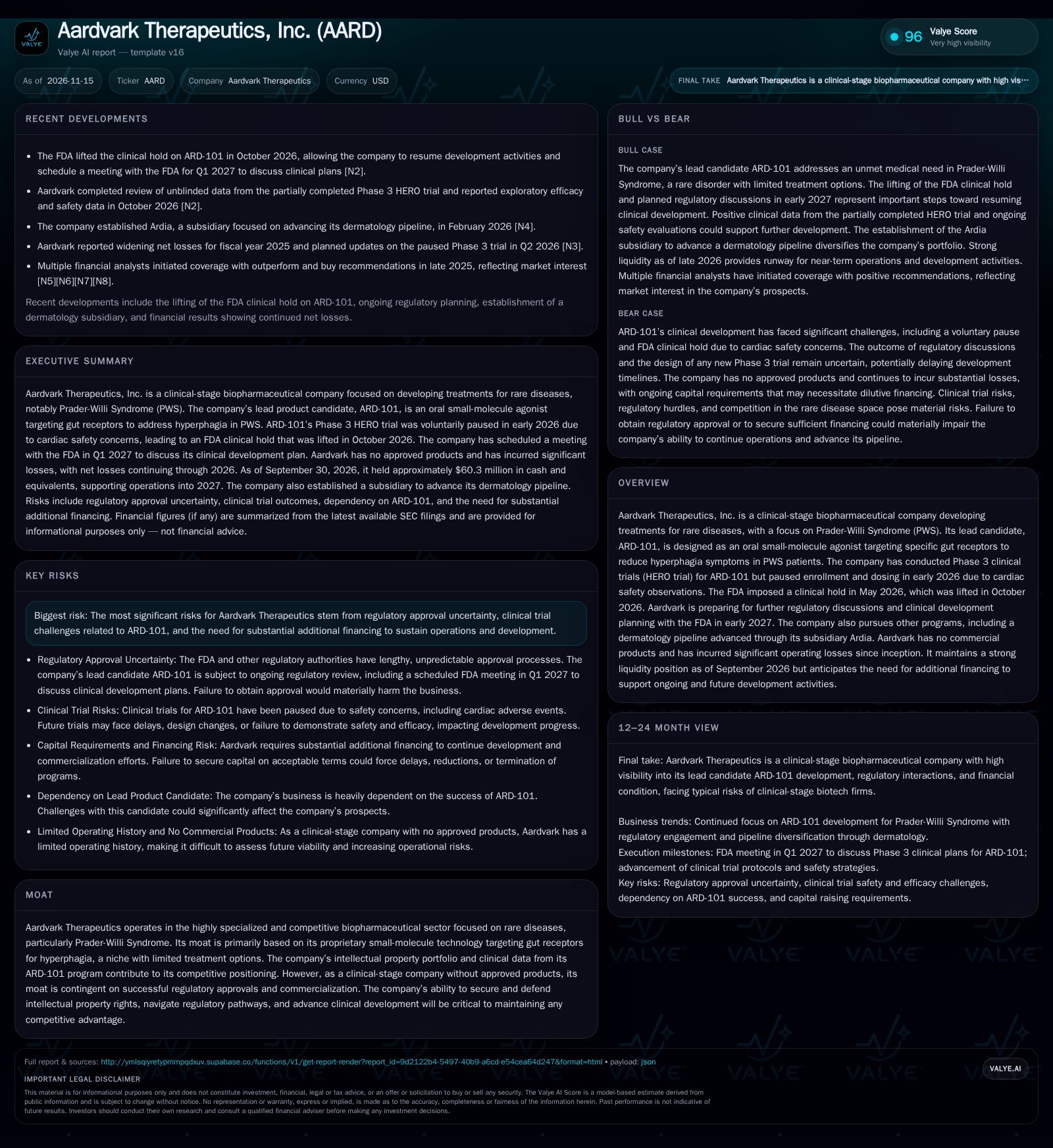
Aardvark Therapeutics is advancing ARD-101 for Prader-Willi Syndrome after the FDA lifted a clinical hold, with a critical regulatory meeting scheduled for Q1 2027. The company remains pre-revenue, has incurred substantial losses, and relies heavily on ARD-101’s prospects. Execution on clinical and regulatory fronts will define Aardvark’s trajectory in the rare disease space. [S2] [N4]
Aardvark Therapeutics stands at a critical juncture as it prepares to re-engage with regulators on its lead asset, ARD-101, for Prader-Willi Syndrome following the resolution of a clinical hold. The recent restoration of development momentum and a reported liquidity position set the stage for a crucial regulatory dialogue in early 2027. Yet, as a company without commercial revenue and with cumulative losses exceeding $171 million, Aardvark’s future rests on its ability to navigate high-stakes clinical and approval processes while managing capital needs and pipeline diversification.
FDA Hold Lifted and Regulatory Milestones Shape Immediate Outlook
The most material recent development for Aardvark Therapeutics is the FDA’s decision in October 2026 to lift the clinical hold on ARD-101, its lead candidate for Prader-Willi Syndrome (PWS). This reversal followed a period of uncertainty after the hold was imposed in May 2026, primarily related to safety concerns. The company has now scheduled a meeting with the FDA for Q1 2027 to discuss the clinical development plan for ARD-101—a meeting that will likely determine both the scope and pace of future trials. These regulatory interactions are critical, as ARD-101 remains Aardvark’s primary asset and the main determinant of near-term value. [S2] The company also paused development on ARD-201, a combination therapy, pending further regulatory clarity, and advanced its dermatology pipeline through the new subsidiary Ardia [N4].
Clinical-Stage Biotech Economics: Capital Intensity and the Quest for Proof-of-Concept
Aardvark’s economic model is typical of clinical-stage biopharma: high upfront R&D spending, no commercial revenues, and heavy dependence on future regulatory and clinical milestones to unlock any intrinsic value. The company’s current cost structure is dominated by clinical trial execution, regulatory consulting, and fixed G&A, with variable spending tied to the pace and scope of trials. With no products on the market, Aardvark’s only path to monetization is through eventual drug approval and commercialization—or, potentially, out-licensing or partnering its assets if early data are compelling.
ARD-101’s target indication, Prader-Willi Syndrome, is a rare disease with limited treatment options, which could support premium pricing and favorable reimbursement terms if efficacy and safety are demonstrated. However, the addressable market is limited by the ultra-rare nature of PWS, so commercial success depends on both regulatory approval and effective market penetration. [S2] Operating leverage would only materialize if a product reaches late-stage trials or commercialization, given the high fixed-cost base and the potential for substantial incremental margin on approved drugs.
In clinical-stage biotech, the timing and scale of capital deployment are highly sensitive to regulatory feedback loops and trial outcomes. For Aardvark, the conditionality of trial design and endpoints from regulators directly influences not only R&D expense pacing but also investor sentiment and financing terms. If regulatory agencies require more extensive or longer-duration studies, the company faces amplified capital requirements and delayed value inflection points. Conversely, streamlined approval pathways or accelerated programs could compress timelines and conserve resources. Understanding the elasticity of Aardvark’s cost structure relative to these regulatory contingencies is crucial for assessing its financial runway and strategic flexibility.
Navigating a Crowded but Unmet Space in Rare Disease Therapeutics
Aardvark’s competitive landscape is shaped by the highly specialized nature of rare disease drug development. For PWS, there are few approved therapies, making ARD-101’s differentiated mechanism—targeting TAS2Rs on enteroendocrine cells to modulate hyperphagia—potentially compelling if clinical data support efficacy. Intellectual property around this approach could provide a modest moat, but competitive barriers are largely contingent on regulatory progress and eventual market entry.
The sector is characterized by intense competition for capital, talent, and regulatory attention, as well as the constant threat of new entrants and substitute therapies, including gene therapies, biologics, or alternative small molecules. Larger pharmaceutical firms with established rare disease franchises may also represent future competitors or acquirers, depending on ARD-101’s clinical trajectory. Aardvark’s establishment of Ardia for dermatology assets suggests a strategy to diversify and hedge against single-asset risk, but the pipeline’s maturity and commercial prospects remain unproven [N4].
Furthermore, talent acquisition and retention in specialized rare disease research is a non-trivial challenge that can impact development velocity and innovation quality. Aardvark’s establishment of Ardia suggests a deliberate approach to diversify scientific focus and reduce dependence on a single asset, which may also help attract multidisciplinary expertise. However, balancing resource allocation between pipelines requires careful prioritization to avoid dilution of focus or capital. The company’s long-term competitive position will depend on its agility in responding to emerging scientific data, regulatory shifts, and competitive moves while maintaining operational efficiency and innovation momentum.
Regulatory Green Light and Compelling Data Unlock Rare Disease Value
The most favorable scenario for Aardvark involves a successful Q1 2027 FDA meeting, resulting in a clear, actionable path to resume and potentially accelerate pivotal trials for ARD-101. Subsequent positive safety and efficacy data would not only support regulatory submission but could also catalyze partnering interest or non-dilutive funding opportunities.
Confirmation would come from FDA guidance that enables a well-defined pivotal trial design, rapid patient enrollment, and favorable interim data releases. Additional evidence would include strategic partnerships, non-dilutive grants, or early signs of licensing discussions, as well as positive updates from Ardia that indicate pipeline breadth beyond the lead asset.
Protracted Development with Incremental Progress and Ongoing Capital Needs
The most plausible path forward is a cautious resumption of ARD-101 development, with the Q1 2027 FDA meeting resulting in additional data requirements or protocol modifications that extend timelines. The company continues to incur losses as it advances ARD-101 through clinical milestones, but progress is measured and subject to the vagaries of patient recruitment, regulatory feedback, and evolving safety data. Financing needs become more acute by late 2027, prompting equity raises under the existing shelf or ATM facility.
This scenario would be confirmed by incremental clinical updates, continued cash burn without a near-term commercial inflection, and periodic financing announcements. Delays in the dermatology pipeline or lack of partnership activity would further reinforce a slow, capital-intensive trajectory.
Clinical or Regulatory Setbacks Compound Dilution and Threaten Viability
A negative outcome would involve the Q1 2027 FDA meeting resulting in further holds, onerous trial requirements, or new safety signals that undermine ARD-101’s development prospects. Clinical setbacks—such as failure to demonstrate efficacy or new adverse events—could erode confidence, limit access to capital, and force Aardvark to curtail pipeline programs or pursue asset sales under distress.
Evidence of this scenario would include adverse FDA feedback, additional clinical holds, poor interim trial results, and a sharp increase in dilutionary financing or cost-cutting measures. Lack of meaningful progress in the dermatology pipeline would amplify the risk of business discontinuity.
Milestones and Evidence That Will Define Aardvark’s Rare Disease Thesis
Outcome of the Q1 2027 FDA meeting on ARD-101, including clarity on trial design, endpoints, and next steps.
Initiation and pace of patient enrollment for resumed or new ARD-101 clinical trials, if disclosed.
Interim safety and efficacy data releases from ongoing ARD-101 studies; a useful metric would be the frequency and severity of adverse events.
Any partnership, licensing, or non-dilutive funding announcements tied to ARD-101 or the dermatology pipeline.
Updates on Ardia’s dermatology program progress, including preclinical or early clinical milestones.
Cash burn rate and timing/terms of new capital raises under the shelf or ATM facility.
Changes in analyst coverage or target price rationale, especially if tied to new clinical/regulatory information.
Regulatory developments or competitive pipeline news in the PWS or rare disease therapeutic space that could affect ARD-101’s commercial potential.
Disclaimer: This is research-only, informational analysis and not investment advice. It may include AI-generated interpretation and general industry context. Always verify important details using primary sources.

Comments