
Colombier Acquisition Corp. III: Post-GrabAGun Merger, the Stakes Shift from Capital Structure to Operational Execution
Colombier Acquisition Corp. III’s transition from a capital-rich SPAC to an operating entity via its merger with GrabAGun marks a turning point.
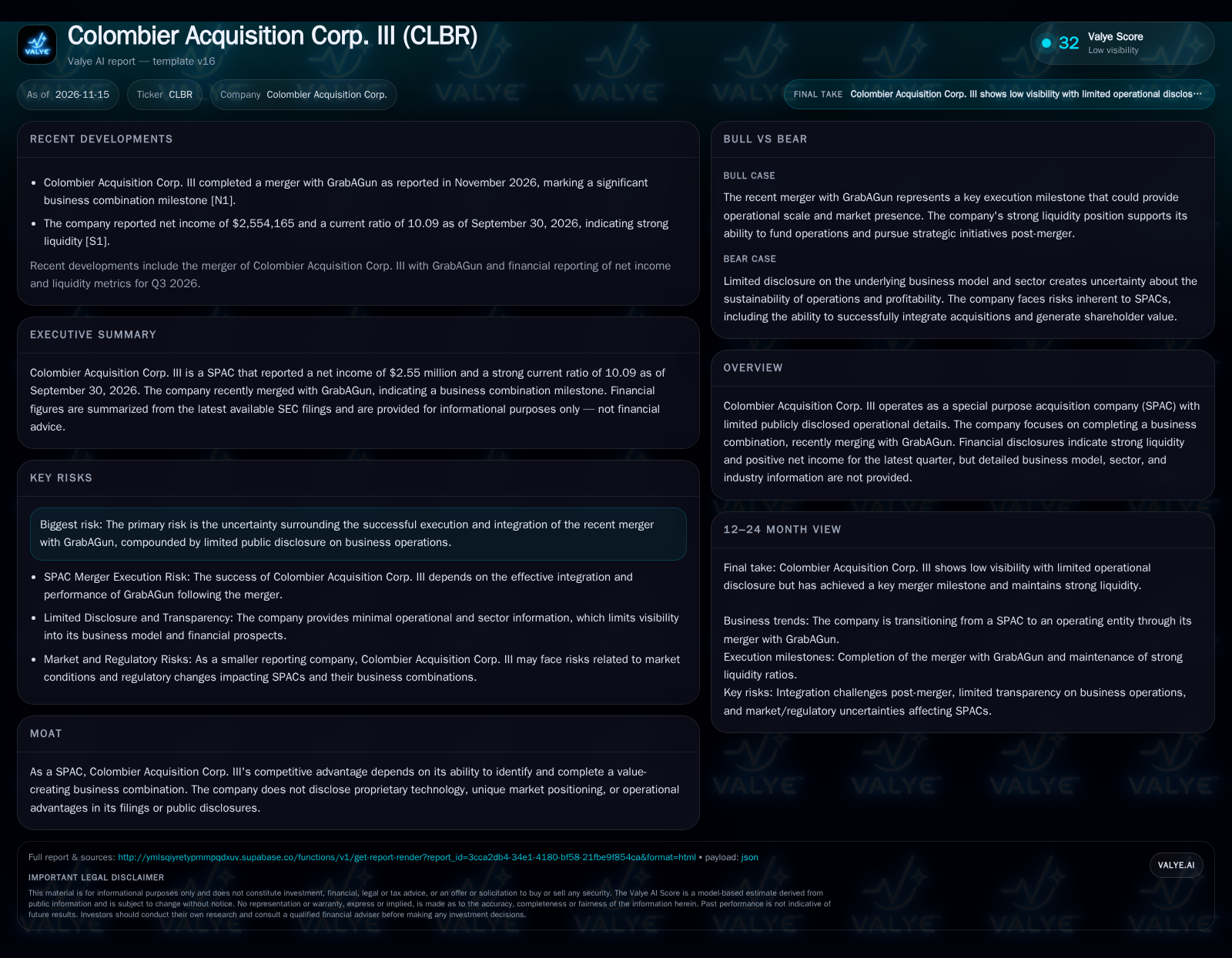
Colombier Acquisition Corp. III completed its merger with GrabAGun in November 2026, moving from a SPAC structure to an operating company. As of September 30, 2026, it reported liquidity position with a current ratio of 10.09 and net income of $2.55 million. The main focus now turns to operational integration and the ability to generate durable shareholder value in a sector with limited public disclosure. Execution risk and transparency remain central issues for investors. [S1] [N1]
Colombier Acquisition Corp. III’s journey as a SPAC culminated in November 2026 with the completion of its merger with GrabAGun, marking a significant pivot from capital aggregation to operational execution. The company’s latest financials prior to the merger show reported liquidity position and a positive net income, but the absence of detailed operational disclosures leaves open questions about the combined entity’s business model and long-term prospects. As Colombier shifts its focus from deal-making to performance delivery, the central challenge becomes whether it can translate financial resources and a merger milestone into sustained value creation in an opaque and potentially competitive sector.
Merger Milestone and Pre-Combination Financial Profile
The most material recent development for Colombier Acquisition Corp. III is the completion of its merger with GrabAGun in November 2026, transitioning the company from a SPAC to an operating entity. This event marks a critical inflection point: the company’s primary objective as a SPAC—to identify and acquire a target—has now been fulfilled. As of September 30, 2026, prior to the merger’s close, Colombier reported current assets of $1,171,183 and current liabilities of $116,042, resulting in a current ratio of 10.09, and posted net income of $2,554,165 for the quarter. The company reported cash and liquidity metrics for the period; these figures do not by themselves establish operating runway, investment capacity, financial flexibility, or financing capacity. However, with minimal operational disclosure, the sustainability and drivers of these results post-merger remain opaque. [S1] [N1]
From Capital Pool to Operating Model: Economic Questions After the SPAC Phase
A SPAC’s economics prior to a merger are fundamentally different from those of an operating business: value is driven by capital management, trust account yields, and deal execution rather than recurring revenue or operational scale. With the merger completed, Colombier’s economic reality shifts. The company will now need to generate cash flows from GrabAGun’s underlying business model, the details of which are not disclosed in current filings. If GrabAGun operates as a traditional retailer or e-commerce platform (as the name suggests), revenue would likely be driven by product sales volume, gross margin on merchandise, and operating leverage as costs scale. The sustainability of profitability will depend on factors such as customer acquisition costs, inventory management, pricing power, and supply chain efficiency. Capital needs may also shift, with working capital, inventory financing, and potential technology investments replacing the trust account’s passive yield. The transition from a capital aggregation vehicle to an active operator introduces execution risk and the need for a fundamentally different skill set.
The shift from a SPAC to an operating company also implies a transition in capital allocation priorities. While the SPAC phase focuses on preserving capital and preparing for an acquisition, the operating phase demands active investment decisions that balance growth initiatives with profitability targets. This includes evaluating the trade-offs between reinvesting in marketing, technology, or infrastructure versus returning capital to shareholders. Additionally, the company must manage working capital dynamics more rigorously, as inventory turnover rates, accounts receivable collections, and payables management become central to operational liquidity. The effectiveness of these financial management practices will materially influence the company’s ability to sustain growth without excessive external financing.
Integration Uncertainty and the Competitive Landscape for SPAC Targets
Colombier’s ability to create durable shareholder value now hinges on GrabAGun’s competitive position within its sector, which remains undisclosed. In the absence of specific information, it is plausible that GrabAGun operates in a competitive retail or online commerce segment, potentially facing established players with scale advantages, brand recognition, and customer loyalty. Post-merger, the new entity’s ability to differentiate—through pricing, product selection, customer experience, or proprietary technology—will be critical. SPAC targets often face skepticism regarding their growth projections and the quality of their operational infrastructure, especially when public disclosure is limited. Without evidence of unique assets, intellectual property, or defensible market positioning, competitive pressures could compress margins and limit growth. The integration process itself is also a source of risk: cultural alignment, systems integration, and retention of key personnel are frequent stumbling blocks in post-SPAC transitions.
The competitive landscape post-merger also raises questions about the company’s ability to adapt to evolving consumer preferences and technological disruption. If GrabAGun operates in a sector characterized by rapid innovation or shifting regulatory environments, the merged entity must demonstrate agility in product development, supply chain responsiveness, and customer engagement strategies. Furthermore, the company’s capacity to leverage data analytics and digital marketing to enhance customer acquisition and retention could provide a meaningful competitive edge. Without clear differentiation or proprietary capabilities, the risk of commoditization and margin pressure increases, particularly if competitors benefit from economies of scale or superior cost structures.
What Could Unlock Value: Successful Integration and Business Model Scale
The most favorable outcome for Colombier centers on the successful integration of GrabAGun and the emergence of a scalable, profitable operating business. If the merged entity can leverage Colombier’s pre-merger liquidity and public listing to accelerate growth—by expanding product offerings, entering new markets, or investing in technology—sustained revenue and margin expansion could follow. Confirmation of this scenario would require disclosure of post-merger revenue growth, improving gross and operating margins, and evidence of recurring customer engagement or high retention rates. A positive inflection in free cash flow generation and the articulation of a coherent growth strategy would further validate the thesis. Conversely, a lack of operational progress, stagnant revenue, or declining profitability would undermine the bullish case.
Post-Merger Reality: Gradual Transition and the Need for Transparency
The most plausible near-term scenario is a period of operational transition, with the company working through integration challenges while gradually disclosing more about its underlying business. Investors should expect a measured ramp-up in transparency as the company shifts from SPAC reporting norms to those of an operating entity. Near-term performance will likely be uneven as integration costs, potential redundancies, and cultural adjustments are absorbed. The base case assumes neither dramatic outperformance nor catastrophic failure, but rather a gradual evolution toward a clearer business model and more consistent financial reporting. Confirmation would come from incremental updates on business operations, initial post-merger revenue figures, and a move toward sector-standard disclosures.
In this transitional phase, the company’s governance and reporting frameworks will be critical in shaping investor confidence. Establishing robust internal controls, transparent accounting practices, and clear communication channels can mitigate skepticism often associated with SPAC transitions. The pace at which the company adopts sector-standard disclosures and provides forward-looking guidance will influence market perceptions of credibility and operational maturity. Additionally, the ability to demonstrate early wins in customer growth, operational efficiency, or product innovation—even if modest—can serve as important signals that the company is progressing beyond its SPAC origins toward sustainable operational execution.
Integration Stumbles and Ongoing Opaqueness Threaten Value Creation
The primary risk lies in failed integration and persistent lack of operational transparency. If Colombier and GrabAGun cannot align systems, cultures, or strategic priorities, the result could be elevated costs, loss of key personnel, and underperformance relative to projections. Continued limited disclosure would exacerbate investor uncertainty and could result in a valuation discount. Additional risks include adverse regulatory developments affecting SPACs or the underlying business, as well as competitive threats that erode any initial scale or market position. Downside confirmation would be signaled by missed financial targets, negative surprises in subsequent filings, or management turnover.
Testing the Post-Merger Thesis: What Will Determine Sustainable Value
Frequency and quality of post-merger operational disclosures, including revenue, gross margin, and customer metrics—any new detail would help test the operating model thesis.
Evidence of successful integration, such as synergies realized, cost discipline, and retention of key GrabAGun management or staff.
Post-merger revenue growth rates and their composition (organic vs. acquisition-driven), if disclosed, to assess whether the business is scaling.
Changes in cash flow and operating margin as the company transitions from SPAC to operator.
Updates on regulatory or litigation risks, particularly if the company operates in a regulated sector.
Management commentary or guidance on strategic priorities, capital allocation, and potential future M&A activity.
Board or management turnover, which could signal integration or strategic dissonance.
Disclaimer: This is research-only, informational analysis and not investment advice. It may include AI-generated interpretation and general industry context. Always verify important details using primary sources.

Comments