
Reviva Pharmaceuticals: Schizophrenia Pipeline Ambition Meets Financial Realities
With over $17 million in cash and a robust current ratio, Reviva Pharmaceuticals continues to advance its lead clinical programs despite persistent net losses and reliance on capital raises. The company's future hinges on successful trial outcomes, regulatory progress, and the challenge of sustaining investor confidence amid dilution risks.
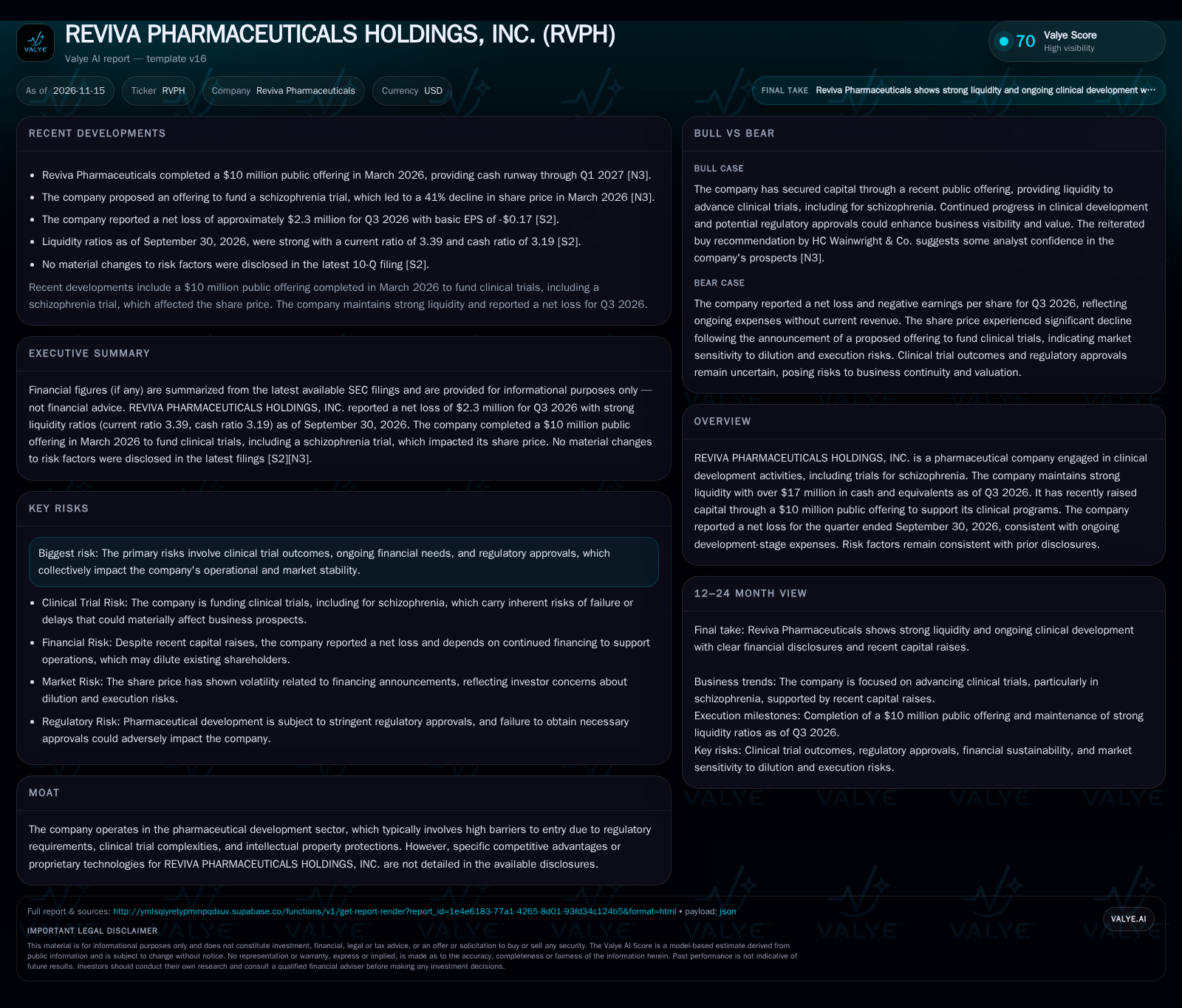
Reviva Pharmaceuticals ended Q3 2026 with reported liquidity position and a $2.3M quarterly net loss, reflecting its development-stage focus. The company’s prospects depend on advancing schizophrenia trials toward approval, but ongoing losses and market sensitivity to capital raises highlight the execution and financing risks inherent to its model. The next phase will be defined by clinical milestones, regulatory outcomes, and access to further funding. [S2]
Reviva Pharmaceuticals Holdings, Inc. stands at a critical juncture typical of clinical-stage biopharma: well-capitalized for now, but wholly dependent on the binary outcomes of its lead development programs. As Reviva targets regulatory approval in high-need indications like schizophrenia, its ability to convert scientific progress into commercial value, while managing dilution and investor expectations, will define its next act. [S2]
Current Context: Liquidity Snapshot and Ongoing Clinical Development
As of September 30, 2026, Reviva Pharmaceuticals reported cash and cash equivalents of $17.5 million, with current assets totaling $18.6 million against current liabilities of $5.5 million. This results in a current ratio of 3.39 and a cash ratio of 3.19, indicating a reported liquidity position for a clinical-stage company. The company reported a net loss of $2.3 million for the quarter, reflecting the ongoing costs of clinical development without offsetting commercial revenue. There were no material changes to risk factors in the latest 10-Q, suggesting business risks remain consistent with prior disclosures. [S2]
Reviva’s primary focus remains the advancement of its clinical pipeline, including trials in schizophrenia. The company’s financial disclosures underscore the typical development-stage profile: substantial R&D outlays, negative earnings, and a reliance on external capital to fund operations. The near-term trajectory will be shaped by the pace of clinical progress and the company’s ability to secure additional funding as needed.
The timing and scale of upcoming trial milestones can significantly influence capital needs, as accelerated enrollment or expanded trial cohorts typically increase near-term expenditures.
Another critical dimension to consider is the potential impact of external macroeconomic and sector-specific financing conditions on Reviva's funding prospects. Market appetite for clinical-stage biopharma equity can fluctuate based on broader investor sentiment toward risk assets, regulatory environment shifts, or competitive trial outcomes in analogous therapeutic areas. These factors may constrain or facilitate access to capital, affecting the company's strategic flexibility. Consequently, even with a seemingly reported liquidity position, the timing and terms of future capital raises remain uncertain and must be actively managed in alignment with clinical progress and market conditions.
Clinical-Stage Model: High Cash Burn, Deferred Revenue, and Dilution Risk
Reviva’s business model is emblematic of clinical-stage biopharma: significant investment in R&D, especially clinical trials, with the expectation of eventual regulatory approval and commercial launch. This approach entails high fixed and variable costs—clinical trial expenses, regulatory submissions, and ongoing G&A—with little to no offsetting revenue until at least one candidate achieves approval and market access. Funding is typically sourced from equity offerings or other dilutive financings, which can depress share price and magnify investor sensitivity to near-term capital raises.
Operating leverage is limited until commercialization, at which point successful products could, in theory, deliver high-margin, scalable revenue streams typical of specialty pharmaceuticals. Until then, the economics are defined by negative cash flow and a reliance on the capital markets.
The clinical-stage biopharma model inherently involves a temporal disconnect between investment and revenue generation, creating a financing dependency that can amplify dilution risk if clinical outcomes are delayed or unfavorable. This dynamic necessitates careful capital structure management, including the potential use of milestone-based financing or strategic partnerships to mitigate equity dilution. Additionally, the scalability of future revenues depends not only on regulatory approval but also on successful market penetration, pricing strategies, and reimbursement negotiations, which are often complex and protracted in neuropsychiatric indications. Hence, the path from clinical success to sustainable profitability is multifaceted and contingent on both scientific and commercial execution.
Furthermore, the operating leverage in clinical-stage biopharma is asymmetrical: costs are front-loaded and relatively fixed during development, while revenues post-approval can benefit from high margins and economies of scale. This creates a high-risk, high-reward profile where incremental clinical data can dramatically alter valuation and financing conditions. However, this profile also means that any delays or setbacks can disproportionately strain financial resources, underscoring the importance of contingency planning and diversified funding sources. Effective communication with investors about these dynamics is critical to maintaining confidence during periods of operational uncertainty.
Barriers to Entry and the Challenge of Differentiation in Neuropsychiatry
The pharmaceutical development sector is characterized by formidable barriers to entry—intellectual property, regulatory hurdles, and high trial costs—but these are industry-wide features rather than unique moats for Reviva. In the neuropsychiatric space, particularly schizophrenia, competition is intense: large-cap pharmas and well-capitalized biotechs are all vying for differentiated efficacy, safety, or improved side-effect profiles.
Without evidence of unique technology or proprietary clinical advantages in the current disclosures, Reviva’s differentiation likely hinges on its clinical data, trial design, and ability to demonstrate a meaningful benefit over existing therapies. Switching frictions are moderate in this category, as prescribers and payers are open to new therapies that show clear advantages, but regulatory and market access hurdles remain high. The ultimate competitive advantage will depend on trial outcomes, intellectual property, and commercial execution rather than structural barriers alone.
Clinical Success Catalyzes Regulatory Progress and Funding Leverage
The most favorable outcome for Reviva would involve positive top-line results from its lead schizophrenia clinical trials, followed by rapid regulatory submission and approval. In this scenario, strong efficacy and safety data would not only de-risk the development program but also attract partnering interest or non-dilutive funding, potentially reducing reliance on further equity raises. Investor sentiment could improve, supporting higher valuations and more favorable financing terms.
Confirmation would come from the public release of statistically significant trial results, initiation of regulatory filings, and any announced licensing or partnership agreements. Falsification would occur if clinical data failed to differentiate the asset or if regulatory setbacks delayed or blocked approval.
Incremental Progress Amid Continued Funding Needs and Volatility
The most plausible path forward sees Reviva advancing clinical programs with available cash, punctuated by periodic equity raises to extend runway. Clinical milestones are met with mixed or inconclusive results, requiring additional studies or resubmissions, while dilution and execution risk remain persistent themes for shareholders.
The business continues to operate as a development-stage company, with no material revenue until at least one asset achieves regulatory clearance and commercial launch. Evidence confirming this scenario would include ongoing net losses, repeated capital raises, and incremental—not transformational—clinical progress. Falsification would require either a major clinical breakthrough or, conversely, a decisive negative outcome halting development.
Adverse Trial Outcomes or Regulatory Setbacks Force Strategic Retrenchment
The primary risk is that one or more key clinical trials fail to meet efficacy or safety endpoints, eroding investor confidence and making new capital harder or more expensive to raise. Regulatory setbacks—such as a clinical hold or rejection—could further delay development, while persistent net losses rapidly deplete the reported cash balance.
In this scenario, Reviva may be forced to curtail pipeline activities, seek strategic alternatives, or accept highly dilutive financing. Confirmation would come from negative or inconclusive clinical releases, a sharp drop in share price following financing announcements, or explicit disclosure of going-concern risks. This scenario is typical of binary-outcome biopharma models where development failure can wipe out equity value.
Milestones and Triggers That Will Shape Reviva’s Thesis
Upcoming readouts from lead clinical trials in schizophrenia—statistical significance, safety profile, and regulatory alignment will be critical inflection points.
Cash burn rate and quarter-to-quarter changes in net loss, as these will determine the timing and size of future financing needs.
Announcement, if any, of partnership, licensing, or non-dilutive funding deals that could extend runway or validate the lead asset’s commercial potential.
Frequency, size, and pricing of new equity offerings—material dilution or unfavorable terms would pressure the share price and investor confidence.
Any change in risk-factor disclosures, especially regarding clinical, regulatory, or financial risks, would signal a shift in underlying business risk.
Progression from clinical development to regulatory submission—public disclosure of IND/NDA filings or regulatory feedback would be a key milestone.
A useful metric would be detailed pipeline updates, including trial enrollment rates, completion timelines, and interim data (if disclosed).
Disclaimer: This is research-only, informational analysis and not investment advice. It may include AI-generated interpretation and general industry context. Always verify important details using primary sources.

Comments